Below is the Extreme Ownership summary: the central idea, the four laws of combat, the principles that matter most outside the military, the book's limits, and a one-week way to try it at work. If you only have a minute, the next section is the whole book.
We wrote this from the publisher's page and its published excerpt of chapter 1, the book's catalog record, the authors' company site and published reviews. The few short quotes are the book's wording; the rest is our paraphrase.
Extreme Ownership summary in one minute
Extreme Ownership says that the leader is responsible for everything that affects the mission, and that teams perform as well as they're led. The book in five lines:
- Own everything. When something goes wrong, the leader takes the blame, finds the cause and fixes it. In the book's words: "There is no one else to blame."
- There are no bad teams, only bad leaders. The same team performs differently under a different leader.
- Believe in the mission, and check your ego. You can't lead people toward something you don't understand or believe in, and pride gets in the way of owning mistakes.
- Four laws of combat: cover and move, keep it simple, prioritize and execute, and decentralize command.
- Plan, lead up as well as down, decide without perfect information, and stay disciplined. The last chapter's title sums it up: discipline equals freedom.
What is Extreme Ownership about?
Extreme Ownership: How U.S. Navy SEALs Lead and Win is a leadership book by Jocko Willink and Leif Babin, first published in October 2015 by St. Martin's Press. An updated edition followed in 2017, at about 380 pages, with an excerpt from their sequel, according to the publisher.
Willink spent 20 years in the SEAL Teams and commanded SEAL Team Three's Task Unit Bruiser in the Battle of Ramadi in Iraq. Babin, a Naval Academy graduate, was a platoon commander in the same task unit. The publisher and the authors describe Task Unit Bruiser as the most highly decorated special operations unit of the Iraq War. After leaving the Navy, the two founded Echelon Front, a leadership consulting firm.
The book has 12 chapters in three parts. Chapter 1, for example, tells a combat story, states the principle, then shows how it applies in a company:
| Part | Chapters |
|---|---|
| Winning the War Within | Extreme Ownership; No Bad Teams, Only Bad Leaders; Believe; Check the Ego |
| Laws of Combat | Cover and Move; Simple; Prioritize and Execute; Decentralized Command |
| Sustaining Victory | Plan; Leading Up and Down the Chain of Command; Decisiveness amid Uncertainty; Discipline Equals Freedom |
What does extreme ownership mean?
Extreme ownership means the leader accepts full responsibility for everything that affects the team's mission, including mistakes made by other people. The book's short version: "The leader must own everything in his or her world."
The opening story explains why. During an operation in Ramadi, confusion between friendly units led to a firefight between them: an Iraqi soldier was killed and others were wounded, including a SEAL. In the debrief, Willink could have listed everyone else's errors. Instead he told the debrief there was only one person to blame: himself, the commander. He writes that owning it increased his superiors' trust in him, and that he suspects blaming others would have gotten him fired. The unit then changed its procedures to cut the risk.
The business lesson is the same. When a project fails, the leader who blames the team, the market or the client learns nothing. The leader who asks "what did I fail to explain, plan or check?" finds the fix.
Try it today: pick one recent miss, even a small one, and write down what you could have done differently, without mentioning anyone else.
Why are there no bad teams, only bad leaders?
The authors say there are no bad teams, only bad leaders, because a team's results depend on the standards its leader sets and enforces. Swap the leader of a struggling team and the same people can start winning. The flip side: when a team underperforms, the leader's first question should be about their own leadership, not the team's talent.
The two chapters that follow support this. Believe: a leader has to understand and believe in the mission before they can get anyone else to, so if you don't see the point of an order, ask until you do. Check the ego: pride makes it hard to admit mistakes or accept help, which makes ownership impossible.
What are the four laws of combat?
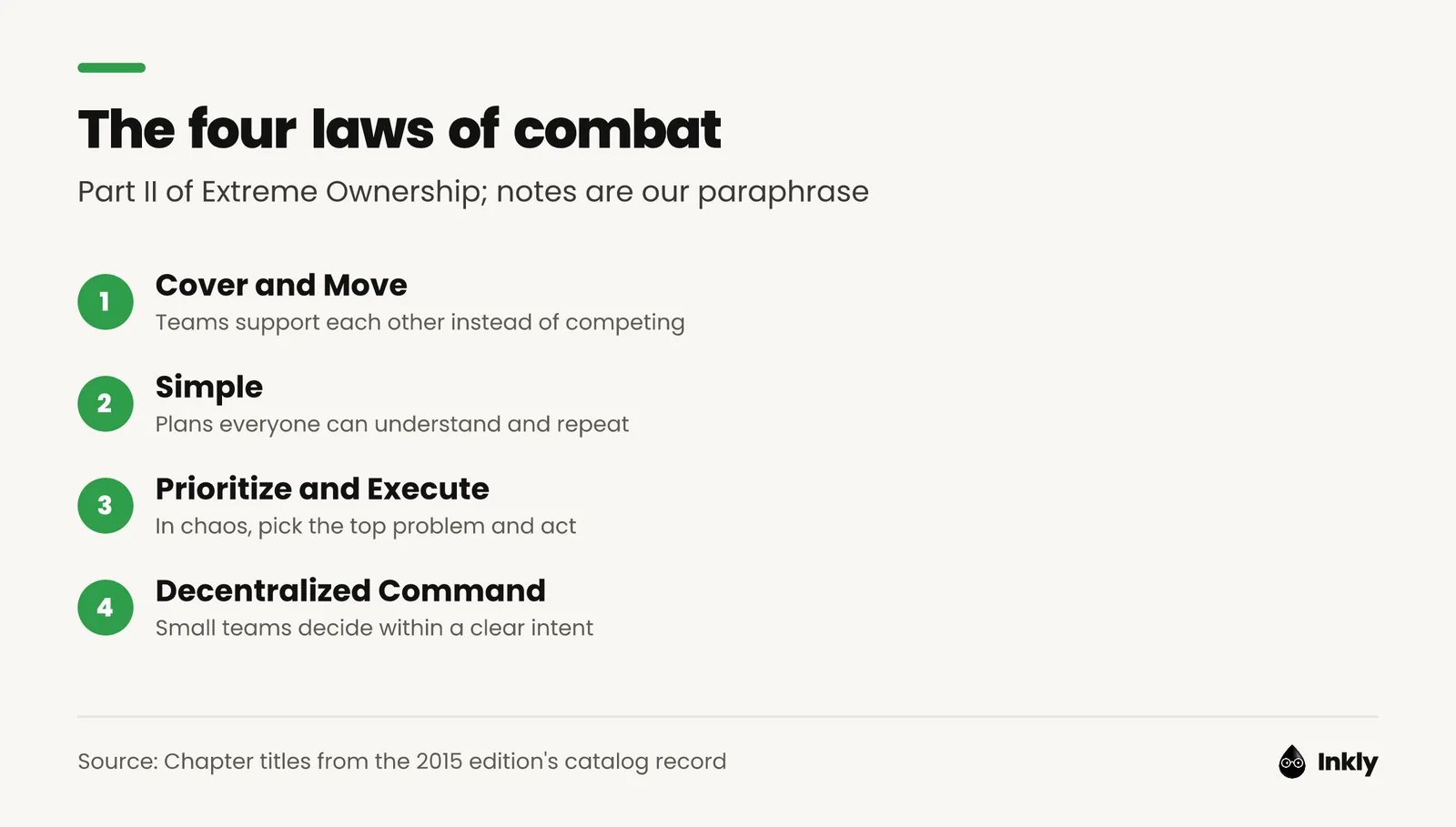
The four laws of combat are cover and move, simple, prioritize and execute, and decentralized command. They make up Part II of the book, and the authors' company teaches them as a set. Each translates cleanly to work:
- Cover and Move: teams succeed together or fail together. Departments that compete with each other, or hoard information, lose to teams that support each other.
- Simple: plans and orders have to be simple enough that everyone understands them. If people can't repeat the plan back, it's too complicated.
- Prioritize and Execute: when everything goes wrong at once, don't try to fix everything. Pick the most important problem, solve it, then move to the next.
- Decentralized Command: no one can manage everything. Push decisions down to small teams, and make sure each leader understands the overall intent well enough to act without asking.
Try it today: on your busiest day this week, write down every open problem, circle one, and finish it before touching the rest.
What else does Extreme Ownership teach?
Part III covers sustaining results over time. The four ideas, in brief:
- Plan: understand the mission, think through what could go wrong, and keep plans flexible enough to adjust.
- Leading up and down the chain of command: if your boss doesn't understand what your team needs, that's your job to fix. Give them the information they're missing instead of complaining about their decisions.
- Decisiveness amid uncertainty: you'll rarely have full information. Leaders have to decide anyway and adjust as they learn.
- Discipline equals freedom: routine and standards give teams more freedom to act, not less. The chapter title also introduces the theme of the authors' next book, The Dichotomy of Leadership, about balancing opposite pulls.
What does Extreme Ownership get wrong?
Extreme Ownership is strongest as a clear, memorable call to take responsibility, and weakest when its single idea is pushed too far. We found no academic or major-press review, so these come from published reader critiques and the authors' own follow-up:
- Ownership can be over-applied. Owning everything is a powerful habit for leaders with real authority. For someone who already blames themselves for things they can't control, it can turn into guilt. One writer, Tom MacWright, noted that the book makes little effort to address that psychological cost.
- The authors wrote a second book on its limits. The Dichotomy of Leadership (2018) is about balancing extreme ownership with other leadership qualities, such as knowing when to let others lead. That's a fair sign the first book's rule needs context.
- The military framing doesn't suit everyone. All the stories come from the Iraq War, and some readers find the "good guys and bad guys" framing hard to accept. Many of the business ideas, such as commander's intent and clear priorities, also appear in other leadership books.
- It's not research. It's two experienced leaders' principles and stories. We found no study testing whether they improve business results.
Is Extreme Ownership worth reading?
Yes, Extreme Ownership is worth reading if you lead a team, have just been promoted, or tend to explain failures by pointing at others. The stories make the ideas easy to remember. Our reading time calculator shows how long the book takes at your speed.
Skip it if combat stories or the Iraq War setting put you off, or if you already carry too much blame for things outside your control. In that case, read the summary and treat "ownership" as "owning your part," not "owning everything."
Is a summary enough? For the principles, yes. The book adds the stories, which are what make people actually change how they lead.
How do you apply Extreme Ownership at work?
You apply Extreme Ownership by starting with small, visible acts of responsibility and simple habits, not a dramatic speech. Here's a one-week start:
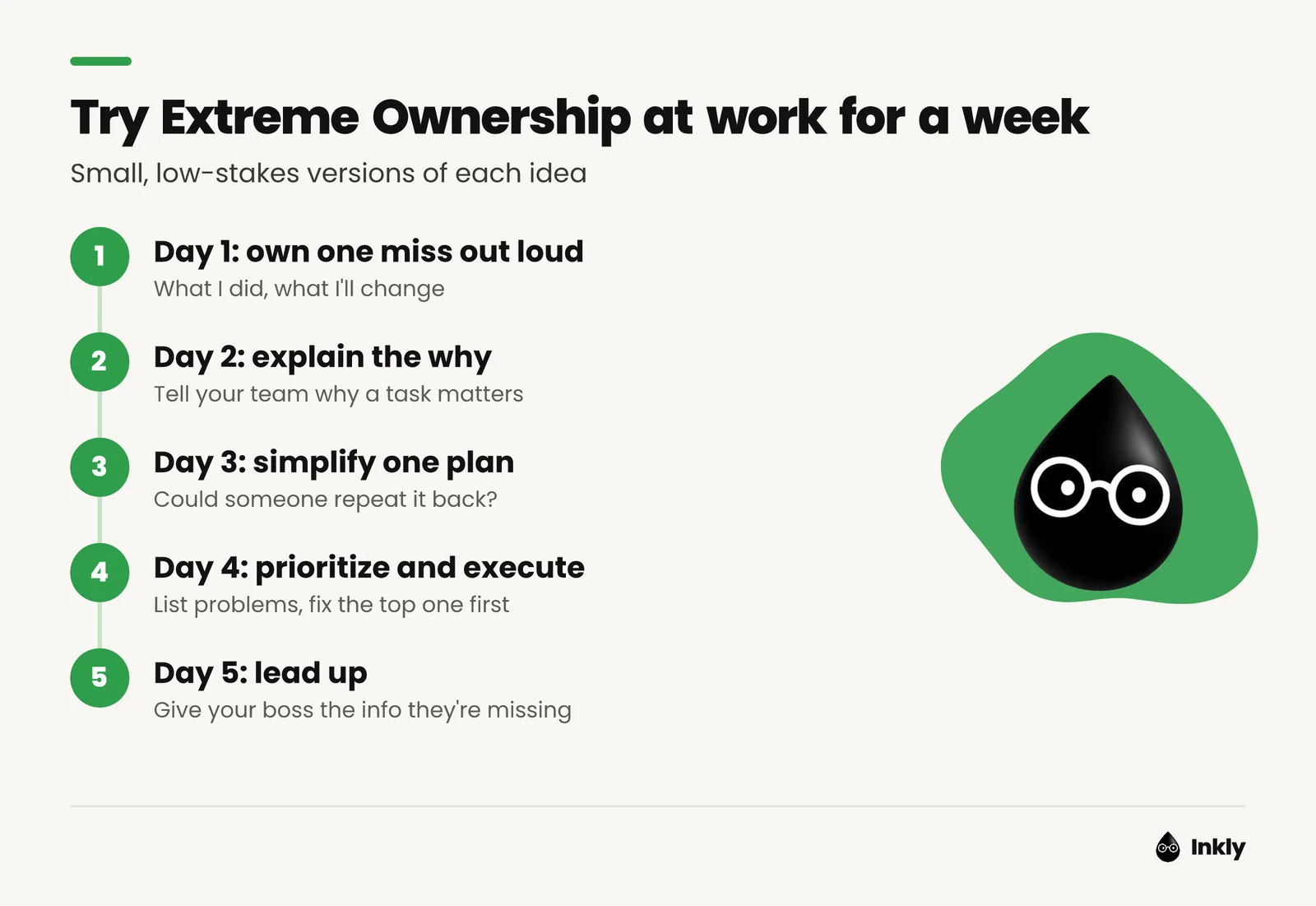
- Day 1: own one miss out loud: what you did, and what you'll change.
- Day 2: explain to your team why a task matters, not only what to do.
- Day 3: cut one plan or message down until someone could repeat it back.
- Day 4: list the open problems, fix the top one first.
- Day 5: give your manager the information they need to make a better call.
Leadership habits take repetition. Our guide on how long it takes to form a habit explains why the first few weeks are the hardest.
What should you read after Extreme Ownership?
If Extreme Ownership clicked, our Atomic Habits summary is the practical guide to building the daily discipline the last chapter calls for, and our How to Win Friends and Influence People summary covers the people skills that make ownership land well with a team. For a deeper look at choosing your response under pressure, try our Man's Search for Meaning summary. More options are in our list of the best self-improvement books.
One more option, and it's ours: Inkly is our app, so weigh this accordingly. It turns big ideas from non-fiction books into short daily lessons with a quick quiz after each one, plus a chat to turn an idea into a concrete action. It's iPhone only and free to download; the daily lessons need a subscription.
FAQ
What is the main idea of Extreme Ownership?
The main idea of Extreme Ownership is that a leader is responsible for everything that affects their team's mission, including failures caused by others. Jocko Willink and Leif Babin argue that taking ownership, rather than blaming people or circumstances, is what lets a leader find and fix problems and earn trust.
What are the 12 principles of Extreme Ownership?
The 12 principles are Extreme Ownership; No Bad Teams, Only Bad Leaders; Believe; Check the Ego; Cover and Move; Simple; Prioritize and Execute; Decentralized Command; Plan; Leading Up and Down the Chain of Command; Decisiveness amid Uncertainty; and Discipline Equals Freedom. Each is a chapter of the book.
What are the four laws of combat?
The four laws of combat in Extreme Ownership are cover and move, simple, prioritize and execute, and decentralized command. They form Part II of the book. In business terms: support other teams, keep plans simple, fix the most important problem first, and let small teams decide within a clear intent.
What does "discipline equals freedom" mean?
"Discipline equals freedom" is the title of the last chapter of Extreme Ownership. The idea is that routines, standards and preparation give a team more freedom to act and adapt, not less.
Who wrote Extreme Ownership?
Extreme Ownership was written by Jocko Willink and Leif Babin, former U.S. Navy SEAL officers who served together in Task Unit Bruiser during the Battle of Ramadi in Iraq. Willink commanded the task unit and Babin led one of its platoons. They now run the leadership consulting firm Echelon Front.
Is Extreme Ownership worth reading?
Extreme Ownership is worth reading if you lead people or tend to blame circumstances for results, and its stories make the ideas stick. Skip it if combat stories put you off or you already blame yourself too much; the authors' own sequel, The Dichotomy of Leadership, covers when to ease off.