Most lists of the best self-help books hand you 40 titles and wish you luck. This one has 15, grouped by the problem each book fixes, and every entry tells you who should skip it. All five books from our 5-book reading checklist made the cut. The other ten had to earn theirs.
We favored books built on research or long clinical practice over one person's success story. We also wanted each one to give you something to do on Monday. If the science behind a book has wobbled since it came out, we say so.
What are the best self improvement books?
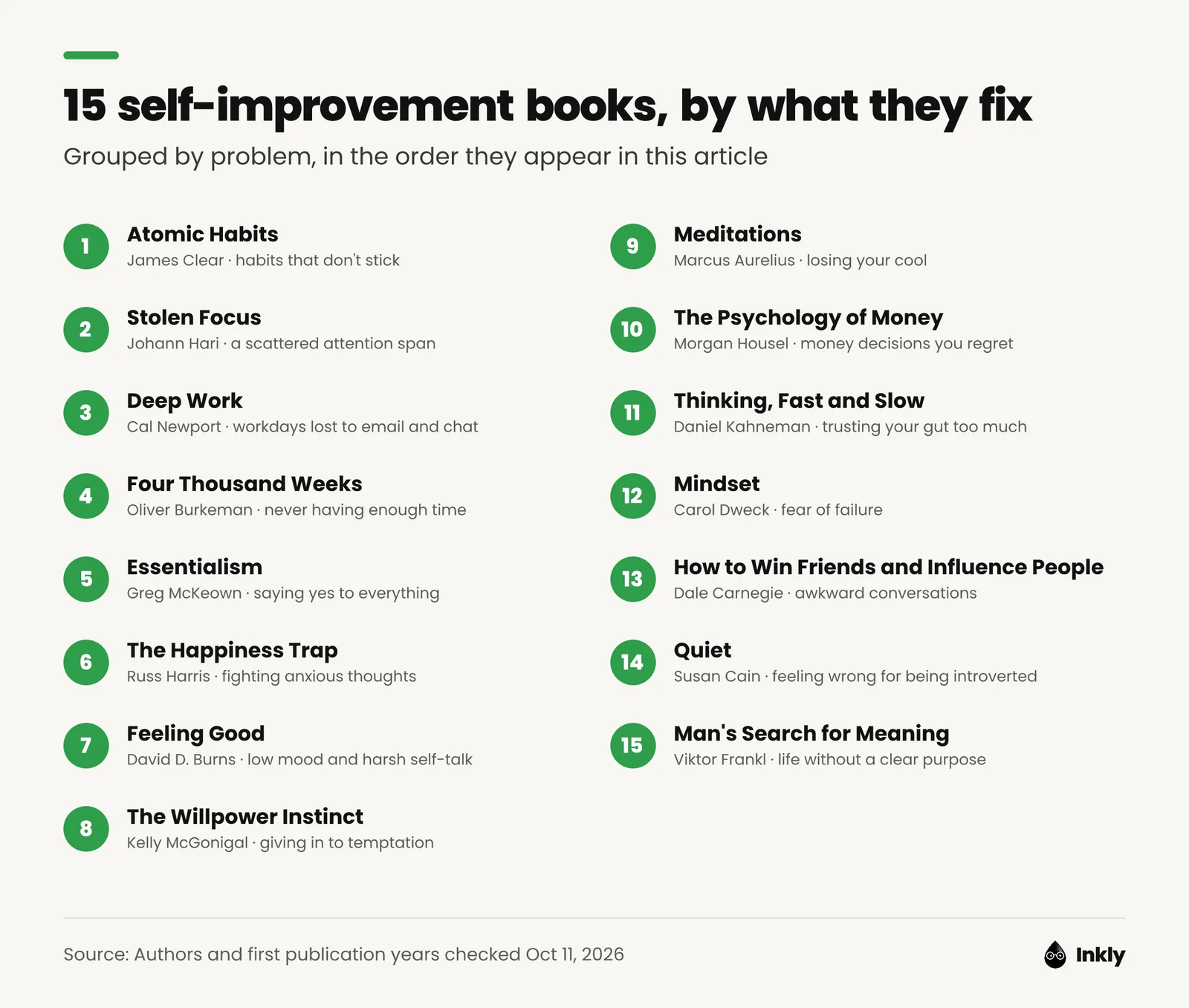
These are our 15 picks, sorted by the problem each one is best for. The years are first publication dates.
| Book | Author | Year | Best for |
|---|---|---|---|
| Atomic Habits | James Clear | 2018 | Building habits that stick |
| Stolen Focus | Johann Hari | 2022 | Understanding why you can't focus |
| Deep Work | Cal Newport | 2016 | Protecting time for hard work |
| Four Thousand Weeks | Oliver Burkeman | 2021 | Feeling behind all the time |
| Essentialism | Greg McKeown | 2014 | Saying no and cutting commitments |
| The Happiness Trap | Russ Harris | 2007 | Anxiety and difficult feelings |
| Feeling Good | David D. Burns | 1980 | Low mood and harsh self-talk |
| The Willpower Instinct | Kelly McGonigal | 2011 | Resisting temptation |
| Meditations | Marcus Aurelius | c. 170-180 AD | Staying calm under pressure |
| The Psychology of Money | Morgan Housel | 2020 | Money habits and money anxiety |
| Thinking, Fast and Slow | Daniel Kahneman | 2011 | Making better decisions |
| Mindset | Carol Dweck | 2006 | Fear of failure |
| How to Win Friends and Influence People | Dale Carnegie | 1936 | Conversations and relationships |
| Quiet | Susan Cain | 2012 | Confidence as an introvert |
| Man's Search for Meaning | Viktor Frankl | 1946 | Finding purpose |
Best books on habits
For most people, the best book on habits is Atomic Habits. It gives you a system you can start using the same day.
1. Atomic Habits by James Clear
First published 2018 · Fixes: habits you start and drop by week two
Atomic Habits argues that your results come from your systems, not from willpower or bigger goals. Clear's four laws say a good habit should be obvious, attractive, easy and satisfying. To break a bad one, you flip each law. The most useful idea in the book is about identity: decide who you want to be, then rack up small actions that prove it.
Read it if you've tried to build the same habit three times and want a system instead of another pep talk. If you've already read two or three habit books, you can skip this one, because the ideas will feel familiar. For a reality check on timelines, see how long it takes to form a habit.
Best books for focus and attention
Read Stolen Focus to understand why your attention feels broken, then Deep Work for what to do about it at your desk.
2. Stolen Focus by Johann Hari
First published 2022 · Fixes: an attention span that feels shredded
In Stolen Focus, journalist Johann Hari argues that your focus problem isn't only a personal failing. He names twelve causes, including apps built to keep you scrolling, exhaustion and constant task-switching. Several of them, he says, are too big for any one person's willpower to fix.
Psychologist Stuart Ritchie pointed out in UnHerd that the book itself admits there are no long-term studies tracking whether people's ability to focus has declined. So read it as a strong argument, not settled science.
Read it if you suspect your phone isn't the whole story. If you want a quick personal toolkit, skip it. Much of the book is about forces you can't change on your own.
3. Deep Work by Cal Newport
First published 2016 · Fixes: workdays that disappear into email and chat
Deep Work makes the case that the ability to concentrate on hard tasks without distraction is getting rarer just as it gets more valuable. Newport, a computer science professor at Georgetown, boils that down to four rules: work deeply, embrace boredom, quit social media and drain the shallows. That last one means batching email and admin so they stop eating your best hours.
This book is for people whose job runs on thinking, like writing or coding, and whose calendar is a mess. Skip it if you don't control your schedule. A lot of the advice assumes you can say no to meetings.
Best productivity books for time and priorities
The two best productivity books here are really anti-productivity books. Both help you do fewer things, on purpose.
4. Four Thousand Weeks by Oliver Burkeman
First published 2021 · Fixes: the feeling that you'll never catch up
If you live to 80, you get roughly 4,000 weeks. Four Thousand Weeks argues that getting more efficient won't make that feel like enough, because demands expand to fill whatever time you free up. Burkeman's answer starts with accepting that you'll never get everything done. From there, you choose what to neglect on purpose and give your best hours to the few things that matter. The appendix has ten practical tools, including a "done list" you keep next to your to-do list.
Read it if you've tried every productivity system and still feel behind. Want a step-by-step planner? This isn't it. It's more philosophy than method.
5. Essentialism by Greg McKeown
First published 2014 · Fixes: saying yes to everything
Essentialism is about doing fewer things, better. McKeown breaks the process into explore, eliminate and execute: figure out what matters, cut most of the rest, then make the remaining work as easy as possible. Steal his 90 percent rule. Score each option against your most important criterion, and if it doesn't reach 90 out of 100, it's a no.
Read it if your calendar is full of other people's priorities. If you've read Four Thousand Weeks and loved it, you can pass: the message overlaps, and this one is pitched at an office crowd.
Best self-help books for anxiety and difficult feelings
For anxiety, start with The Happiness Trap. For low mood and a harsh inner critic, start with Feeling Good. Neither one replaces a therapist if you're struggling badly.
6. The Happiness Trap by Russ Harris
First published 2007 · Fixes: fighting anxious thoughts and losing
The Happiness Trap is a plain-English guide to acceptance and commitment therapy (ACT), written by a doctor and therapist. The trap is the struggle itself. The harder you try to get rid of unpleasant thoughts and feelings, the more room they take up. Harris teaches you to make space for them, unhook from the unhelpful thoughts and act on what you care about anyway.
Get the expanded second edition. More than 50 percent of it is new material.
It's for you if you've spent years trying to think positive and it never stuck. Skip it if you want your bad feelings gone fast. ACT is about living well alongside discomfort, not making it vanish.
7. Feeling Good by David D. Burns
First published 1980 · Fixes: low mood and brutal self-talk
Feeling Good is the book that brought cognitive behavioral therapy (CBT) to a mass audience. Its core idea: your feelings follow your thoughts, and a lot of the thoughts behind a bad mood are distorted, like treating anything short of perfect as total failure. Burns shows you how to catch those thoughts on paper and argue back.
It has also been tested in trials. A 2005 review in the British Journal of General Practice pooled six trials of Feeling Good and found a large effect on depression compared with waiting for treatment. The review's own caveat: every trial was small.
Read it if your inner critic is louder than anyone else in your life. Skip it if you want something short and modern. It's long, and some examples feel very 1980.
Best books on discipline and willpower
The Willpower Instinct explains how self-control works. Meditations shows what steady discipline looks like from the inside.
8. The Willpower Instinct by Kelly McGonigal
First published 2011 · Fixes: giving in to the same temptations
The Willpower Instinct grew out of McGonigal's Stanford course, The Science of Willpower. She treats self-control as a mind-body response you can train with sleep, exercise, food and mindfulness, rather than a virtue you either have or don't. The best part is the small exercises at the end of each chapter, which you try on yourself.
One chapter has aged badly. It leans on the idea that willpower works like a muscle that tires with use, and a 2016 replication across 23 labs and 2,141 people found that effect was close to zero. Luckily, the exercises don't depend on it.
Read it if you know exactly what you should do and keep not doing it. If you want a drill sergeant, skip it. McGonigal is warm and curious, more science class than boot camp.
9. Meditations by Marcus Aurelius
Written around 170-180 AD · Fixes: losing your cool over things you can't control
Meditations is the private notebook of Marcus Aurelius, Roman emperor from 161 to 180 AD. He wrote it in Greek, and probably for no one's eyes but his own. The theme he keeps coming back to: separate what's in your control (your judgments and your actions) from what isn't, and stop spending energy on the second pile. Get a modern translation. Gregory Hays's version is the easiest way in.
Read it if you want a book to dip into, two pages each morning. Skip it if you want a structured argument. It's a notebook, and it repeats itself on purpose.
Best book for money habits
Our pick is The Psychology of Money, because most money problems are behavior problems.
10. The Psychology of Money by Morgan Housel
First published 2020 · Fixes: money decisions you regret later
The Psychology of Money says doing well with money depends more on how you behave than on how smart you are. Over 19 short stories, Housel argues for patience, for avoiding the mistakes you can't recover from, and for deciding what "enough" means before you need to know.
Read it if you earn decent money and still feel anxious or confused about it. Need a budgeting system or investing mechanics? Skip it. There isn't a spreadsheet in sight.
Best psychology and mindset books for thinking clearly
Thinking, Fast and Slow shows how your judgment goes wrong. Mindset is about how your beliefs about your own ability shape what you're willing to try.
11. Thinking, Fast and Slow by Daniel Kahneman
First published 2011 · Fixes: trusting your gut when you shouldn't
Kahneman, a psychologist who won the 2002 Nobel Prize in economics, splits your thinking into two modes. System 1 is fast and intuitive. System 2 is slow and effortful. Thinking, Fast and Slow shows how many mistakes come from System 1 shortcuts that System 2 doesn't bother to check. Once you can name those biases, you start catching them in your own decisions.
The chapter on priming hasn't held up. Kahneman himself admitted in 2017 that he had put too much faith in small, underpowered studies there.
Read it if you make big decisions at work or with money and want to make fewer bad ones. If you want a quick read, look elsewhere. It's long and dense, best taken a chapter at a time.
12. Mindset by Carol Dweck
First published 2006 · Fixes: avoiding hard things because you might fail
Mindset contrasts two beliefs about ability. With a fixed mindset, talent is set, so every failure says something about you. With a growth mindset, ability grows with effort and good strategy, so failure is information. Dweck, a Stanford psychologist, argues that this belief shapes whether you take on challenges or dodge them.
The effect is real, just smaller than the book's tone suggests. In a 2019 national study published in Nature, a growth-mindset program of under an hour, given to 12,490 US ninth graders, raised lower-achieving students' grades by about a tenth of a grade point.
Read it if you quit things the moment you're not instantly good at them. If you already know the fixed versus growth idea, skip it: the core fits on one page, and the rest is examples.
Best books for relationships and confidence
How to Win Friends and Influence People teaches you to get along with others. Quiet helps you stop apologizing for who you are.
13. How to Win Friends and Influence People by Dale Carnegie
First published 1936 · Fixes: awkward conversations and people who don't warm to you
How to Win Friends and Influence People is almost embarrassingly simple. Be genuinely interested in people, remember their names, listen more than you talk, skip the criticism and try to see things from the other person's side. It works because so few people do it consistently.
Read it if you want people skills you can use in your next conversation. Skip it if 1930s salesman anecdotes make you roll your eyes, though the updated 2022 edition helps.
14. Quiet by Susan Cain
First published 2012 · Fixes: feeling like something's wrong with you for being an introvert
Quiet argues that American culture runs on an "Extrovert Ideal" that rewards talking over thinking. Cain treats introversion as a normal preference for quieter, less stimulating settings. She shows introverts how to work and lead in ways that suit them, instead of copying the loudest person in the room.
Read it if you leave parties drained and wonder why. Extroverts looking for confidence tips can skip it, since the book is mostly about understanding introverts.
Best book for finding meaning and purpose
Of all the books that promise to change your life, Man's Search for Meaning has the best case.
15. Man's Search for Meaning by Viktor Frankl
First published 1946 · Fixes: feeling stuck, or empty, without a clear purpose
Frankl was a Viennese psychiatrist who survived Nazi concentration camps, including Auschwitz. Man's Search for Meaning has two parts. The first is a short, hard account of camp life. The second introduces logotherapy, his idea that our deepest drive is to find meaning. Frankl argues that meaning can come from the work you do, the people you love and the way you face suffering you can't avoid. It's a short book, and he wrote it in nine days.
Read it if you're doing fine on paper and still feel empty. Skip it for now if you're not in a place to read about the Holocaust. Part one is hard going.
How do you get more out of self-help books?
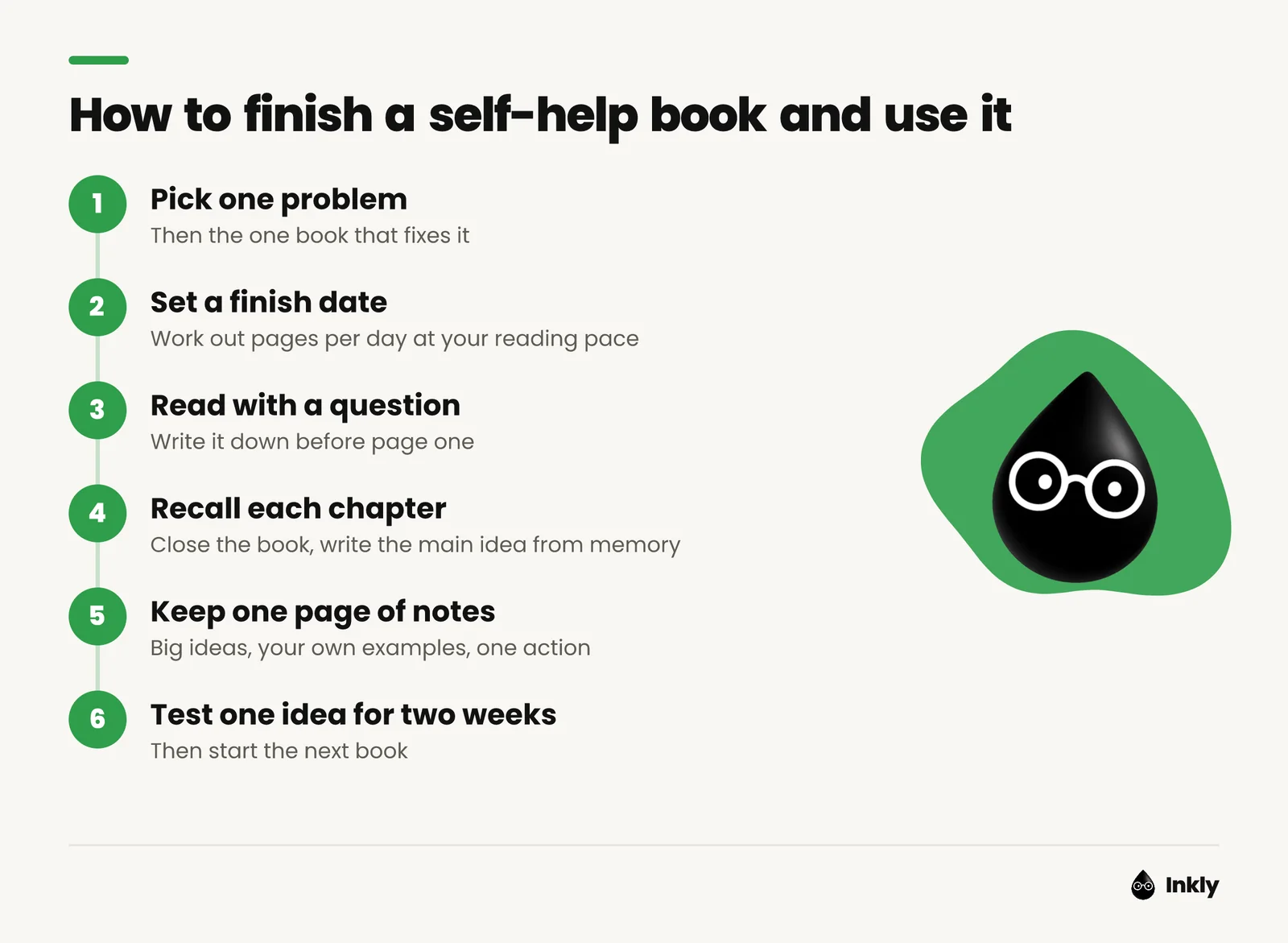
Read fewer of them, and use more of each one. It's easy to finish a self-help book, feel great for a weekend and remember almost nothing a month later. These steps fix that:
- Pick one problem and one book from the table above. Ignore the other 14 for now.
- Set a finish date. Our reading time calculator shows how long a book will take at your pace.
- Before you read page one, write down the question you want the book to answer.
- After each chapter, close the book and write the main idea from memory. A 2011 classroom study with real students and real exams found that quizzing yourself beats rereading. Our guide on how to remember what you read covers more methods.
- Keep your notes to one page. Our free book notes template has room for the big ideas, your own examples and one action.
- Test one idea for two weeks before you open the next book. Track what you finish in a printable reading log.
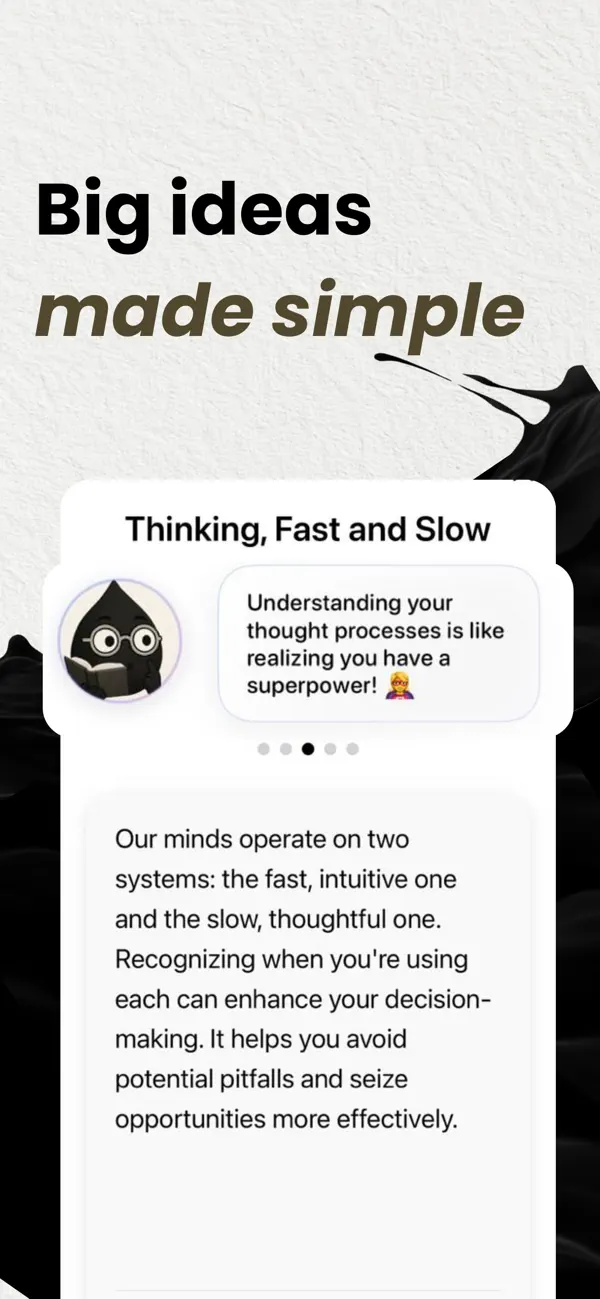
If step 4 is the one you'll skip, an app can do the quizzing for you. Inkly is our app, so weigh this accordingly. Inkly turns big ideas from non-fiction books like these into short daily lessons with a quick quiz after each one, and you can chat with Inkly about how to put an idea into practice. It's free to download on the App Store, but the full daily lessons and quizzes need an Inkly Unlimited subscription. It only runs on iPhone.
FAQ
What is the number one self-help book?
There's no official number one. If you go by sales, the modern leader is Atomic Habits: James Clear's site says it has sold over 30 million copies worldwide. Atomic Habits is also our pick for most people. If you already own three habit trackers, try Four Thousand Weeks instead.
Which self-improvement book should I read first?
Start with the book that matches whatever problem is costing you the most right now. The table near the top maps each book to a problem. If nothing jumps out, read Atomic Habits first: you can use an idea from it the same day, and better habits make every other book here easier to apply.
Are self-help books actually helpful?
Some are. The evidence is strongest for books based on cognitive behavioral therapy: a 2005 review in the British Journal of General Practice found a large effect for Feeling Good across six small trials on depression. The same review found no trial evidence at all for several other popular self-help books. For most titles, the value depends on whether you apply what you read.
What's the difference between self-help and self-improvement books?
Mostly the label. "Self-help" usually means fixing something that hurts, like anxiety or low mood. "Self-improvement" usually means getting better at something, like habits, focus or money. The two overlap, and most books on this list do both.
Which books will change your life?
A book can't change your life on its own, but acting on one idea from it can. Man's Search for Meaning has the strongest track record: a 1991 survey for the Library of Congress and the Book-of-the-Month Club named it one of the ten most influential books in the US. For a change you'll notice within a month, we'd bet on Atomic Habits or Four Thousand Weeks.