Below is the 48 Laws of Power summary: all 48 laws in six themes (our grouping), what the book teaches, why critics call it nonsense and prisons ban it, and how to use it without becoming the person it describes. If you only have a minute, the next section is the whole book.
We wrote this from the publisher's page, the book's catalog contents, Kirkus's review, press reports and published commentary. Law titles are Greene's; the rest is our paraphrase.

48 Laws of Power summary in one minute
The 48 Laws of Power says that every workplace, court or social circle runs on power, and that you're either playing the game or being played. The book in five lines:
- Power is social. It comes from how others see you, so image, reputation and timing matter more than merit.
- Never threaten the people above you. Law 1's statement: "Always make those above you feel comfortably superior."
- Reveal less. Conceal your intentions, say less than necessary, and let actions do the arguing.
- Create leverage. Make others need you, control their options, and use their wants and weaknesses.
- Know when to stop. The last laws warn against overreaching, reforming too fast and becoming too rigid to adapt.
What is The 48 Laws of Power about?
The 48 Laws of Power is a book by Robert Greene, produced with the book packager Joost Elffers and first published by Viking in 1998. The current Penguin paperback runs about 496 pages. Penguin Random House describes it as distilling three thousand years of the history of power into 48 laws, drawing on writers such as Machiavelli, Sun Tzu and Clausewitz, and calls it a multi-million-copy bestseller.
Greene, born in Los Angeles in 1959, studied classics and worked many jobs before writing it. He later wrote The Art of Seduction, The 33 Strategies of War, Mastery and The Laws of Human Nature, according to his own site.
Each law is its own chapter: a short statement of the law, then historical stories of people who broke it and people who followed it, then advice on applying it and, in many chapters, on when to do the opposite. The laws stand alone, so you can read them in any order.
What are the 48 laws of power?
The 48 laws of power are the 48 chapter titles of Greene's book. Here they are in full, sorted into six themes of our own so they're easier to take in. Greene numbers them 1 to 48 but doesn't group them.
Handling the people above and around you
- 1 Never Outshine the Master
- 2 Never Put Too Much Trust in Friends, Learn How to Use Enemies
- 19 Know Who You're Dealing With: Do Not Offend the Wrong Person
- 24 Play the Perfect Courtier
- 41 Avoid Stepping into a Great Man's Shoes
- 46 Never Appear Too Perfect
Guarding your image
- 5 So Much Depends on Reputation: Guard It with Your Life
- 6 Court Attention at All Cost
- 25 Re-Create Yourself
- 27 Play on People's Need to Believe to Create a Cultlike Following
- 30 Make Your Accomplishments Seem Effortless
- 32 Play to People's Fantasies
- 34 Be Royal in Your Own Fashion: Act Like a King to Be Treated Like One
- 37 Create Compelling Spectacles
Saying less and revealing less
- 3 Conceal Your Intentions
- 4 Always Say Less Than Necessary
- 9 Win Through Your Actions, Never Through Argument
- 14 Pose as a Friend, Work as a Spy
- 21 Play a Sucker to Catch a Sucker: Seem Dumber Than Your Mark
- 38 Think as You Like but Behave Like Others
- 44 Disarm and Infuriate with the Mirror Effect
Creating leverage
- 7 Get Others to Do the Work for You, but Always Take the Credit
- 8 Make Other People Come to You: Use Bait If Necessary
- 11 Learn to Keep People Dependent on You
- 13 When Asking for Help, Appeal to People's Self-Interest, Never to Their Mercy or Gratitude
- 20 Do Not Commit to Anyone
- 31 Control the Options: Get Others to Play with the Cards You Deal
- 33 Discover Each Man's Thumbscrew
- 40 Despise the Free Lunch
Strategy and timing
- 15 Crush Your Enemy Totally
- 23 Concentrate Your Forces
- 28 Enter Action with Boldness
- 29 Plan All the Way to the End
- 35 Master the Art of Timing
- 42 Strike the Shepherd and the Sheep Will Scatter
- 45 Preach the Need for Change, but Never Reform Too Much at Once
- 47 Do Not Go Past the Mark You Aimed For; In Victory, Learn When to Stop
- 48 Assume Formlessness
Protecting yourself
- 10 Infection: Avoid the Unhappy and Unlucky
- 12 Use Selective Honesty and Generosity to Disarm Your Victim
- 16 Use Absence to Increase Respect and Honor
- 17 Keep Others in Suspended Terror: Cultivate an Air of Unpredictability
- 18 Do Not Build Fortresses to Protect Yourself: Isolation Is Dangerous
- 22 Use the Surrender Tactic: Transform Weakness into Power
- 26 Keep Your Hands Clean
- 36 Disdain Things You Cannot Have: Ignoring Them Is the Best Revenge
- 39 Stir Up Waters to Catch Fish
- 43 Work on the Hearts and Minds of Others
What are the main lessons of The 48 Laws of Power?
The main lessons of The 48 Laws of Power are that perception matters as much as performance, that saying less gives you more control, and that the people who hold power reward those who make them feel secure. Three ideas are worth understanding even if you never use them:
- Don't threaten insecure bosses. Law 1 is the book's most quoted rule for a reason. Showing up the person above you, however good your work, can cost you. The decent version: make your manager look good while you do great work.
- Say less than you think. Laws 3, 4 and 9 come down to this: the more you explain and argue, the more you reveal and the less people respect you. The decent version: listen more, commit to less in the moment, and let results make your case.
- Plan to the end, and stop at the mark. Laws 29 and 47 warn that people who win often keep pushing until they lose it all. That one applies to careers, negotiations and arguments with family alike.
Try it today: before your next meeting, decide the one thing you want from it, and say less than you planned.
Why is The 48 Laws of Power controversial?
The 48 Laws of Power is controversial because many of its laws describe manipulation, and the book presents them without moral judgment. Laws like "Pose as a Friend, Work as a Spy," "Use Selective Honesty and Generosity to Disarm Your Victim" and "Crush Your Enemy Totally" speak for themselves.
- Critics called it nonsense. In its 1998 review, Kirkus called the book a sort of anti-Book of Virtues, said its rules often contradict each other and never define power, and concluded that it was either silly or brilliant satire.
- Prisons ban it. Utah State Prison banned it as a security risk, fearing it could teach inmates to control people, the Salt Lake Tribune reported in 2017. A 2023 PEN America report found it was the second most frequently banned book in the US prisons that track bans, according to infoDOCKET.
- History as evidence is thin. The laws rest on selected stories from royal courts, wars and con artists. A story where a tactic worked doesn't show that it usually works, and you rarely hear from the people it backfired on.
Is The 48 Laws of Power worth reading?
The 48 Laws of Power is worth reading if you want to recognize power games at work or in negotiations, and if you read it with your ethics switched on. The historical stories are entertaining, and some laws are sound advice in any setting. At about 496 pages it's long, and our reading time calculator shows how long that is at your speed.
Skip it if you're early in your career and looking for a playbook, because following it literally will cost you trust with the people you most need. Skip it, too, if you want relationships built on honesty; the book treats every relationship as a contest.
Is a summary enough? For most people, yes. The list of laws plus a few stories gives you the vocabulary to spot the moves; the full book mostly adds more stories.
How do you use The 48 Laws of Power without becoming a jerk?
You use The 48 Laws of Power well by reading it as a defense manual: learn to spot the moves, not to make them. A simple approach:
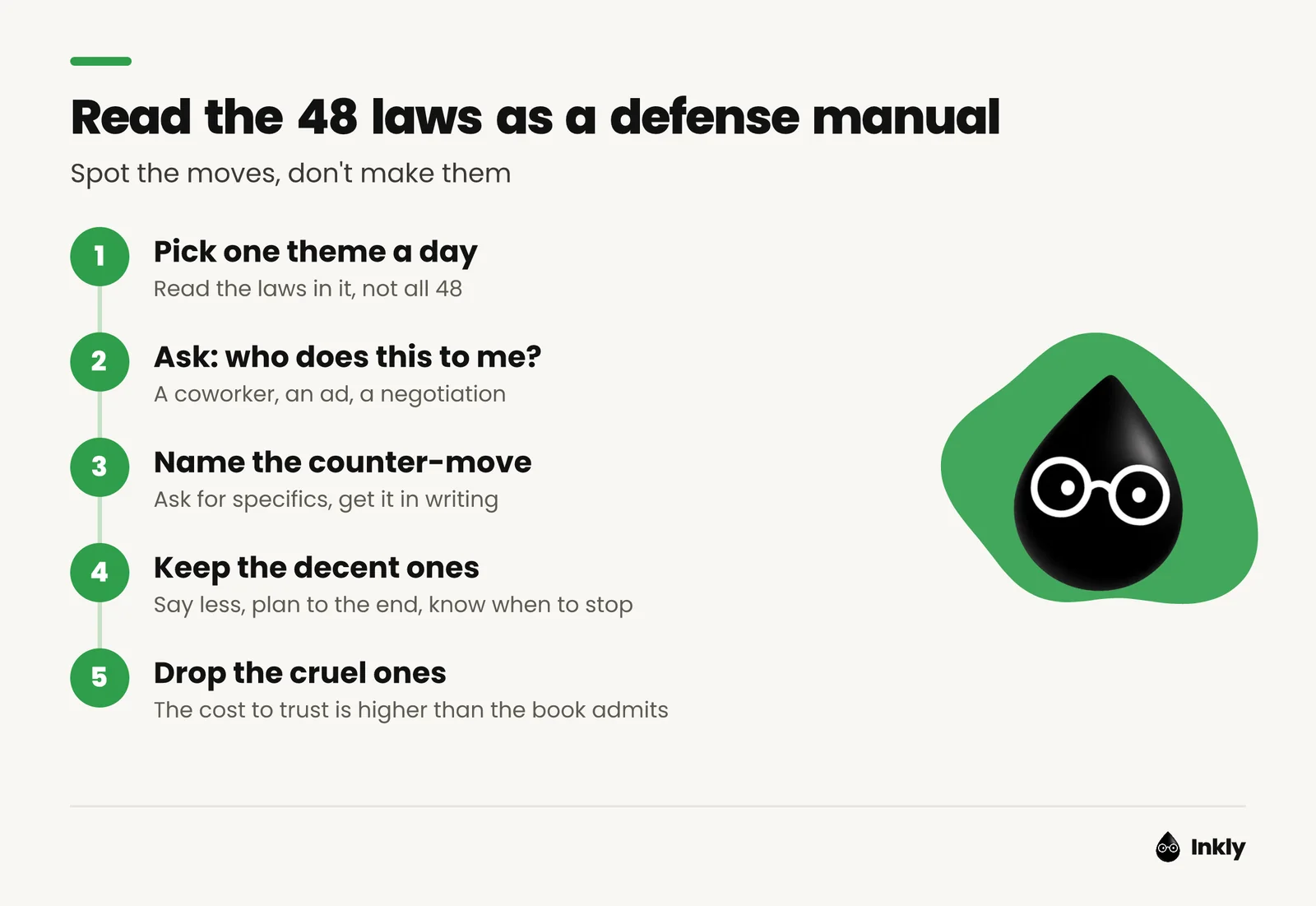
- Pick one theme a day from the six above, rather than all 48 laws at once.
- Ask who does this to you: a coworker who takes credit (Law 7), a salesperson creating urgency, a negotiator who says little.
- Name the counter-move. Asking for specifics, putting agreements in writing and making credit visible beat most of these tactics.
- Keep the decent ones. Saying less, planning to the end, mastering timing and knowing when to stop are good advice for anyone.
- Drop the cruel ones. Manipulation can win once and lose you people's trust for good.
What should you read after The 48 Laws of Power?
For the opposite philosophy, read our How to Win Friends and Influence People summary: Dale Carnegie's route to influence through sincere interest and appreciation. Our Rich Dad Poor Dad summary covers another bestseller worth reading critically, and our list of the best self-improvement books has gentler options.
One more option, and it's ours: Inkly is our app, so weigh this accordingly. It turns big ideas from non-fiction books into short daily lessons with a quick quiz after each one, with Influence as one of its six growth areas. It's iPhone only and free to download; the daily lessons need a subscription.
FAQ
What is the main message of The 48 Laws of Power?
The main message of The 48 Laws of Power is that power is a social game played everywhere, and that you can learn its rules from history. Robert Greene argues that image, timing and leverage often matter more than merit, and that you're better off understanding these dynamics than pretending they don't exist.
What is the first law of power?
The first law of power is "Never Outshine the Master." Greene's short statement of it is: "Always make those above you feel comfortably superior." The idea is that showing up an insecure superior, even unintentionally, can make them see you as a threat.
Why is The 48 Laws of Power banned in prisons?
Prisons ban The 48 Laws of Power because officials fear it teaches manipulation. Utah State Prison banned it as a security risk, the Salt Lake Tribune reported in 2017, and a 2023 PEN America report found it was the second most frequently banned title in US prisons that track bans.
Is The 48 Laws of Power evil?
The 48 Laws of Power isn't evil in itself, but many of its laws describe manipulative tactics without judging them. Critics such as Kirkus have called it amoral. Read it to recognize how people try to gain power over you, and choose which laws to use based on your own values.
How many pages is The 48 Laws of Power?
The current Penguin paperback of The 48 Laws of Power runs about 496 pages, and the 1998 Viking hardcover ran about 450. Each of the 48 laws is its own chapter, so it's easy to read in pieces or in any order.
What are the most useful laws in The 48 Laws of Power?
The most useful laws for everyday life are the ones that hold up ethically: say less than necessary (Law 4), plan all the way to the end (Law 29), master the art of timing (Law 35), and in victory, learn when to stop (Law 47). Law 1, about not outshining your boss, is the most quoted.