Below is the Man's Search for Meaning summary: what happens in each part of the book, Frankl's three sources of meaning, logotherapy in plain terms, the criticism from historians, and a few reflection questions to take with you. If you only have a minute, the next section is the whole book.
A note before you start: the first half of this book describes life and death in Auschwitz and other camps. This summary keeps that part brief and factual.
We wrote this from the publisher's page, the Viktor Frankl Institute, Britannica, library records of the book's editions, and published scholarship. The few short quotes are Frankl's own words as printed in reliable sources; the rest is our paraphrase.
Man's Search for Meaning summary in one minute
Man's Search for Meaning argues that people can endure almost anything if they have a reason to, and that finding that reason is the central task of a life. The book in five lines:
- Part One is a memoir. Frankl, a Viennese psychiatrist, describes how prisoners reacted to the camps: shock on arrival, then apathy, then a difficult return to life after liberation.
- Meaning kept people going. Frankl saw that prisoners who held on to a purpose, such as a loved one or unfinished work, had more to live for.
- One freedom can't be taken. Frankl called the freedom to choose one's attitude in any circumstances "the last of the human freedoms."
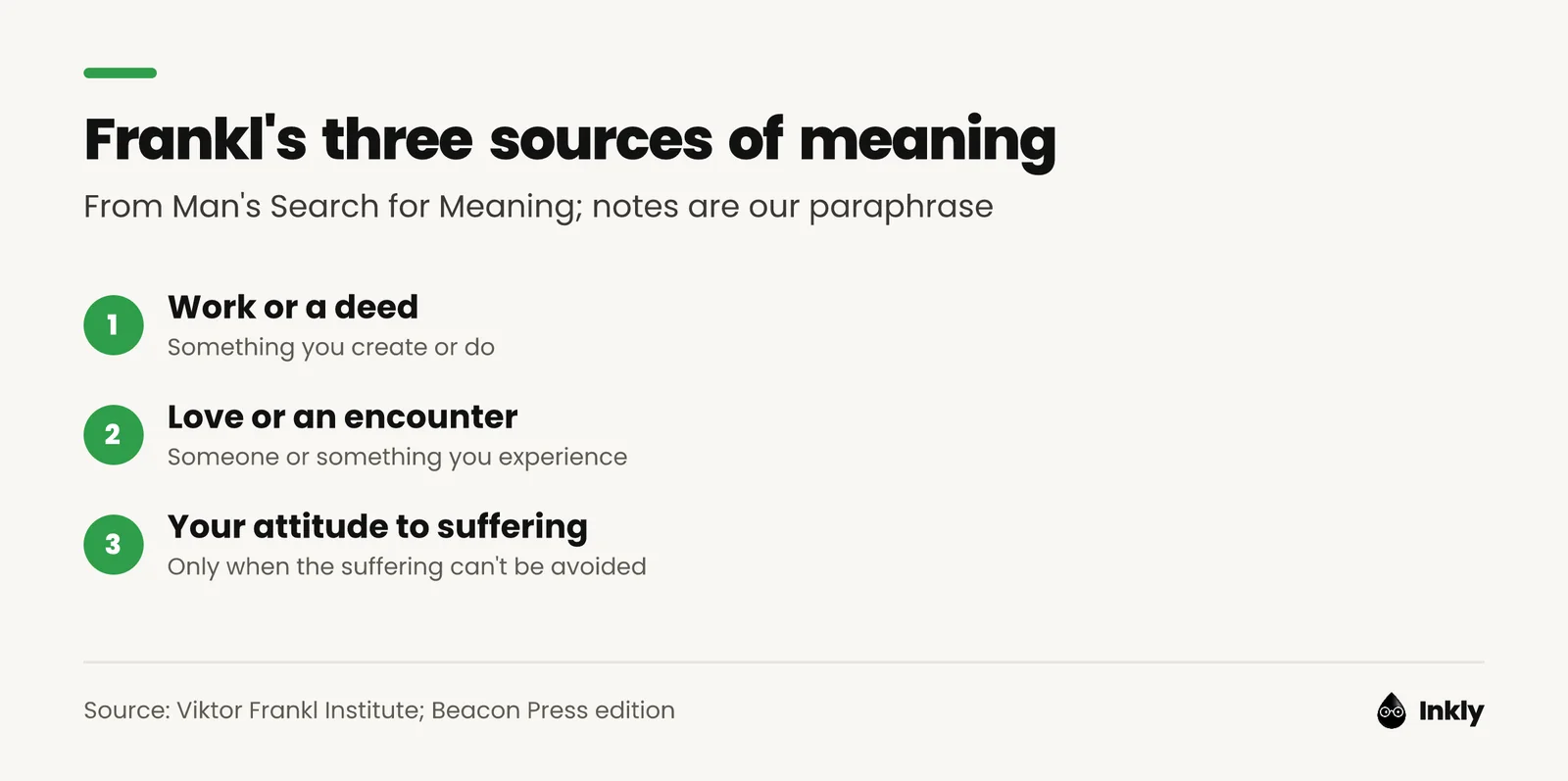
- Meaning has three sources: what you create or do, what or whom you love, and the attitude you take toward suffering you can't avoid.
- Part Two explains logotherapy, Frankl's therapy built on the idea that the search for meaning is our primary motivation.
What is Man's Search for Meaning about?
Man's Search for Meaning is a book by the Austrian psychiatrist and neurologist Viktor E. Frankl, first published in German in 1946. According to the Viktor Frankl Institute, he dictated it in nine days after the war. The first English edition appeared in 1959 as From Death-Camp to Existentialism and was later renamed Man's Search for Meaning. Today Beacon Press publishes it at about 180 pages and says it has sold over 16 million copies in more than 50 languages.
Frankl (1905-1997) was deported to the Theresienstadt ghetto in 1942 with his wife and parents. In 1944 he was sent to Auschwitz, where he spent a few days before being moved to Kaufering and Türkheim, subcamps of Dachau. He was liberated in April 1945. His father died in Theresienstadt, his mother and brother were murdered in Auschwitz, and his wife, Tilly, died in Bergen-Belsen.
In 1991, members of the Book-of-the-Month Club surveyed for the Library of Congress named it among the books that had made a difference in their lives. The current edition has three parts:
| Part | What it covers |
|---|---|
| Experiences in a Concentration Camp | Frankl's account of camp life and of how prisoners' minds responded to it |
| Logotherapy in a Nutshell | A short introduction to his therapy, built on the search for meaning |
| Postscript 1984: The Case for a Tragic Optimism | How to say yes to life despite pain, guilt and death |
What happens in Part One?
Part One describes the psychology of camp life through three phases Frankl observed in prisoners, including himself. First comes shock on arrival, when people still hoped they might be spared. Then comes apathy: feelings go numb, and everything narrows to getting through the day. The third phase begins after liberation, when many survivors felt numb, then bitter or disillusioned on returning to a world that had moved on.
Frankl doesn't present this as a study. It's one man's account, written within a year of liberation. What he draws from it is the book's core claim: the prisoners who still had something to live for, whether a person waiting for them or a task left to finish, were better able to bear the conditions.
What are Frankl's three sources of meaning?
Frankl's three sources of meaning are creating a work or doing a deed, experiencing something or encountering someone (above all, through love), and the attitude we take toward unavoidable suffering. That third one is often misread, so it's worth being precise.
Frankl was not saying suffering is good or that you should seek it out. If suffering can be avoided, the meaningful thing is to avoid or remove it. The third source applies only when it can't be changed: an illness, a loss, a situation outside your control. Even then, he argued, you still choose how you meet it.
Try it today: write one line for each source. What am I making or doing that matters? Who do I love or show up for? What am I carrying that I can't change, and how do I want to carry it?
What is logotherapy?
Logotherapy is Frankl's school of psychotherapy, built on the idea that the search for meaning, not pleasure or power, is the primary human motivation. The name comes from the Greek word "logos," which Frankl used in the sense of meaning. The Viktor Frankl Institute describes three core concepts: freedom of will, the will to meaning, and meaning in life.
A logotherapist doesn't hand you a meaning. The aim is to help you find your own, in the specific situation you're in. Britannica describes logotherapy as the third Viennese school of psychotherapy, after Freud's and Adler's.
How does it hold up? A 2025 meta-analysis pooled 35 studies with 1,656 participants and found large effects on depressive symptoms, but the studies varied a lot, and the authors called for more and broader research. Treat it as promising, not settled.
What is tragic optimism?
Tragic optimism is Frankl's term, from the 1984 postscript, for staying hopeful in spite of the three unavoidable facts of life he calls the tragic triad: pain, guilt and death. It isn't cheerfulness. It's the stance that you can turn suffering into an achievement, use guilt as a reason to change for the better, and treat the shortness of life as a reason to act responsibly now.
What do critics say about Man's Search for Meaning?
Man's Search for Meaning is one of the most influential books of its century, and it has serious critics, mostly historians and literary scholars of the Holocaust. The main points:
- It may bend Auschwitz to fit a theory. The scholar Lawrence Langer argued that Frankl's account distorts the reality of the camps to support his ideas about meaning. The historian Timothy Pytell made a similar case in a 2003 article in Holocaust and Genocide Studies.
- His time in Auschwitz was short. Pytell's 2015 biography notes that Frankl spent far less time at Auschwitz than many readers assume. The Frankl Institute's own timeline says a few days.
- Purpose was no protection. Many prisoners with every reason to live were murdered. Read Frankl's point as being about how people endured what they couldn't escape, not about who survived.
None of this cancels the book's value for readers today. It does mean reading Part One as a personal account and testimony, not as history or science.
Is Man's Search for Meaning worth reading?
Yes, Man's Search for Meaning is worth reading if you're going through a hard period, questioning what your life is for, or want to understand one of the 20th century's most read books. It's short, and our reading time calculator tells you how long it'll take at your speed.
Skip it, or wait, if graphic accounts of the Holocaust would be too much right now. And if you're dealing with depression or grief, the book is a companion, not a treatment; talk to a professional.
Is a summary enough? Not for this one. The power of the book is in Frankl's voice and in the testimony itself. A summary gives you the ideas; the book gives you the reason they matter.
How do you apply Man's Search for Meaning?
You apply Man's Search for Meaning by looking for meaning in your own specific situation, which is where Frankl said it is found. Five reflection questions based on his three sources:
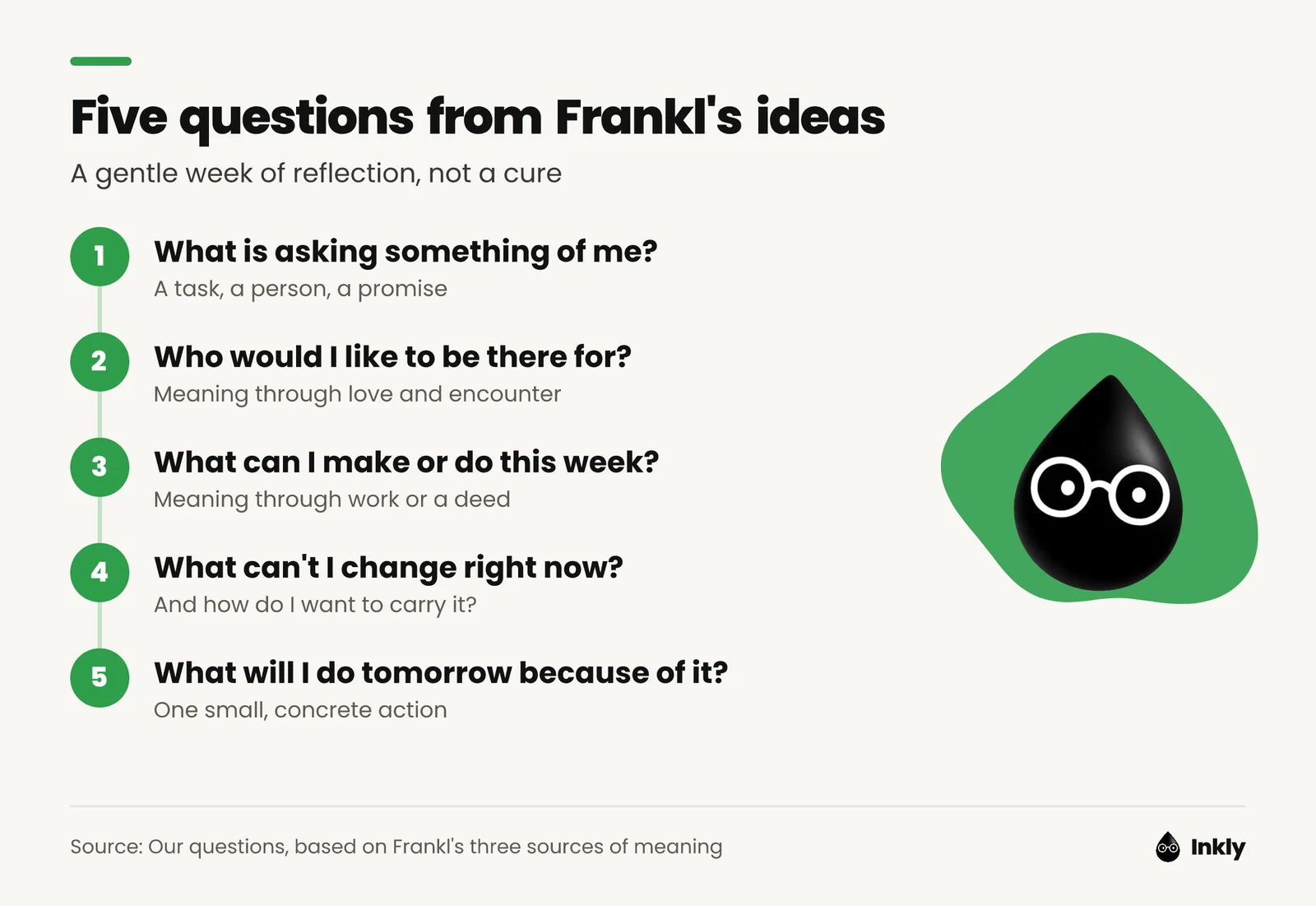
- What is asking something of me right now? A task, a person, a promise.
- Who would I like to be there for? Meaning through love and encounter.
- What can I make or do this week? Meaning through work.
- What can't I change right now? And how do I want to carry it?
- What will I do tomorrow because of this? One small, concrete action.
Writing your answers down helps. A one-page book notes template is enough room.
What should you read after Man's Search for Meaning?
If Frankl's book moved you, our Four Agreements summary covers a gentler, everyday version of choosing your response, and our Extreme Ownership summary takes the idea of owning your situation into work and leadership. Meditations by Marcus Aurelius, from our list of the best self-improvement books, is the ancient Stoic take on what you can and can't control.
One more option, and it's ours: Inkly is our app, so weigh this accordingly. It turns big ideas from non-fiction books into short daily lessons with a quick quiz after each one, plus a chat for reflecting on how an idea applies to you. It's iPhone only and free to download; the daily lessons need a subscription.
FAQ
What is the main message of Man's Search for Meaning?
The main message of Man's Search for Meaning is that the search for meaning is the deepest human drive, and that meaning can be found even in terrible circumstances. Viktor Frankl says it comes from what we create or do, whom we love, and the attitude we take toward suffering we cannot avoid.
What are the three ways to find meaning according to Frankl?
Frankl's three ways to find meaning are by creating a work or doing a deed, by experiencing something or encountering someone, especially through love, and by the attitude you take toward unavoidable suffering. The third applies only when suffering truly can't be avoided or changed.
What does "the last of the human freedoms" mean?
"The last of the human freedoms" is Frankl's phrase for the freedom to choose your attitude in any set of circumstances. He argued that even when everything else is taken away, as it was in the camps, a person still decides how to respond inwardly to what happens to them.
Is Man's Search for Meaning a true story?
Yes. Part One is Viktor Frankl's first-person account of his time in Nazi concentration camps from 1942 to 1945, including Theresienstadt, Auschwitz and subcamps of Dachau. Historians such as Timothy Pytell have questioned how Frankl framed parts of his experience, so read it as testimony rather than a history.
How long is Man's Search for Meaning?
Man's Search for Meaning runs about 180 pages in the current Beacon Press paperback, including a foreword, the postscript and an afterword. The main text is shorter, and most readers finish it in a few sittings. Page counts vary between editions.
What is logotherapy in simple terms?
Logotherapy is a form of psychotherapy founded by Viktor Frankl. In simple terms, it holds that people are driven above all by a need for meaning, and it helps them find meaning in their own situation rather than handing them one. Its name comes from "logos," which Frankl used to mean meaning.