If you searched "how long does it take to form a habit" because day 22 came and went and your new routine still feels like homework, relax. You're on schedule.
How long does it take to form a habit, according to research?
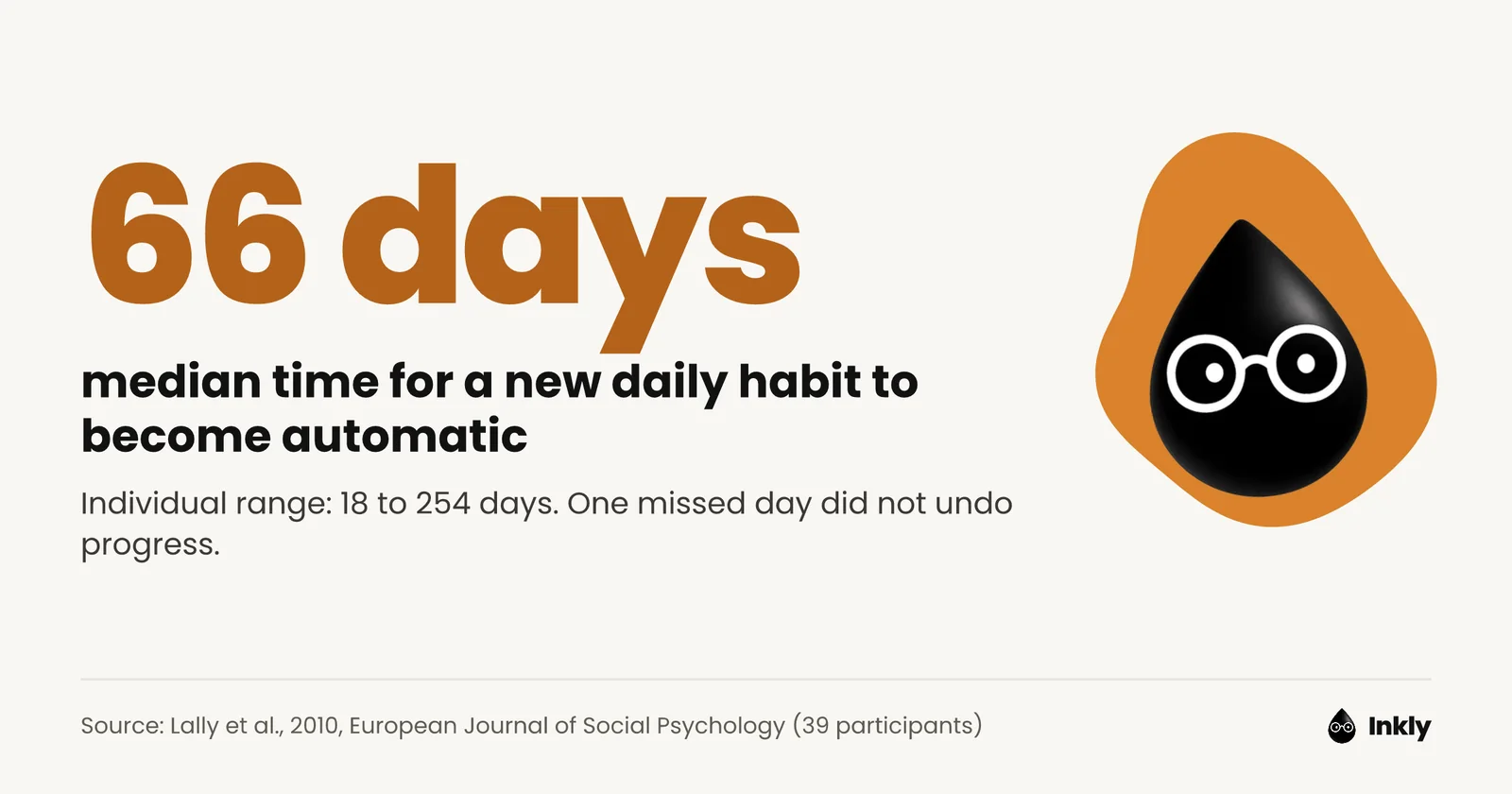
A new daily habit takes a median of 66 days to become automatic. That's from a study by Phillippa Lally and colleagues at University College London, published in the European Journal of Social Psychology (online in 2009, in print in 2010), and it's still the most-cited answer.
The study had 96 volunteers, mostly postgraduate students with an average age of 27. Each one picked a new eating, drinking or exercise behavior and tied it to a daily cue: a piece of fruit with lunch, say, or a 15-minute run before dinner. For 84 days, they logged whether they did it and rated how automatic it felt.
Of the 96, 14 dropped out, leaving 82 with enough data. The researchers fit a curve to each person's scores. It worked for 62 people and fit well for 39. For those 39, the median time to reach 95% of their automaticity plateau was 66 days, with a range of 18 to 254 days.
The fine print most write-ups skip:
- The 254 days is a projection. The study ran for 84 days, so anything longer is the curve extended forward. Nobody was tracked that long.
- "Formed" means "plateaued." The earliest repetitions gave the biggest jumps in automaticity, and later ones added less and less. Think of day 66 as roughly when a habit stops getting easier, rather than the first day it feels easy.
- About half didn't get there. These were motivated volunteers, and the authors still noted that roughly half didn't do the behavior consistently enough to reach habit status.
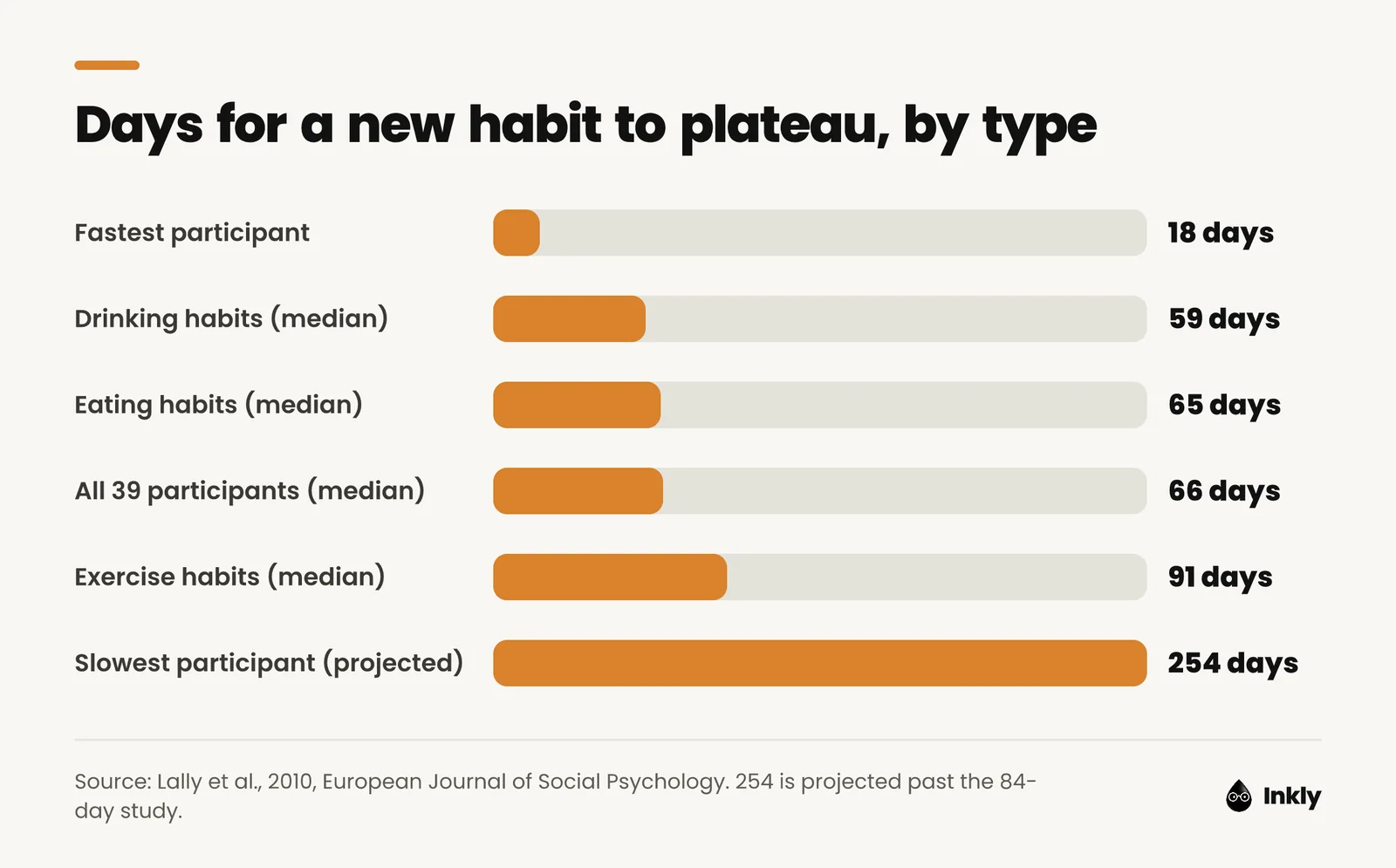
The type of habit mattered, a bit. Drinking habits (most often water) took a median of 59 days, eating habits 65 and exercise habits 91. The groups were too small for that gap to be statistically significant. Still, exercise took about one and a half times as long, which fits the idea that complex behaviors take longer to automate.
Keep the limits in mind: 39 people, mostly students in London, rating their own automaticity. It's the best-known study on the question, but one study is still one study.
Is it 21 days or 66 days to form a habit?
It's closer to 66 days. The idea that it takes 21 days to form a habit didn't come from a habit study at all. It came from a plastic surgeon.
Maxwell Maltz published his self-help book Psycho-Cybernetics in 1960. He noticed that patients seemed to need about three weeks to get used to a new face after surgery, and that amputees felt a phantom limb for about as long. He wrote that it usually takes a minimum of about 21 days to change a mental image, as this UCL health psychology blog post explains.
Over the decades, "a minimum of about 21 days" to adjust your self-image got shortened to "21 days to form a habit." The word "minimum" fell off, and so did the small detail that he was describing self-image, not habits.
The "66 days to form a habit" line has a problem too. People repeat it like a rule, when it's the middle of a range that runs from under three weeks to more than eight months. If your habit feels automatic by day 21, great. If it doesn't, nothing is wrong with you.
What do newer studies say about habit formation time?
Newer research agrees on two things: there's no magic number, and the type of habit matters a lot. The main studies, side by side (checked October 2026):
| Study | Habit | Who | Time to habit |
|---|---|---|---|
| Lally et al., 2010 | Eating, drinking or exercise, once a day | 39 of 96 volunteers with a good model fit | Median 66 days (range 18 to 254) |
| Kaushal & Rhodes, 2015 | Working out at the gym | 111 new gym members | At least 6 weeks of 4+ workouts a week |
| Buyalskaya et al., 2023 | Going to the gym | 30,110 gym members | Median of about 4 to 7 months |
| Buyalskaya et al., 2023 | Hand sanitizing at work | 3,124 hospital workers | About 2 weeks (9 to 10 shifts) |
| Singh et al., 2024 | Health habits (review of 20 studies) | 2,601 people | Medians 59 to 66 days; averages 106 to 154 days |
The 2023 PNAS study, by Anastasia Buyalskaya, Colin Camerer and colleagues, didn't ask anyone how automatic anything felt. It ran machine learning on objective data from more than 12 million gym check-ins and more than 40 million handwashing opportunities. A habit counted as formed once a person's behavior became predictable from context, such as the day of the week or the time since their last visit.
Gym habits took months. Handwashing took weeks. The authors say that's because going to the gym happens less often and involves more steps. Two caveats. The hospital workers weren't tracked from scratch, so many probably had some handwashing habit already. And "predictable" isn't quite the same as "automatic."
A smaller survey of 111 new gym members (Kaushal & Rhodes, 2015) put the minimum at six weeks of four or more workouts a week. Change how you measure "habit" and you change the answer.
The 2024 review in Healthcare by Ben Singh and colleagues pulled together 20 studies, though only four reported how long habits took. Individual times ran from 4 to 335 days, and the averages sit well above the medians, a sign that a few slow cases pull them up. Morning habits and self-chosen habits tended to be stronger, but most of the studies had a high risk of bias.
Our read: plan on two to three months for a simple daily habit and longer for something like exercise. Go by how automatic it feels, not by the calendar.
Does missing a day ruin a habit?
No. Lally's team looked at exactly this and found 140 cases, across 55 people, where someone skipped the behavior after doing it three days in a row. The next day, automaticity dipped by 0.29 points on a 0 to 42 scale. A single miss had no longer-term cost.
Lally's team didn't test long breaks. An earlier exercise study they cite found that missing a whole week did predict worse follow-through. The 2023 gym data points the same way: for 76% of members, the longer it had been since their last visit, the less likely they were to go on any given day.
Which gives you a simple rule: never miss twice in a row. It doesn't come from a study, but it's the practical reading of the data.
What is habit stacking?
Habit stacking means attaching a new habit to something you already do every day, so the old habit reminds you to do the new one.
The method comes from BJ Fogg, who directs the Behavior Design Lab at Stanford and created Tiny Habits. Fogg calls the existing routine an "anchor." His recipe template, from a Stanford Medicine Tiny Habits handout, reads "After I [existing routine], I will [new tiny behavior]."
James Clear made the name famous in Atomic Habits (2018). He credits Fogg for the method and says he borrowed the term from S.J. Scott's book Habit Stacking. For the long versions, read Fogg's Tiny Habits and Clear's Atomic Habits. Our best self-improvement books list has more picks.
Why does it work? A habit stack is an if-then plan, which psychologists call an implementation intention. A 2006 meta-analysis by Gollwitzer and Sheeran pooled 94 tests and found these plans had a medium-to-large effect on reaching goals (d = .65).
Lally's study worked the same way: each volunteer tied their behavior to a once-a-day event like "after breakfast," and the team chose events over clock times on purpose. An event reminds you by itself. A clock time makes you watch the clock.
Habit stacking template
After I [something I already do every day, at a specific moment], I will [a tiny version of the new habit].
A good anchor happens once a day, every day, at a clear moment. "After I pour my coffee" works, but "in the morning" doesn't.
8 habit stacking examples
- After I pour my morning coffee, I will read one page of a book.
- After I sit down at my desk, I will write down the one task that matters most today.
- After I sit down to lunch, I will drink a full glass of water.
- After I brush my teeth at night, I will floss one tooth.
- After I start the dishwasher, I will lay out tomorrow's gym clothes.
- After I plug in my phone at night, I will write one line about my day.
- After I finish a chapter, I will write one sentence about what it said. (It's also the easiest way to remember what you read.)
- After I close my laptop for the day, I will do 10 squats.
Notice they're all tiny. "Floss one tooth" sounds like a joke, and that's the point. You never need motivation for it, and once the floss is in your hand, the rest is easy.
How to build a habit that sticks: a 66-day plan
Here's the plan we'd follow, built from the studies above.
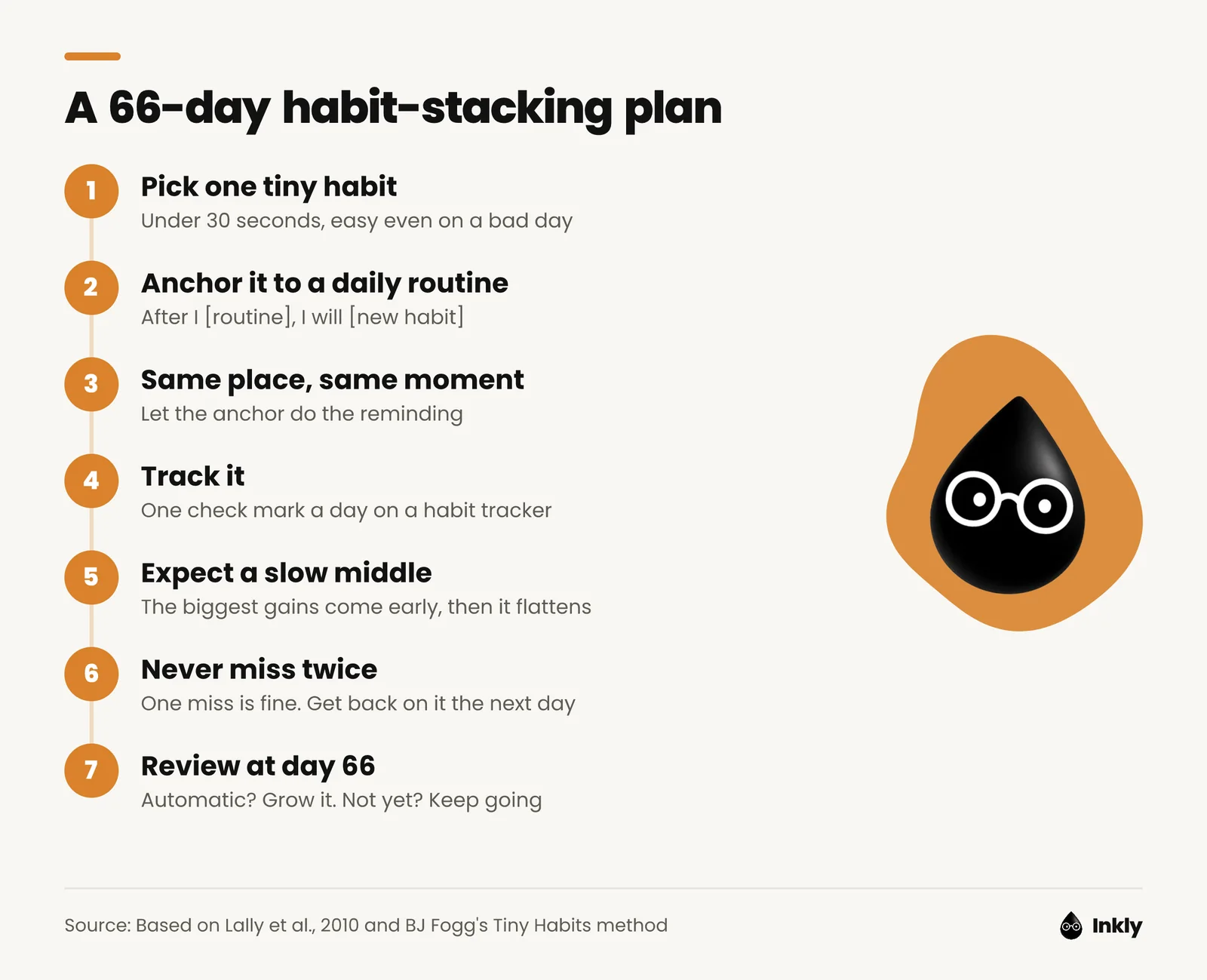
- Pick one tiny habit. Fogg defines a tiny habit as something you do at least once a day that takes less than 30 seconds and little effort. One page, not one chapter. You can grow it later.
- Anchor it. Write your recipe ("After I..., I will...") and stick it where you'll see it at the anchor moment.
- Same place, same moment, every day. Repetition in a stable context is what builds the habit. In the 2023 gym data, 69% of members were more likely to go on the same weekdays they had gone before.
- Track it. A 2016 meta-analysis of 138 studies (19,951 people) found that monitoring progress helped people reach their goals, and helped more when the progress was physically recorded. Our free printable monthly habit tracker gives you one box per day.
- Expect a slow middle. In Lally's data, the first repetitions gave the biggest jumps in automaticity, then each day added less. So a few weeks in, the novelty has worn off and the habit still doesn't feel automatic. That's the normal shape of the curve, not a sign of failure.
- Don't panic about one missed day. One miss didn't undo progress in Lally's study. Just don't miss two in a row.
- Review at day 66. Do you do it without thinking? Would skipping it feel weird? If yes, grow it (one page becomes ten) or stack the next habit on top. If not, keep going. Plenty of Lally's volunteers needed longer, and exercise habits often take months.
How long does it take to break a habit?
Nobody has a reliable number, so be suspicious of anyone who offers one. The studies above timed habits being built, not old ones fading. The research does show how to make breaking one easier.
- Change the cues. In a 2005 study by Wendy Wood and colleagues, students who transferred to a new university kept their exercise, newspaper and TV habits only when the context stayed similar, like still reading the paper with other people. Otherwise the habit broke down and their current intentions took over.
- Use big life changes. In a field experiment with 800 people, an intervention promoting greener habits worked better for people who had recently moved house (Verplanken & Roy, 2016). The window was about three months after the move.
- Add friction. At a cafeteria salad bar, moving a food about 10 inches farther away or swapping the spoon for tongs cut how much people took by roughly 8 to 16% (Rozin et al., 2011).
- Plan a replacement. In experiments by Adriaanse and colleagues, if-then plans that named a replacement ("If I reach for my phone in bed, I will open my book instead") took away the old habit's head start. The catch is that behavior only changed as much as people actually wanted the alternative.
James Clear's version is to flip his four laws of behavior change and make the bad habit invisible, unattractive, difficult and unsatisfying.
Our take: breaking a habit usually means building a new one in the same spot, so expect a similar timeline. Weeks for a simple swap, months for something complex.
Does a habit tracker help?
Yes, if you actually use it, which is the whole trick. Recording progress has good evidence behind it (see step 4), and paper works fine. Our free habit tracker PDF fits up to 10 habits on one page. Prefer your phone? We compared the options in our guide to the best self-improvement apps.
If the habit you're building is learning itself, that's what we made Inkly for. Inkly is our app, so weigh this accordingly. It's an iPhone app that works like Duolingo for personal growth: short daily lessons from non-fiction books, a quick quiz, a daily learning streak and a growth map, all in a few minutes a day. It's free to download on the App Store, though the daily lessons need an Inkly Unlimited subscription.
FAQ
Is it 21 or 66 days to form a habit?
Neither is a rule. The 21 days comes from Maxwell Maltz's 1960 book Psycho-Cybernetics, which was about how long people take to adjust to a changed self-image, not how long habits take to form. The 66 days is the median from Lally et al. (2010), where individual times ranged from 18 to 254 days. Plan on about two months for a simple daily habit and longer for exercise.
What happens if I miss a day?
Almost nothing. In Lally's study, a single missed day caused a tiny, temporary dip in how automatic the habit felt, with no lasting cost. Longer gaps are a different story, so get back to it the next day and avoid missing twice in a row.
How long does it take to break a bad habit?
There's no reliable number, because studies have measured building habits, not losing them. What helps is changing the cues around the habit, adding friction and planning a replacement behavior. Since breaking a habit often means building a new one in its place, a fair guess is weeks for simple swaps and months for complex ones.
What is habit stacking?
Habit stacking means linking a new habit to one you already do every day, using the formula "After I [current habit], I will [new habit]." BJ Fogg developed the method as part of Tiny Habits, and James Clear popularized the name in Atomic Habits. Example: "After I pour my coffee, I will read one page."
What are the 4 laws of behavior change?
They're James Clear's framework from Atomic Habits: make it obvious, make it attractive, make it easy and make it satisfying. To break a bad habit, he inverts them: make it invisible, unattractive, difficult and unsatisfying.
Why do some habits take longer to form than others?
Complexity and frequency seem to matter most. In Lally's small study, exercise habits took a median of 91 days versus 59 for drinking habits. In the 2023 PNAS study, gym habits took months while hospital handwashing took weeks. Simple behaviors you repeat often, in the same context, become automatic faster.