Below is the How to Win Friends and Influence People summary in plain English: the four parts, the principles that matter most, the honest criticism (it's been called manipulative since the 1930s), and a one-week way to practice. If you only have a minute, the next section is the whole book.
We wrote this from the publisher's and Dale Carnegie company's pages, library records of the book's editions, Britannica and published criticism. The principle wording comes from the Dale Carnegie company's own list, which may differ slightly from your printed edition; the rest is our paraphrase.
How to Win Friends and Influence People summary in one minute
How to Win Friends and Influence People says you change how people treat you by changing how you treat them. The book in five lines:
- Stop criticizing. Criticism makes people defensive and almost never changes them. Appreciation does more.
- Be interested, not interesting. Ask about people, remember their names, listen, and talk about what matters to them.
- Don't try to win arguments. You lose the person even when you win the point. Respect their view, admit when you're wrong, and let them arrive at the idea.
- Correct people kindly. Start with praise, mention your own mistakes first, ask instead of ordering, and let them save face.
- Mean it. Carnegie insists on sincerity throughout. Flattery without it, he says, is easy to spot.
What is How to Win Friends and Influence People about?
How to Win Friends and Influence People is a self-help book by Dale Carnegie, first published in 1936 by Simon & Schuster. It grew out of the public-speaking and human-relations classes Carnegie had taught since 1912, after Leon Shimkin of Simon & Schuster took one of his courses and talked him into a book, according to Britannica. Britannica says it has sold more than 30 million copies.
Carnegie (1888-1955) was born Dale Carnagey on a Missouri farm and worked as a salesman before he started teaching. The book has been revised twice:
| Edition | What changed |
|---|---|
| 1936 original | Six parts, including advice on business letters and a section on a happy home life |
| 1981 revision | Edited with Dorothy Carnegie and Arthur R. Pell; cut to four parts, with updated language and examples |
| 2022 edition | Supervised by his daughter, Donna Dale Carnegie, with material restored from the 1936 text; about 320 pages (Simon & Schuster) |
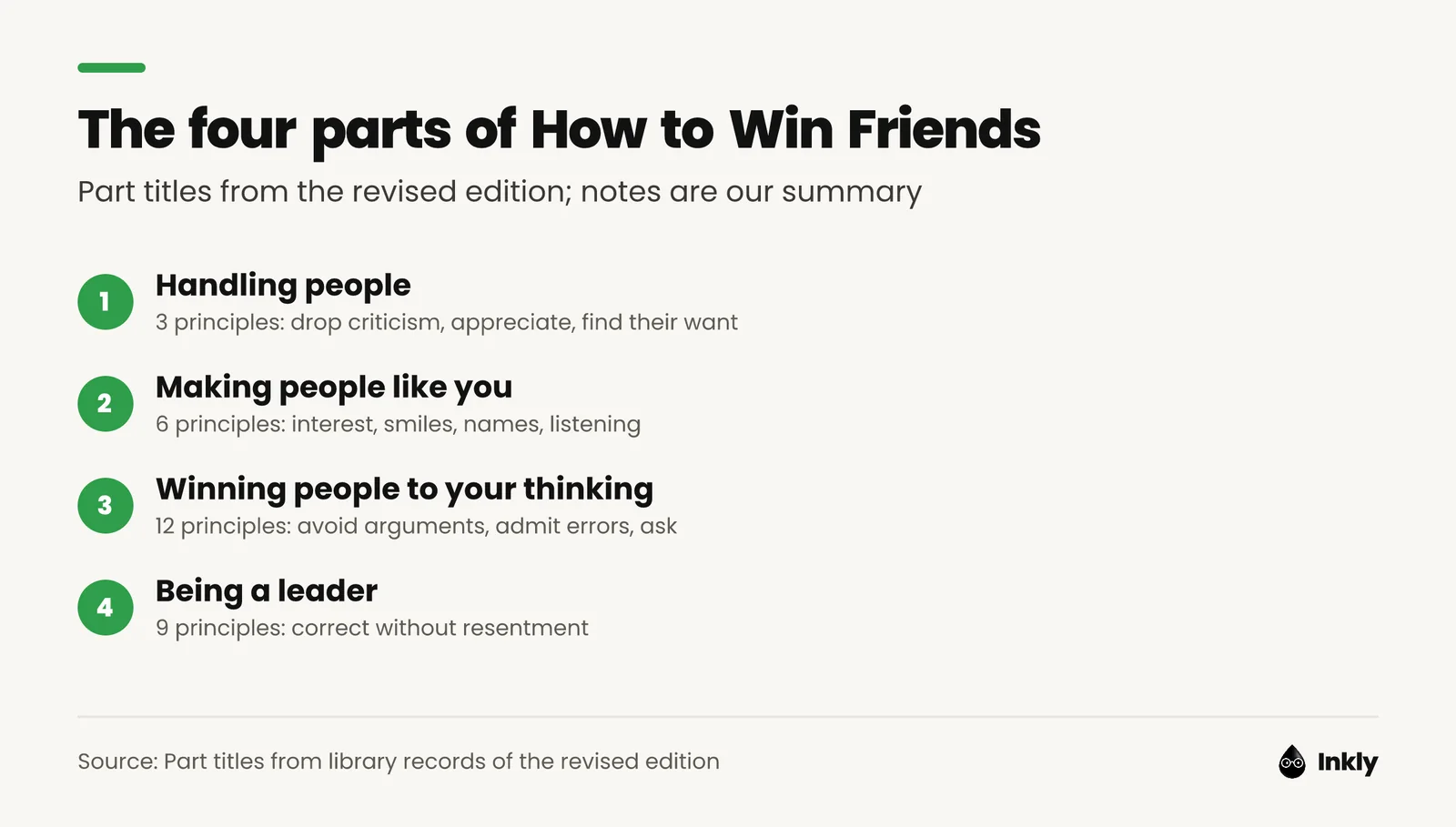
The version most people read has four parts and 30 principles. You'll find all 30 on the Dale Carnegie company's site, which sells training based on the book.
Why does Carnegie say never to criticize?
Carnegie says criticism doesn't work because it puts people on the defensive and makes them justify themselves instead of changing. That's the whole of Part One: don't criticize, condemn or complain; give honest, sincere appreciation; and get people to want what you're asking for.
The third idea is the most useful. Carnegie's "arouse in the other person an eager want" means framing a request around what the other person cares about. "Please clean your room" is your want. "Want to have friends over this weekend?" is theirs.
Try it today: go one full day without criticizing anyone out loud. Notice how often you nearly do.
How do you make people like you, according to Carnegie?
You make people like you, Carnegie says, by being more interested in them than in impressing them. Part Two's six principles are the most quoted in the book: become genuinely interested in other people, smile, remember names, be a good listener, talk in terms of the other person's interests, and make the other person feel important, sincerely.
None of these is a trick. They're the opposite of what most of us do when nervous, which is to talk about ourselves. Carnegie's point about names holds up in everyday life: forgetting a name tells someone they didn't register, and using it tells them they did.
Try it today: in your next conversation, ask two follow-up questions before you tell any story of your own.
How do you win people to your way of thinking?
You win people to your way of thinking by avoiding the argument, not winning it. Part Three is the longest, with twelve principles, and it starts with Carnegie's claim that the only way to get the best of an argument is to avoid it. Even if you win on the facts, the other person feels beaten and digs in.
The other principles are about lowering the temperature. Show respect for the other person's opinion and never tell them flat out that they're wrong. If you're wrong, admit it quickly. Start friendly. Get early agreement on small points. Let the other person do most of the talking, and let them feel the idea is theirs. Try honestly to see things their way.
In our view, this part has aged best.
Try it today: the next time you disagree with someone, ask "how did you get to that?" before you argue your side.
How does Carnegie say to change people without resentment?
Carnegie says to change people by correcting them in a way that protects their pride. Part Four, "Be a Leader," has nine principles for managers, parents and anyone who has to give feedback. Begin with praise and honest appreciation. Point out mistakes indirectly. Talk about your own mistakes first. Ask questions instead of giving orders. Let the other person save face. Praise every improvement, however small. Give them a reputation to live up to. Make the fault seem easy to fix. And make them happy to do what you suggest.
If you manage people, this is the part to reread once a year.
Try it today: turn one instruction into a question. "Could we try it this way?" lands better than "do it this way."
What does How to Win Friends and Influence People get wrong?
How to Win Friends and Influence People is strongest as practical advice on everyday courtesy and weakest when its techniques are used without the sincerity it asks for. The main criticisms:
- It can read as manipulation. Critics have said so since the start. Sinclair Lewis mocked it within a year as a guide to faking interest in people to get something from them, and the historian Gail Thain Parker examined Carnegie's "problem of sincerity" in a 1977 American Quarterly article. Carnegie's own principles keep saying "honest" and "sincere"; the risk is in readers who skip those words.
- It isn't science. Britannica's verdict is that the book revealed little that was unknown about human psychology. What it adds is the reminder that attitude decides how people respond to you.
- Parts are dated. The 1936 book included rules for a happy marriage and a section on business letters, both cut in 1981. Older copies also say "the other man" where newer ones say "the other person." Check which edition you have.
Is How to Win Friends and Influence People worth reading?
Yes, How to Win Friends and Influence People is worth reading if you feel awkward with people, argue more than you'd like, or have started managing others. It's short and story-driven, and our reading time calculator tells you how long it'll take at your speed.
Skip it if you want research on social psychology, or if you already do the basics well and want depth. The book's ideas are simple; its value is in the many stories that make them stick.
Is a summary enough? For the principles, yes. To change habits, you need practice, and the book's stories help you remember to do it. A one-page book notes template is a good place to write down the three principles you most need.
How do you practice Carnegie's principles?
You practice Carnegie's principles one at a time, in ordinary conversations, rather than trying all 30 at once. Here's a one-week start:
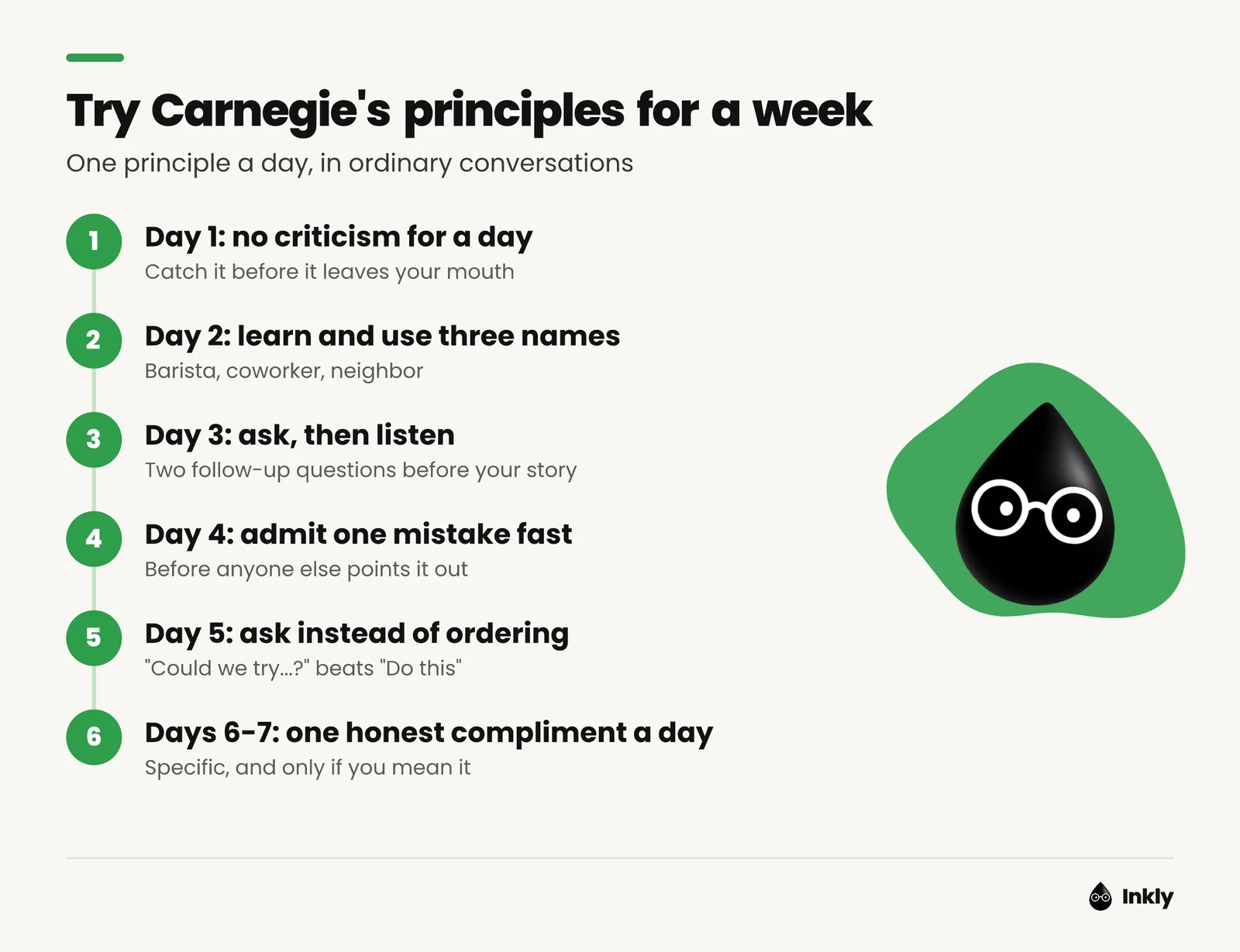
- Day 1: no criticism, condemning or complaining, out loud, for a full day.
- Day 2: learn and use the names of three people you usually don't name.
- Day 3: in every conversation, ask a follow-up question before talking about yourself.
- Day 4: admit one mistake quickly, before anyone points it out.
- Day 5: turn your requests into questions.
- Days 6-7: give one specific, honest compliment a day.
Then pick the principle that felt hardest and repeat it for a month. Building any habit takes longer than a week; our guide on how long it takes to form a habit shows why.
What should you read after How to Win Friends and Influence People?
If Carnegie clicked, our Atomic Habits summary shows how to turn one principle into a daily habit, and our Four Agreements summary covers the inner side: not taking things personally and not making assumptions. For a darker, very different take on influence, see our 48 Laws of Power summary. Quiet by Susan Cain, from our list of the best self-improvement books, is the companion for introverts.
One more option, and it's ours: Inkly is our app, so weigh this accordingly. It turns big ideas from non-fiction books into short daily lessons with a quick quiz after each one, plus a chat to turn an idea into something you'll actually do. It's iPhone only and free to download; the daily lessons need a subscription.
FAQ
What is the main idea of How to Win Friends and Influence People?
The main idea is that you change how people respond to you by changing how you treat them. Dale Carnegie says to stop criticizing, show sincere interest and appreciation, avoid arguments, and correct people in a way that protects their pride. The book sets out 30 principles across four parts.
What are the six ways to make people like you?
Carnegie's six ways to make people like you are: become genuinely interested in other people, smile, remember people's names, be a good listener and encourage others to talk about themselves, talk in terms of the other person's interests, and make the other person feel important, sincerely. They form Part Two of the book.
Is How to Win Friends and Influence People manipulative?
How to Win Friends and Influence People has been called manipulative since the 1930s, because its techniques can be used to flatter people for gain. Carnegie's own principles insist on honest, sincere appreciation and real interest in others. Used that way, they're ordinary courtesy; used cynically, people tend to notice.
Is How to Win Friends and Influence People still relevant?
Yes, most of it is still relevant, especially the advice on listening, avoiding arguments and giving feedback. Some examples and language are dated, and the 1936 sections on marriage and business letters were cut in 1981. The 2022 edition, supervised by Carnegie's daughter, is the current one from Simon & Schuster.
How many principles are in How to Win Friends and Influence People?
The revised edition has 30 principles in four parts: 3 on handling people, 6 on making people like you, 12 on winning people to your way of thinking, and 9 on leading people without resentment. The Dale Carnegie company lists all 30 on its website.
When was How to Win Friends and Influence People published?
How to Win Friends and Influence People was first published in 1936 by Simon & Schuster. It was revised in 1981, cutting the book from six parts to four, and updated again in 2022 under the care of Carnegie's daughter, Donna Dale Carnegie.