Below is the Atomic Habits summary in plain English: the big ideas, the four laws with an example of each, what habit research says about the claims, where the book oversells, and a one-week plan to try it. If you only have a minute, the next section is the whole book.
We wrote this from the publisher's excerpt, James Clear's own site (which publishes parts of the book), the book's catalog record and the published research. Short quotes are the book's wording; the rest is our paraphrase.
Atomic Habits summary in one minute
Atomic Habits says that small habits, repeated daily, decide your results, and that good habits come from a good system rather than willpower. The book in six lines:
- Tiny changes compound. Getting 1% better each day sounds like nothing, but it adds up. Clear calls habits "the compound interest of self-improvement."
- Systems beat goals. Winners and losers often share the same goals. What differs is the daily process.
- Start with identity. Decide who you want to be ("a runner"), then prove it with small wins. Each repetition is evidence.
- Every habit runs on a loop: cue, craving, response, reward.
- Four laws hack the loop: make it obvious, attractive, easy and satisfying. To break a habit, flip them.
- Expect a slow start. Results often show up long after the effort, so judge your direction, not today's numbers.
What is Atomic Habits about?
Atomic Habits: An Easy & Proven Way to Build Good Habits & Break Bad Ones is a self-help book by James Clear, published in October 2018 by Avery, an imprint of Penguin Random House. It runs about 320 pages. The author's site says it has sold over 30 million copies and been translated into more than 60 languages.
Clear is a writer, not a scientist. He played baseball at Denison University and began publishing articles on habits at jamesclear.com in 2012. The book pulls together ideas from psychology and behavior research, with stories from sport, business and medicine.
It has 20 chapters in six sections: the fundamentals, one section for each of the four laws, and "advanced tactics" on talent, motivation and the downside of habits.
Why does Clear say systems beat goals?
Clear says systems beat goals because the goal doesn't separate the winners from the losers: everyone in a race wants to win. What makes the difference is the process you repeat every day. His shortest version: "You fall to the level of your systems."
He lists four problems with goals. Losers often share the winners' goals. Hitting a goal is a single moment, after which many people drift back. Goals push happiness into the future ("I'll be happy when..."). And finishing the goal removes the reason to keep going. He doesn't throw goals out: they set the direction, and the system does the work.
The famous 1% line belongs here. If you got 1% better every day for a year, the math works out to about 37 times better (1.01 to the 365th power is 37.78). That's arithmetic, not a research finding. Real progress isn't a steady 1% a day, and Clear presents it as a thought experiment. The point survives: small changes look like nothing until they don't.
Try it today: take one goal you have and write the system under it. "Run a half marathon" becomes "run three times a week, before work."
What are identity-based habits?
Identity-based habits start with who you want to become, not what you want to achieve. Clear describes three layers of change: outcomes (what you get), processes (what you do) and identity (what you believe about yourself). Most people start at the outside; he says lasting change starts at the center.
The method has two steps. Decide the type of person you want to be, then prove it to yourself with small wins. Clear's framing is that every action is a vote for that identity. You don't need a unanimous vote, only a majority.
Try it today: finish the sentence "I'm the kind of person who..." for one habit, then do the smallest action that fits it.
What are the four laws of behavior change?
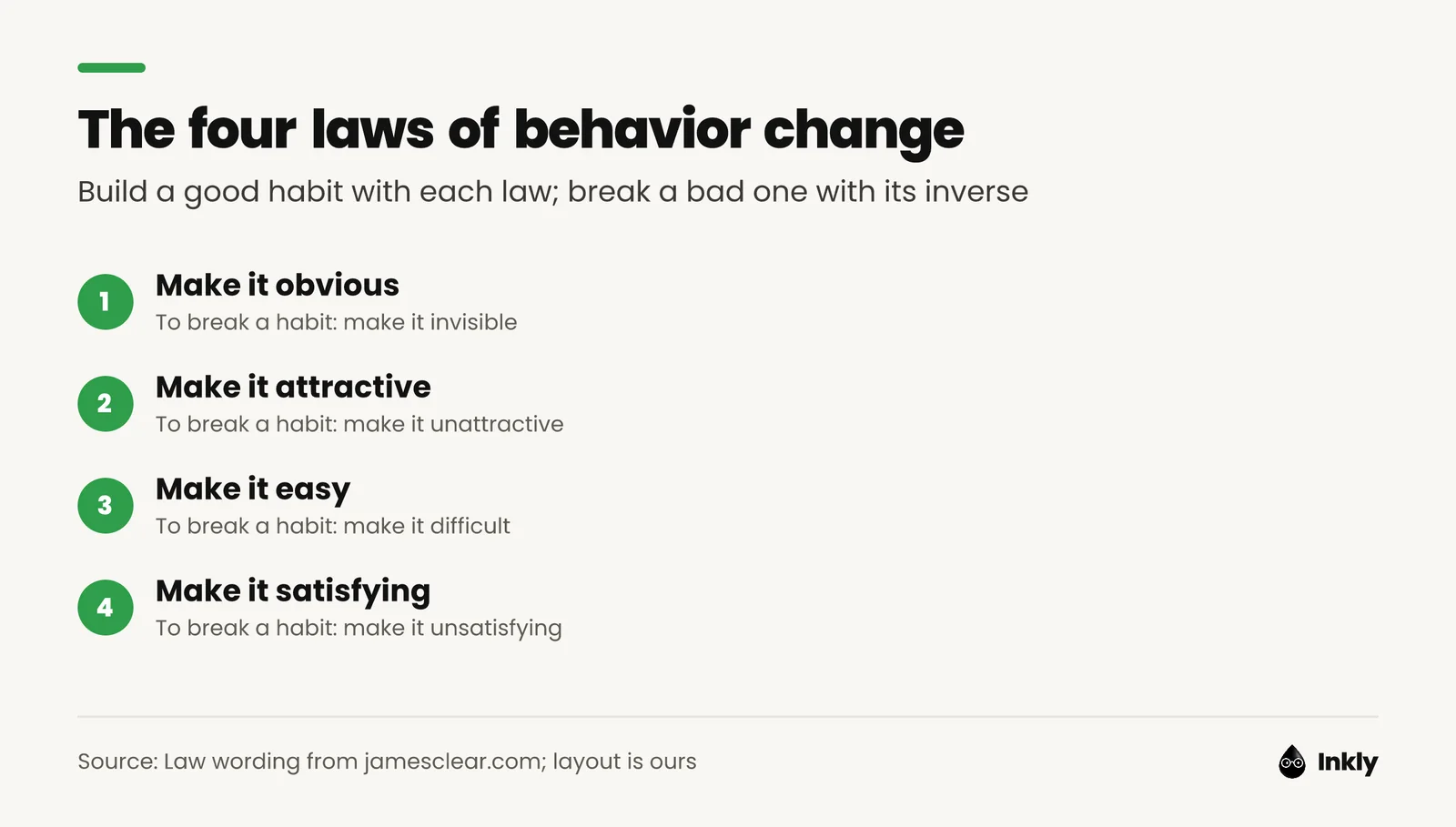
The four laws of behavior change are Clear's rules for each step of the habit loop: make it obvious (the cue), make it attractive (the craving), make it easy (the response) and make it satisfying (the reward). To break a bad habit, you invert each one: make it invisible, unattractive, difficult and unsatisfying. Here is each law with the idea Clear is best known for.
Law 1: make it obvious
The first law says a habit needs a clear cue. Clear's two favorite tools:
- Habit stacking: attach a new habit to one you already do. "After I pour my coffee, I'll read one page." Clear credits BJ Fogg for the idea. It's a form of what psychologists call an implementation intention, and a 2006 meta-analysis by Gollwitzer and Sheeran found these if-then plans had a medium-to-large effect on reaching goals across 94 tests.
- Environment design: change your space so the cue is hard to miss and the temptation is out of sight. Clear titles a whole chapter "Motivation Is Overrated: Environment Often Matters More."
Law 2: make it attractive
The second law says we act when we expect a reward. Pair something you need to do with something you want to do (Clear calls it temptation bundling), and spend time with people for whom your new habit is normal. Habits spread through the groups we belong to.
Law 3: make it easy
The third law is the most practical: reduce the friction. Its best-known tool is the two-minute rule: when you start a new habit, it should take less than two minutes. "Read before bed" becomes "read one page." The aim is to master showing up; you can scale up later.
Law 4: make it satisfying
The fourth law says behavior that feels good right away gets repeated. Good habits often pay off late, so you add an immediate reward. Clear's favorite is a habit tracker: an X on a calendar for each day you do it. A 2016 meta-analysis by Harkin and colleagues found that monitoring progress helped people reach their goals, more so when they physically recorded it. Our free monthly habit tracker is made for this.
Clear's rule for when you slip: one miss is an accident, two in a row is the start of a new pattern. Get back on the next day.
What does the research say about Atomic Habits?
Most of Atomic Habits rests on well-established habit research, but the book is a guide for general readers, not a research paper, and some of its numbers are illustrations. Three checks:
- Habits take time. The best-known study, Lally and colleagues (2010), followed 96 volunteers and found a median of 66 days for a simple daily habit to feel automatic, with a range of 18 to 254 days. Our guide on how long it takes to form a habit explains the study and its limits.
- Missing one day is fine. In the same study, missing a single opportunity didn't materially hurt habit formation, which supports Clear's "don't miss twice" advice.
- Cues drive habits. Habit researchers such as Wood and Neal (2007) describe habits as responses triggered by context, which fits Clear's focus on cues and environment.
What does Atomic Habits get wrong?
Atomic Habits is strongest as a clear, usable toolkit and weakest as anything new or as a guide for every kind of goal. Three honest criticisms:
- Much of it is renamed. In The Guardian, Steven Phillips-Horst argued that the book mostly gives new labels to ideas that already existed. The habit loop builds on Charles Duhigg's The Power of Habit, and habit stacking comes from BJ Fogg.
- The numbers are illustrations. The 37x figure is a math exercise, and the British cycling story Clear tells is a single success, not proof that marginal gains work everywhere.
- It can feel joyless. Writing in Slate, Laura Miller called the core advice solid but found the book's vision of constant self-optimization dispiriting, and noted that not every goal fits into tiny daily increments.
None of this makes the advice wrong. It means you can get most of the value from a good summary and a week of practice.
Is Atomic Habits worth reading?
Yes, Atomic Habits is worth reading if you keep starting habits and dropping them, and you want a step-by-step system rather than motivation. At about 320 pages it's a quick read for its size; our reading time calculator gives you an estimate at your own speed.
Skip it if you've already read The Power of Habit or Tiny Habits, since the ground overlaps, or if you want the research itself. And if self-optimization talk wears you out, a book like Four Thousand Weeks from our list of the best self-improvement books is the antidote.
Is a summary enough? For the four laws, mostly yes. The book's extra value is in its examples, which help the ideas stick.
How do you use Atomic Habits in real life?
You use Atomic Habits by picking one habit, scaling it down to two minutes, and building the four laws around it. Here's a one-week start:
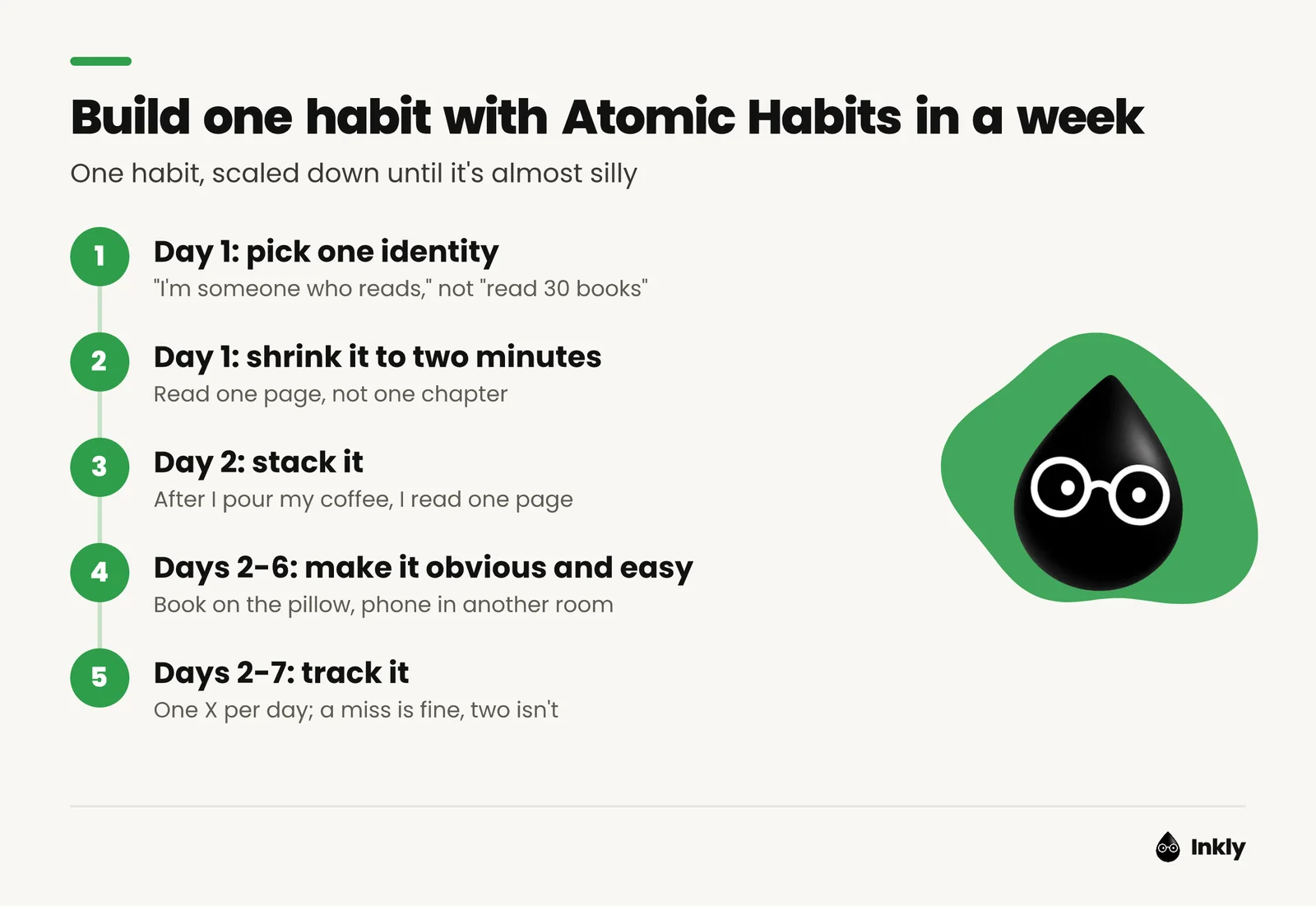
- Day 1: pick one identity ("I'm a reader") and shrink the habit to two minutes ("read one page").
- Day 2: stack it on something you already do every day.
- Days 2-6: make the cue obvious (book on your pillow) and the competing habit harder (phone charging in the kitchen).
- Days 2-7: mark an X for every day you do it. If you miss one, don't miss the next.
- Day 7: if it felt easy, add a little. If it didn't, shrink it more.
What should you read after Atomic Habits?
If Atomic Habits clicked, try our Four Agreements summary for the inner-voice side of change, and our How to Win Friends and Influence People summary for habits with other people. For more ways to make ideas stick, see how to remember what you read.
One more option, and it's ours: Inkly is our app, so weigh this accordingly. It works like Duolingo for personal growth, with streaks, short daily lessons from non-fiction books like this one, and a quick quiz after each. It's iPhone only and free to download; the daily lessons need a subscription.
FAQ
What are the four laws of Atomic Habits?
The four laws of Atomic Habits are make it obvious, make it attractive, make it easy and make it satisfying. Each targets one step of the habit loop: cue, craving, response and reward. To break a bad habit, James Clear says to invert them: make it invisible, unattractive, difficult and unsatisfying.
What is the main idea of Atomic Habits?
The main idea of Atomic Habits is that small habits, repeated consistently, add up to big results, and that you get there by fixing your system rather than relying on willpower. Clear adds that lasting change starts with identity: you build habits that prove you're the person you want to become.
What is the 1% rule in Atomic Habits?
The 1% rule is James Clear's illustration that getting 1% better every day for a year leaves you about 37 times better, because gains compound. It's a math example, not a research result. The practical lesson is that small, steady improvements matter more than occasional big efforts.
What is the two-minute rule?
The two-minute rule says a new habit should take less than two minutes when you start it. "Run three miles" becomes "put on your running shoes," and "read before bed" becomes "read one page." Clear's point is to make starting automatic first and to scale up once showing up is easy.
How long does it take to form a habit?
The best-known study, by Lally and colleagues in 2010, found a median of 66 days for a simple daily habit to feel automatic, with a range of 18 to 254 days. Missing a single day didn't materially set people back. That fits Atomic Habits' advice to focus on showing up, not on a deadline.
Is Atomic Habits worth reading?
Atomic Habits is worth reading if you want a practical, step-by-step system for building habits, and it's one of the clearest books on the topic. Skip it if you've read The Power of Habit or Tiny Habits, since much of the ground overlaps, or if you want research rather than a guide.