This is The Charisma Myth summary in plain English: the three parts of charisma, the four styles, the inner obstacles and their fixes, what the research backs up, and a one-week practice plan. If you only searched the book's title, the next section is the whole book in one minute.
We wrote it from the publisher's page, the author's site (including the sample chapter and exercise list she posts there), her interviews from 2012, library records of the contents and the studies linked below. It's our paraphrase unless a line is in quotation marks. It follows the original 2012 edition, not the 2026 revision.
The Charisma Myth summary in one minute
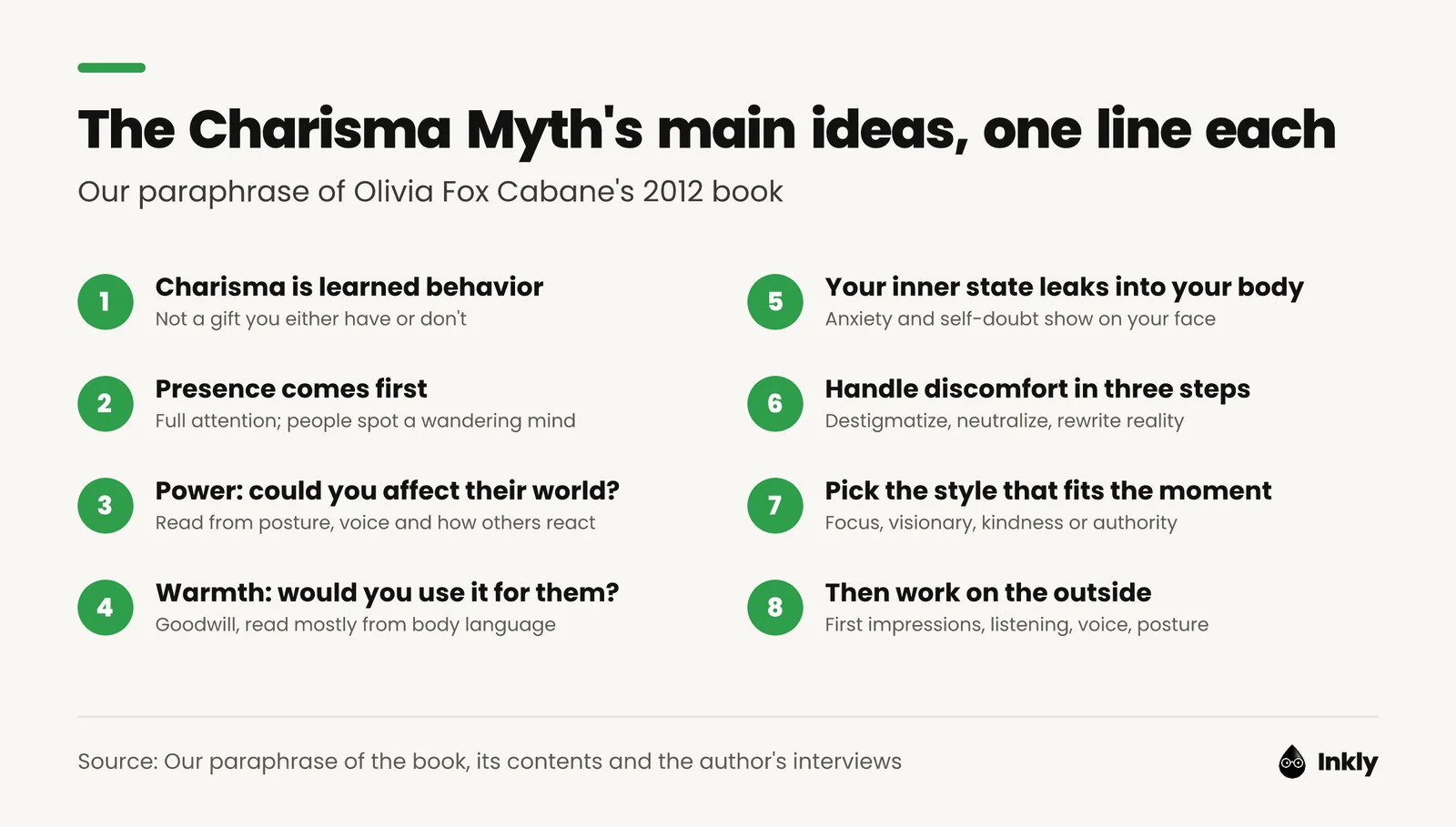
The Charisma Myth says charisma is a set of behaviors anyone can learn, and that most of the work happens inside your head. The book in six lines:
- Charisma isn't innate. The "myth" of the title is that you're born with it or you aren't. Cabane says it comes from specific behaviors you can practice.
- It has three parts. Presence (you're fully with the other person), power (you seem able to affect the world) and warmth (you seem to wish them well).
- Your body shows what your mind is doing. Anxiety, irritation and self-doubt leak into your face and voice, and people read them in a split second. You can't fake presence for long.
- So fix the inside first. Notice physical and mental discomfort, then destigmatize it, neutralize negative thoughts and rewrite how you see the situation.
- Choose a style. Focus, visionary, kindness and authority charisma each mix the three parts differently and suit different moments.
- Then polish the outside. First impressions, listening, voice, body language, presentations and hard conversations each get their own chapter.
What is The Charisma Myth about?
The Charisma Myth: How Anyone Can Master the Art and Science of Personal Magnetism is a self-help book by Olivia Fox Cabane, published by Portfolio, a Penguin imprint, in 2012. Penguin Random House sells the US paperback (2013, 320 pages) and describes the book as techniques Cabane first developed for Harvard and MIT, broken down into charisma's components.
Cabane is an executive coach who, per the publisher, has lectured at Stanford, Yale, Harvard, MIT and the United Nations. Her book site adds that she was Director of Innovative Leadership for Stanford StartX. In a 2012 interview with Bob Morris, she said she was a socially awkward introvert in her late teens and started studying how people connect out of necessity.
The original edition has 13 chapters, which fall into four blocks:
| Chapters | What they cover |
|---|---|
| 1-2 | What charisma is, and its three behaviors: presence, power and warmth |
| 3-5 | The inner obstacles, how to overcome them, and how to create charismatic mental states |
| 6 | The four charisma styles |
| 7-13 | First impressions, speaking and listening, body language, difficult situations, presenting, crises, and charisma in everyday life |
Chapter list from library records of the 2012 hardcover. The back of the book has chapter summaries and a collected list of exercises. The 2026 revised edition, published by Penguin in the UK, adds two chapters, on neurodivergence and on charisma online (Penguin UK).
What are presence, power and warmth?
Presence, power and warmth are the three behaviors Cabane says charisma is made of. Presence is full attention on the person in front of you. Power is the impression that you can affect the world around you. Warmth is the impression that you'd use that power in the other person's favor.
Her explanation is evolutionary. When we meet someone, we size them up fast: are they a friend or a foe, and could they act on it? Warmth answers the first question and power answers the second. A charismatic person seems to have a lot of power and to like you a lot. Cabane put it plainly in the Morris interview: "Warmth, simply put, is goodwill toward others."
Presence is the foundation. When your mind drifts mid-conversation, your face reacts a fraction of a second late, and Cabane says people notice. The other two need each other: warmth without power can look eager to please, and too much power without warmth can look arrogant or intimidating.
Try it today: set a timer for one minute and focus on one thing: the sounds around you, your breath, or the feeling in your toes. That's the book's basic presence drill.
What are the four charisma styles?
The four charisma styles in The Charisma Myth are focus, visionary, kindness and authority. Each leans on a different mix of presence, power and warmth, and Cabane described all four in her Morris interview:
| Style | Built mostly on | How it makes people feel | Cabane's example |
|---|---|---|---|
| Focus | Presence | Heard, listened to and understood | Elon Musk (her 2012 pick) |
| Visionary | Belief and confidence | Inspired, even if they don't like you | Steve Jobs |
| Kindness | Warmth | Welcomed and completely accepted | The Dalai Lama |
| Authority | Power | That you can change their world | Colin Powell |
Focus charisma is the one introverts tend to underrate. Cabane told Morris that introversion can be an asset for it, because you don't need the spotlight to make someone feel heard.
No style is free. Cabane is frank that authority charisma is possibly the strongest but can stop people from thinking critically, discourage the feedback you need, and look arrogant. Kindness charisma can draw people who get too attached. She says leaders should know which style comes naturally to them and what each one costs.
Try it today: pick your next important conversation and decide which style fits it. Giving bad news is not the moment for authority.
What holds charisma back, according to Cabane?
Cabane says the main things holding charisma back are internal: discomfort you feel, which then shows on your face. She splits it in two.
- Physical discomfort. Clothes that are too tight, a room that's too hot, the sun in your eyes. The other person can't see the cause, only the tension, and may misread it. Her fix is boring and useful: plan ahead, arrive early, and choose your seat.
- Mental discomfort. Summaries of the book's chapter 3 list four kinds: anxiety from uncertainty, dissatisfaction from comparing yourself with others, self-criticism and self-doubt. Cabane calls self-doubt the biggest inhibitor and spends a lot of time on impostor syndrome, which she says is worst among high performers.
The point: you can learn every body-language trick and still look uncharismatic if you walk in anxious.
Try it today: before your next meeting, fix one physical thing: loosen a collar, move out of the glare, or grab water.
How does The Charisma Myth say to handle anxiety and self-doubt?
The Charisma Myth handles anxiety and self-doubt with a three-step process: destigmatize the feeling, neutralize negative thoughts, and rewrite reality. The exercise list on the author's bonus content page spells each one out.
- Destigmatize. Remind yourself the feeling is normal, that people you admire have felt it, and that many people feel it right now. Cabane pairs this with dedramatizing: these are just physical sensations, and nothing serious is happening this minute.
- Neutralize. Treat negative thoughts as possibly wrong. Picture them as graffiti on a wall or a radio you can turn down, or observe them like a scientist ("how interesting, self-critical thoughts").
- Rewrite reality. Ask yourself what would make this experience a good thing for you, or write the version where it goes well, by hand.
For uncertainty and comparison, her signature tool is the responsibility transfer: close your eyes, breathe, and imagine lifting everything you're worried about off your shoulders and handing it to any benevolent force you choose. The outcome is now taken care of, so you can relax into the moment. It sounds odd. Try it before you judge it; it takes two minutes.
Try it today: do a two-minute responsibility transfer the night before something you're dreading.
How do you get into a charismatic state?
You get into a charismatic state, Cabane says, by using your imagination, because your body responds to vividly imagined scenes much as it does to real ones. Her main tool is visualization with all five senses: before a big moment, replay a time you felt confident, down to the sounds, faces and the feeling of your feet on the floor.
The book also gives tools for warmth: gratitude (find three small things to appreciate right now), compassion (imagine the other person's past and present), self-compassion, and a loving-kindness meditation called metta. She also suggests planning the hours before an important event so you arrive in the right mood, down to a playlist for confidence and another for warmth.
Try it today: spend 60 seconds before your next call replaying one moment you felt sure of yourself.
What does The Charisma Myth say about body language and first impressions?
The Charisma Myth says people judge you within seconds, and that body language, voice and listening shape those judgments more than your words. The book's second half is practical:
- Dress for the tribe. People trust people like them, so match the setting, then pick the upper end of what's normal there.
- Shake hands properly. Hand vertical, full palm contact, firmness matched to theirs.
- Listen like you mean it. Never interrupt. Let your face react to what they said, then pause about two seconds before you answer.
- Sound powerful. Speak slowly, pause, and let your voice drop at the end of statements instead of rising like a question.
- Cut the reassurance. Constant nodding and "uh-huh" read as low status; use them on purpose when you want a shy person to open up.
- Sit at an angle. Next to someone or at 90 degrees feels more comfortable than directly across a table.
Try it today: in your next meeting, end each statement on a lower note. Notice how much less you need to say.
What does The Charisma Myth get wrong?
The Charisma Myth is right that charisma can be learned, but the research behind its specific methods is thinner than the subtitle's "science" suggests. Three honest caveats:
- Its science is mostly about first impressions, not its exercises. The first-impressions chapter leans on "thin slice" research like the Harvard study of silent teacher clips (Ambady and Rosenthal, 1993, Journal of Personality and Social Psychology): strangers' ratings of clips under 30 seconds, of 13 teaching fellows, predicted end-of-semester student ratings. That shows people judge fast. It doesn't test whether visualization or the responsibility transfer change those judgments, and we found no study that does. Some body-language advice has aged too: the "big gorilla" exercise of taking up space echoes the famous power-posing study (Carney, Cuddy and Yap, 2010, 42 people), whose hormone effects didn't show up in a replication with 200 people, though people still felt more powerful.
- The best training evidence tested something else. Antonakis, Fenley and Liechti (2011, Academy of Management Learning & Education) randomly assigned 34 Swiss managers to training or a control group; three months later, coworkers rated the trained managers as more charismatic. A second study of 41 MBA students, rated by 135 viewers, found similar gains. That supports the book's headline. But the training taught speaking tactics (metaphors, stories, contrasts, moral conviction, an animated voice and gestures), not inner states, and took about 30 hours for the managers and 80-90 for the students.
- More charisma isn't always better. In Vergauwe and colleagues (2018, Journal of Personality and Social Psychology), two samples of leaders (306 and 287) were rated most effective at moderate charisma, with highly charismatic leaders weaker on day-to-day operations. That study measured charismatic personality, not trained behavior, but it's a useful brake on the idea that more charisma is always better. Cabane does list the costs of authority charisma herself.
Is The Charisma Myth worth reading?
Yes, The Charisma Myth is worth reading if nerves, not lack of knowledge, are what make you come across badly: before interviews, presentations, or meetings with people who intimidate you. It's also a good fit for introverts, because its idea of charisma starts with attention, not with being loud. Check how long it'll take you with our reading time calculator.
Skip it if you want research you can rely on line by line; the Antonakis paper above is a better read for that. Skip it, too, if meditation-style exercises put you off. Even a positive review in Psychology Today noted that some exercises feel odd to try at first, and the responsibility transfer asks you to imagine handing your worries to a higher power.
Is a summary enough? For the model, yes: presence, power, warmth and four styles fit on an index card. The book earns its keep through the exercises, which only work if you do them. Copy the two or three you'll actually use onto a one-page book notes template.
How do you practice The Charisma Myth's techniques?
You practice The Charisma Myth's techniques one at a time, in low-stakes moments, before you need them in a high-stakes one. Here's a one-week start:
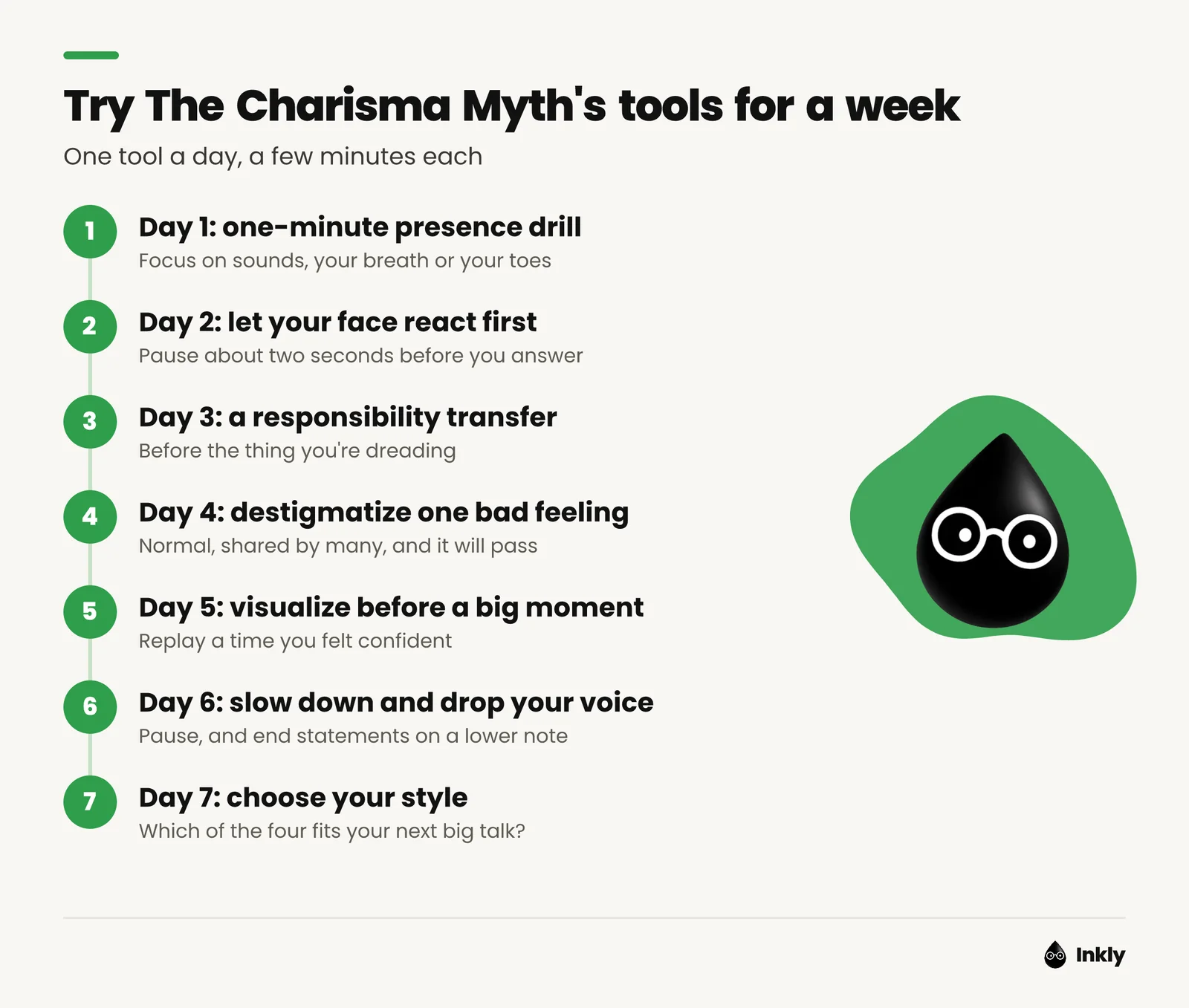
- Day 1: do the one-minute presence drill (sounds, breath or toes) twice.
- Day 2: in every conversation, let your face react, then wait about two seconds before you reply.
- Day 3: before something that worries you, do a responsibility transfer.
- Day 4: when a bad feeling shows up, destigmatize it: normal, shared by many, temporary.
- Day 5: before a call or meeting, visualize a time you felt confident, with all five senses.
- Day 6: speak more slowly, pause, and drop your voice at the end of statements.
- Day 7: look at your week ahead and pick the charisma style each big conversation needs.
Then keep the one tool that made the biggest difference. For research-backed habits that go beyond the book, see our guide on how to be more charismatic.
What should you read after The Charisma Myth?
If The Charisma Myth clicked, read Dale Carnegie next for the everyday side of warmth; our How to Win Friends and Influence People summary covers all 30 principles. Cabane's own reading list includes Robert Cialdini's Influence and Viktor Frankl's Man's Search for Meaning, which she recommends for perspective in a crisis (here's our Man's Search for Meaning summary). Our list of the best books on charisma sorts more picks by weak spot, the free book recommendation quiz picks three for you, and the best self-improvement books go wider.
One more option, and it's ours: Inkly is our app, so weigh this accordingly. Inkly turns ideas from well-known non-fiction into short daily lessons with a quick quiz after each one, and its growth map tracks six areas, one of which is Influence. It won't make you charismatic; that takes practice with real people. It's iPhone only and free to download; the daily lessons need an Inkly Unlimited subscription.
FAQ
What are the three elements of charisma in The Charisma Myth?
The three elements are presence, power and warmth. Presence is giving someone your full attention, power is seeming able to affect the world, and warmth is seeming to wish them well. Olivia Fox Cabane says charismatic people come across as both powerful and warm, with presence as the foundation.
What are the four types of charisma?
The Charisma Myth names four styles: focus charisma (based on presence; people feel heard), visionary charisma (people feel inspired), kindness charisma (based on warmth; people feel accepted) and authority charisma (based on power). Cabane says each suits different situations and each has costs.
Can charisma be learned?
Yes, at least partly. A 2011 study by John Antonakis and colleagues found that managers trained in charismatic speaking tactics were rated as more charismatic by coworkers three months later than untrained managers. The training took real time, about 30 hours, so expect weeks of practice, not a quick fix.
What is the responsibility transfer?
The responsibility transfer is a visualization from The Charisma Myth for anxiety about outcomes you can't control. You relax, breathe, and imagine handing everything you're worried about to a benevolent force of your choice, so the outcome feels taken care of. Cabane uses it to calm uncertainty and comparison before important moments.
Is The Charisma Myth based on science?
Partly. The Charisma Myth draws on real research on first impressions and nonverbal behavior, and a 2011 study backs its claim that charisma can be trained. We found no study testing its inner-state exercises, such as the responsibility transfer, as charisma training.
Is The Charisma Myth worth reading?
The Charisma Myth is worth reading if anxiety or self-doubt make you come across worse than you are, or if you're an introvert who assumed charisma wasn't for you. Skip it if you dislike meditation-style exercises or want rigorous research. The core model fits in a summary; the value of the book is in doing its exercises.