Most lists of charisma books are really lists of every social skills book ever printed. This one has 10, grouped by the problem each book fixes, and each entry says who should skip it. The numbers are just the order they appear in, not a ranking. A book about small talk can't beat a book about negotiation. They do different jobs.
We picked books that give you something to try in your next conversation, and we favored ones built on research or long professional practice. Where the science behind a book has wobbled, we say so. All bibliographic details come from the publishers' own pages.
What are the best books on charisma?
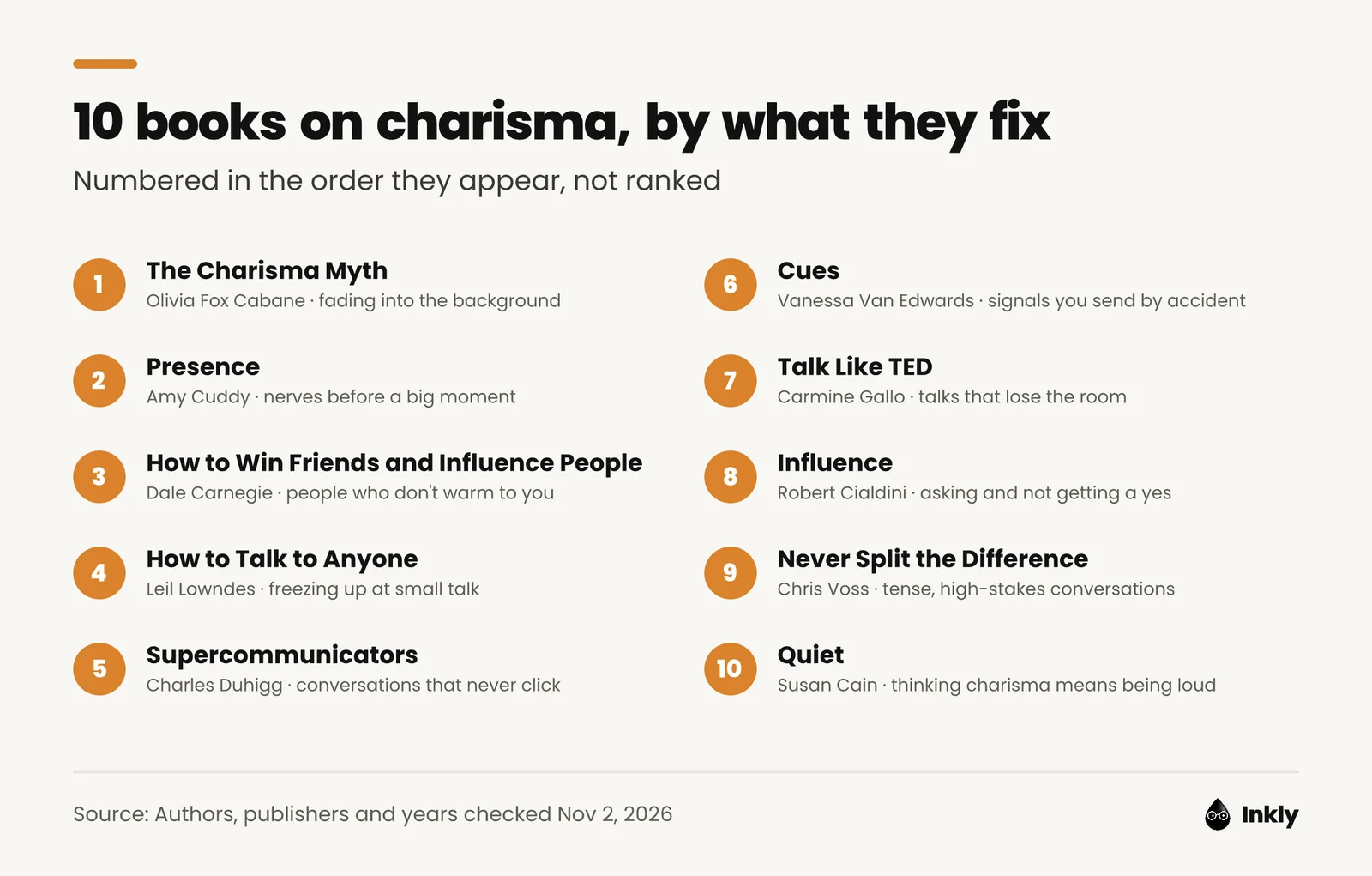
These are our 10 picks, sorted by what each one fixes. Years are first publication; page counts are from the publisher's listing for the edition named in our notes.
| Book | Author | Year | Best for | Pages |
|---|---|---|---|---|
| The Charisma Myth | Olivia Fox Cabane | 2012 | Presence and charisma basics | 320 |
| Presence | Amy Cuddy | 2015 | Nerves in high-pressure moments | 352 |
| How to Win Friends and Influence People | Dale Carnegie | 1936 | Warmth and likability | 320 |
| How to Talk to Anyone | Leil Lowndes | 2003 | Small talk and first impressions | n/a |
| Supercommunicators | Charles Duhigg | 2024 | Deeper conversations | 320 |
| Cues | Vanessa Van Edwards | 2022 | Body language and tone | 320 |
| Talk Like TED | Carmine Gallo | 2014 | Public speaking | 304 |
| Influence | Robert Cialdini | 1984 | Persuasion | 592 |
| Never Split the Difference | Chris Voss with Tahl Raz | 2016 | Negotiation and tense talks | 288 |
| Quiet | Susan Cain | 2012 | Confidence as an introvert | 352 |
If you only read one of these books to improve charisma, read The Charisma Myth. It's the only book here that tries to explain charisma as a whole, and the others fill in the parts.
Which books help with presence?
The Charisma Myth is the best book on presence, because it treats being fully there in a conversation as the base everything else sits on. Presence by Amy Cuddy is about the specific moments when nerves knock you out of it.
1. The Charisma Myth by Olivia Fox Cabane
First published 2012 · Portfolio · Fixes: talking to people and still fading into the background
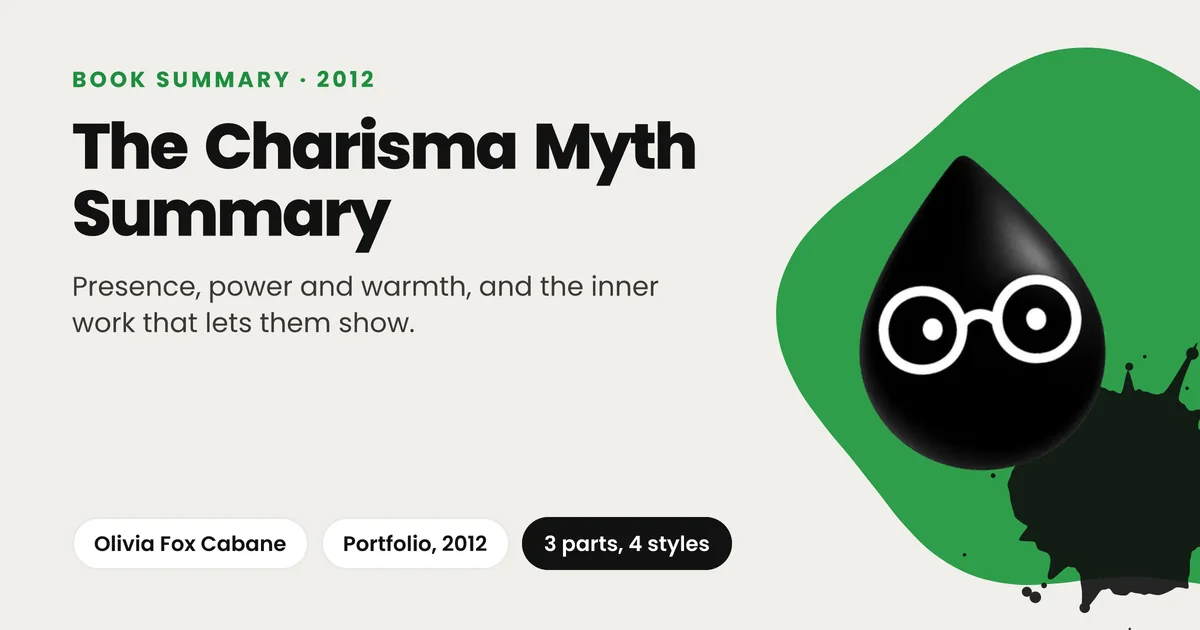
The Charisma Myth argues that charisma isn't something you're born with. It's a set of behaviors you can learn. Cabane, an executive coach, breaks it into three parts: presence (your attention is really on the person), power (you seem able to affect the world) and warmth (you seem to like them and mean well). Much of the book is about the inner states that leak into your face and voice, like anxiety or self-criticism, and exercises to calm them before they show.
Read it if you want the whole map before you work on any one road. The catch: some of the exercises feel odd at first, a point even a positive review in Psychology Today makes. If you hate that kind of thing, you'll skim a third of the book. Our Charisma Myth summary covers the main ideas chapter by chapter.
2. Presence by Amy Cuddy
First published 2015 · Little, Brown · Fixes: freezing up in interviews, pitches and hard conversations
Presence is about the moments when you most need to come across as calm and sure of yourself, and least feel it. Cuddy, a social psychologist, argues that small tweaks to your body language, behavior and mindset can change how you feel going in. The book grew out of her hugely popular TED talk on "power poses."
The catch is a big one. The original 2010 power-posing study claimed that holding an expansive pose raised testosterone and lowered cortisol. A 2015 replication by Ranehill and colleagues in Psychological Science, with 200 people (the original had 42), found no effect on either hormone and no effect on risk-taking. The University of Zurich's summary of the study notes one thing did hold up: people said they felt more powerful. So read Presence for its advice on nerves and mindset. Don't read it for the hormone chapter.
Read it if you're fine in everyday chat but fall apart when the stakes go up. Skip it if you want conversation skills; this book is about your own state, not the other person.
What are the best books for social skills?
The best books for social skills are How to Win Friends and Influence People for warmth, How to Talk to Anyone for small talk and Supercommunicators for deeper conversations. If you're after books to improve social skills from scratch, read them in that order.
3. How to Win Friends and Influence People by Dale Carnegie
First published 1936 · Simon & Schuster · Fixes: people who never quite warm to you
How to Win Friends and Influence People is the oldest book here and still the most useful page for page. The core is almost embarrassingly simple: be genuinely interested in people, remember their names, listen more than you talk, don't criticize and try to see things their way. Warmth is half of charisma, and Carnegie is the best teacher of it.
Read it if people tell you that you seem distant or hard to read. Skip it if 1930s sales anecdotes make your eyes roll, though the updated 2022 edition helps. Our summary of Carnegie's principles boils the book down to five lines.
4. How to Talk to Anyone by Leil Lowndes
First published 2003 · McGraw-Hill · Fixes: freezing up at small talk and parties
How to Talk to Anyone is a grab bag of 92 small, specific techniques for first impressions, small talk, working a room and sounding confident. The best-known is the "flooding smile": instead of grinning the moment you meet someone, look at their face for a beat, then let the smile spread, so it feels meant for them.
Read it if you want something you can try at a party tonight. The catch: 92 tricks is a lot, and they vary in quality. Some feel dated or a little gimmicky. Pick five that suit you and ignore the rest.
5. Supercommunicators by Charles Duhigg
First published 2024 · Random House · Fixes: conversations that go fine but never click
In Supercommunicators, Duhigg (the Pulitzer Prize-winning journalist behind The Power of Habit) argues that every conversation is really one of three kinds. A practical one is about solving a problem. An emotional one is about how people feel. A social one is about who people are to each other. If you don't know which kind you're in, Duhigg argues, you're unlikely to connect. The people he calls supercommunicators notice which kind is going on and respond to it.
Read it if your small talk is fine but your real conversations, with a partner, a boss or a friend in trouble, keep going sideways. The catch: it's a Duhigg book, so it runs on long stories. You'll wait a while between practical takeaways.
Which book helps with body language and first impressions?
Cues by Vanessa Van Edwards is the best book on the nonverbal side of charisma: the signals you send with your face, voice and words before you've said anything interesting.
6. Cues by Vanessa Van Edwards
First published 2022 · Portfolio · Fixes: coming across colder, or less capable, than you are
Cues is built on a simple formula: charisma is warmth plus competence. Van Edwards, a behavioral researcher, sorts the signals people read from you into four kinds: nonverbal (posture, gestures, face), vocal (pace, volume, pitch), verbal (your words, including in emails) and imagery (photos and clothes). Then she shows which ones read as warm, which read as competent, and which accidentally say neither.
Read it if you get feedback like "intimidating" or "a bit of a pushover" and don't know why. The catch: it reads like a reference guide and leans toward work, from job interviews to video calls. Her earlier book, Captivate (2017), covers related ground.
Which book makes you a better public speaker?
Talk Like TED by Carmine Gallo is our pick for public speaking, because it breaks good talks into parts you can copy.
7. Talk Like TED by Carmine Gallo
First published 2014 · St. Martin's · Fixes: talks and presentations that lose the room
For Talk Like TED, Gallo, a public speaking coach, broke down hundreds of TED talks and interviewed popular TED speakers and researchers. He boils what he found down to nine secrets. One of the best known is the 18-minute rule: keep a talk to 18 minutes or less.
Read it if you have to present at work and want a clear structure. The catch: it's built around the TED format, a polished, rehearsed solo talk. Charisma in a meeting or a one-on-one is a different skill, and the examples are now more than a decade old.
What are the best books on persuasion?
Influence explains why people say yes. Never Split the Difference shows how to stay calm and get to yes when the other side is pushing back.
8. Influence by Robert Cialdini
First published 1984 · New and expanded edition 2021, Harper Business · Fixes: asking for things and not getting them
Influence is the classic on the psychology of persuasion. Cialdini, a psychology professor at Arizona State University, groups the main levers into principles: reciprocation, commitment and consistency, social proof, liking, authority and scarcity. The 2021 edition adds a seventh, unity, the pull of a shared identity. The publisher pitches it as much as a defense against these levers as a guide to using them.
Read it if your job involves asking people for things: sales, fundraising, hiring, managing. The catch: the new edition runs to 592 pages. Read the chapter on liking first, since it's the one closest to charisma, and dip into the rest. For a darker, history-heavy take on power, see our 48 Laws of Power summary.
9. Never Split the Difference by Chris Voss
First published 2016 · Harper Business · Fixes: tense, high-stakes conversations
Never Split the Difference is written by a former FBI hostage negotiator, with co-writer Tahl Raz. Its core idea is tactical empathy: show the other person you understand how they feel and see the situation, even when you disagree. Then use calibrated questions, open questions that usually start with "how" or "what," to get them working on the problem with you.
Read it if you dread salary talks, difficult clients or arguments with family. The catch: these are hostage-negotiation techniques. Used on a friend over dinner plans, they can feel calculated, and people notice.
Is there a charisma book for introverts?
Quiet by Susan Cain is the one to read, because it questions the idea that charisma has to be loud.
10. Quiet by Susan Cain
First published 2012 · Crown · Fixes: believing charisma means being the loudest person in the room
Quiet argues that Western culture runs on an "Extrovert Ideal" that rewards talking over thinking, and that it wastes a lot of talent as a result. Cain, a former lawyer, treats introversion as a normal preference for quieter, less stimulating settings, and shows introverts how to work, speak and lead in ways that suit them. It pairs well with The Charisma Myth, whose idea of presence is mostly about listening.
Read it if you leave parties drained and suspect charisma is for other people. Skip it if you want techniques. Quiet is mostly about understanding yourself, not a playbook.
Which charisma book should you read first?
Read The Charisma Myth first if you're not sure what's holding you back. It gives you the three parts of charisma, and once you know which part is weak, the rest of the list tells you what to read next:
- Weak presence (people say you seem distracted): stay with The Charisma Myth, then read Quiet.
- Weak warmth (people say you seem cold): How to Win Friends and Influence People, then Cues.
- Stuck in small talk: How to Talk to Anyone, then Supercommunicators.
- Dreading presentations: Talk Like TED, then Presence for the nerves.
- Not getting a yes: Influence, then Never Split the Difference.
Can't decide? Our free book recommendation quiz picks three books for you in about a minute. If this list made you want more beyond social skills, our 15 best self-improvement books cover habits, focus, money and more.
Can a book make you more charismatic?
A book can show you what to do, but only practice in real conversations makes you more charismatic. Charisma is how other people read you, so you can't build it alone on the couch.
The good news is that charisma behaviors can be taught. In a 2011 study by John Antonakis and colleagues, 34 managers had their charisma rated by coworkers. Half then got training in tactics like stories, metaphors and rhetorical devices. Three months later, the trained managers' ratings had risen more than the others'. A second experiment with 41 MBA students found that speeches using more of these tactics were rated higher. The authors warn there are no quick fixes, and that overdoing the tactics comes off as self-parody.
We couldn't find a study testing whether reading a charisma book, on its own, makes people more charismatic. Treat these books as training plans, not cures. For what the research says about charisma itself, see our guide on how to be more charismatic.
To get the most out of any book on this list:
- Pick one weak spot and one book. Ignore the other nine for now.
- After each chapter, write down one behavior to try in your next real conversation.
- Try it at least three times before you judge it. The first attempt always feels fake.
- Keep one page of notes per book. Our free one-page book notes template has room for the big ideas, your own examples and one action.
Inkly is our app, so weigh this accordingly. Inkly turns ideas from well-known non-fiction, including How to Win Friends and Influence People, into short daily lessons with a quick quiz after each one, and its growth map tracks your learning across six areas, one of which is Influence. It won't make you charismatic; you still have to practice with real people. It's free to download on the App Store, but the full daily lessons and quizzes need an Inkly Unlimited subscription, and it only runs on iPhone.
FAQ
What is the best book on charisma?
For most people, The Charisma Myth by Olivia Fox Cabane. It's the only book here that treats charisma as a whole skill, built from presence, power and warmth, and it gives exercises for each part. If you already know your weak spot, pick the book for that spot from the table above instead.
What books improve social skills fastest?
How to Win Friends and Influence People and How to Talk to Anyone give you things to try in your next conversation. Carnegie's advice to listen more and remember names takes no practice to start. Supercommunicators takes longer to pay off but goes deeper.
Is charisma something you're born with?
Partly temperament, but a lot of it is behavior you can learn. A 2011 study by Antonakis and colleagues found that managers trained in charismatic speaking tactics were later rated as more charismatic by their coworkers than managers who weren't trained. The Charisma Myth is built on the same idea.
Do power poses really work?
Not the way the original study claimed. A 2015 replication with 200 people, published in Psychological Science, found that power poses did not change testosterone, cortisol or risk-taking. People did report feeling more powerful, so a pose before a big moment may help your mood, but don't expect it to change your hormones.
Are books on charisma manipulative?
They can be used that way, especially the persuasion books. Influence is pitched as much as a defense against manipulation as a guide to persuading people. The books on warmth, like Carnegie's, only work if your interest in people is real; faked interest tends to show.
What should introverts read to be more charismatic?
Start with Quiet by Susan Cain, then read The Charisma Myth. Quiet shows that being reserved isn't a flaw, and The Charisma Myth shows that presence, which is mostly attentive listening, is a quieter kind of charisma that suits introverts well.