Charisma looks like a gift some people are born with. The research says a good chunk of it is behavior, and behavior can be practiced.
Below is how to be more charismatic in eight steps, what each is based on, and one thing to try today. No power poses, no mirroring tricks.
What is charisma, really?
Charisma is the quality that makes people want to listen to you, trust you and be around you. Researchers usually measure it as a perception: other people rate how charismatic you seem.
Olivia Fox Cabane's book The Charisma Myth (Portfolio, 2012) breaks it into three parts: presence (you're fully in the conversation), power (you seem able to get things done) and warmth (you seem to have good intentions toward the other person). Her model is a coaching framework, not a lab finding.
It fits a bigger body of research, though. In a 2007 review in Trends in Cognitive Sciences, Susan Fiske, Amy Cuddy and Peter Glick argued that people judge each other on two basic dimensions: warmth (is this person friend or foe?) and competence (can they act on those intentions?). People seen as high on both get the most positive reactions. Cabane's "warmth" and "power" map loosely onto those two.
Can you learn charisma?
Yes, at least partly. The best evidence comes from John Antonakis, Marika Fenley and Sue Liechti's 2011 study in Academy of Management Learning & Education, titled "Can Charisma Be Taught?"
They taught people a set of "charismatic leadership tactics": verbal ones (metaphors, stories and anecdotes, contrasts, lists, rhetorical questions, moral conviction, high expectations and confidence that they can be met) and nonverbal ones (an animated voice, facial expressions and gestures that show feeling).
- Study 1: 34 middle managers at a large Swiss company were randomly assigned to the training or a control group. Three months later, their coworkers rated the trained managers as more charismatic than the control group.
- Study 2: 41 MBA students gave a speech on video, learned the tactics, and gave the speech again six weeks later. 135 independent raters scored the second speeches as more charismatic.
The effects were close to medium in Study 1 and medium in Study 2. The limits are real: both samples were small, Study 2 had no control group, and charisma was measured as other people's ratings, not business results. It wasn't quick, either: the managers put in at least 30 hours (a five-hour workshop, coaching and weekly practice), the MBA students about 80 to 90.
Some of charisma does seem harder to train. In a 2016 study in Psychological Science, William von Hippel and colleagues timed 417 people answering 30 general-knowledge questions (like "name a precious gem") and asked their friends to rate their charisma. Faster answerers were rated as more charismatic, even after accounting for intelligence and personality, per the Association for Psychological Science's summary. That's a correlation, and you can't make your brain faster this week, so spend the effort on the behaviors below.
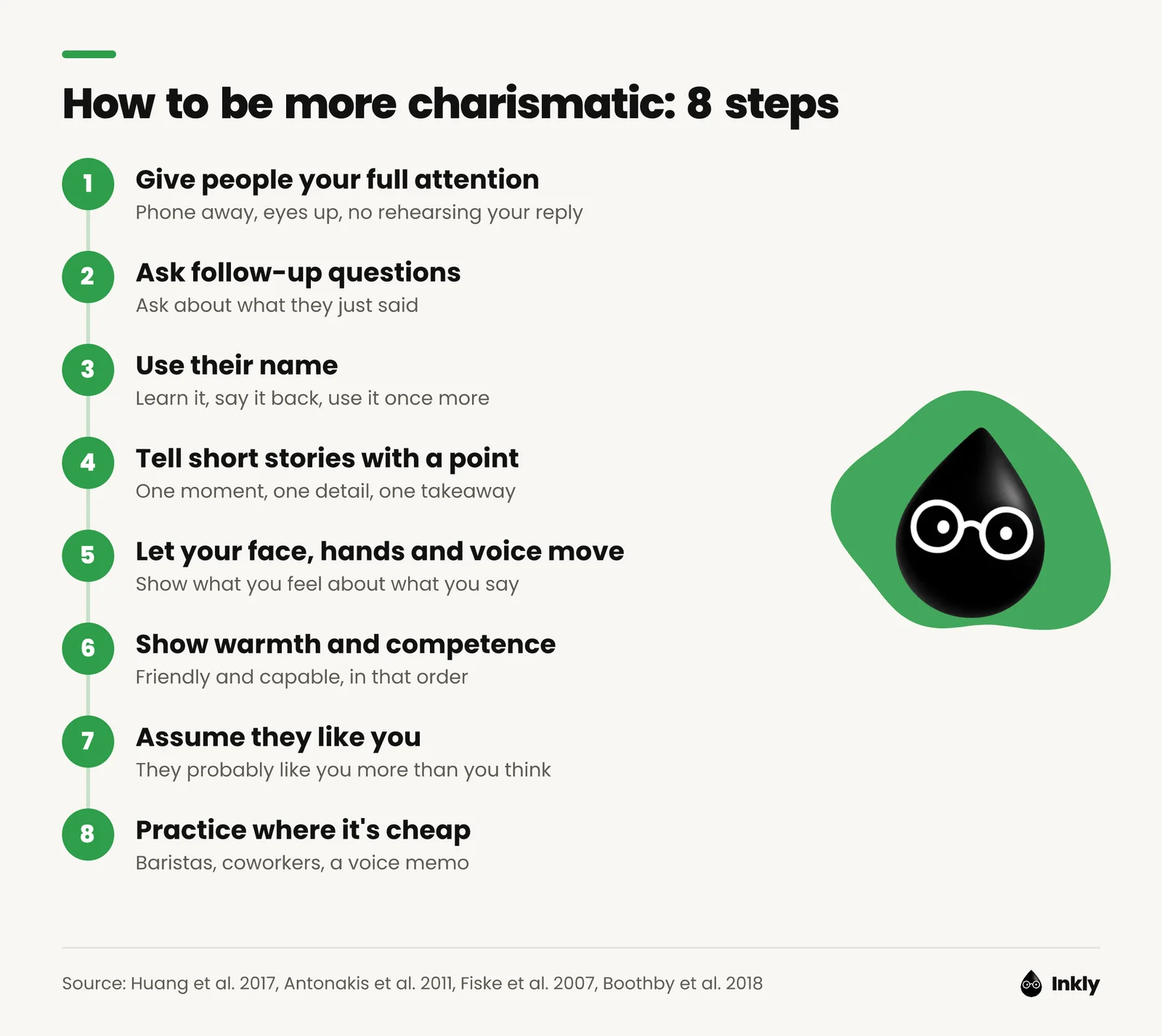
How to be more charismatic in 8 steps
You become more charismatic by changing what you do in conversations, one behavior at a time. Add one step a week and keep the earlier ones going.
1. Give people your full attention
Put your phone away, look at the person, and listen instead of planning your reply. Cabane calls this presence, the first of her three parts. People can tell when your mind is elsewhere.
The phone part is less settled than you'd think. A 2013 study by Andrew Przybylski and Netta Weinstein found that strangers who talked with a phone sitting nearby felt less close than those with a notebook there instead. A 2021 replication with 356 people didn't find that effect. So a phone on the table may not ruin a chat by sitting there, but you can't give full attention while you're checking it. If you reach for it on autopilot, our guide on how to stop doomscrolling has fixes that work on the phone itself.
Try it today: In your next conversation, put your phone in a pocket or bag (face down on the table doesn't count) and notice how often you want to check it.
2. Ask follow-up questions
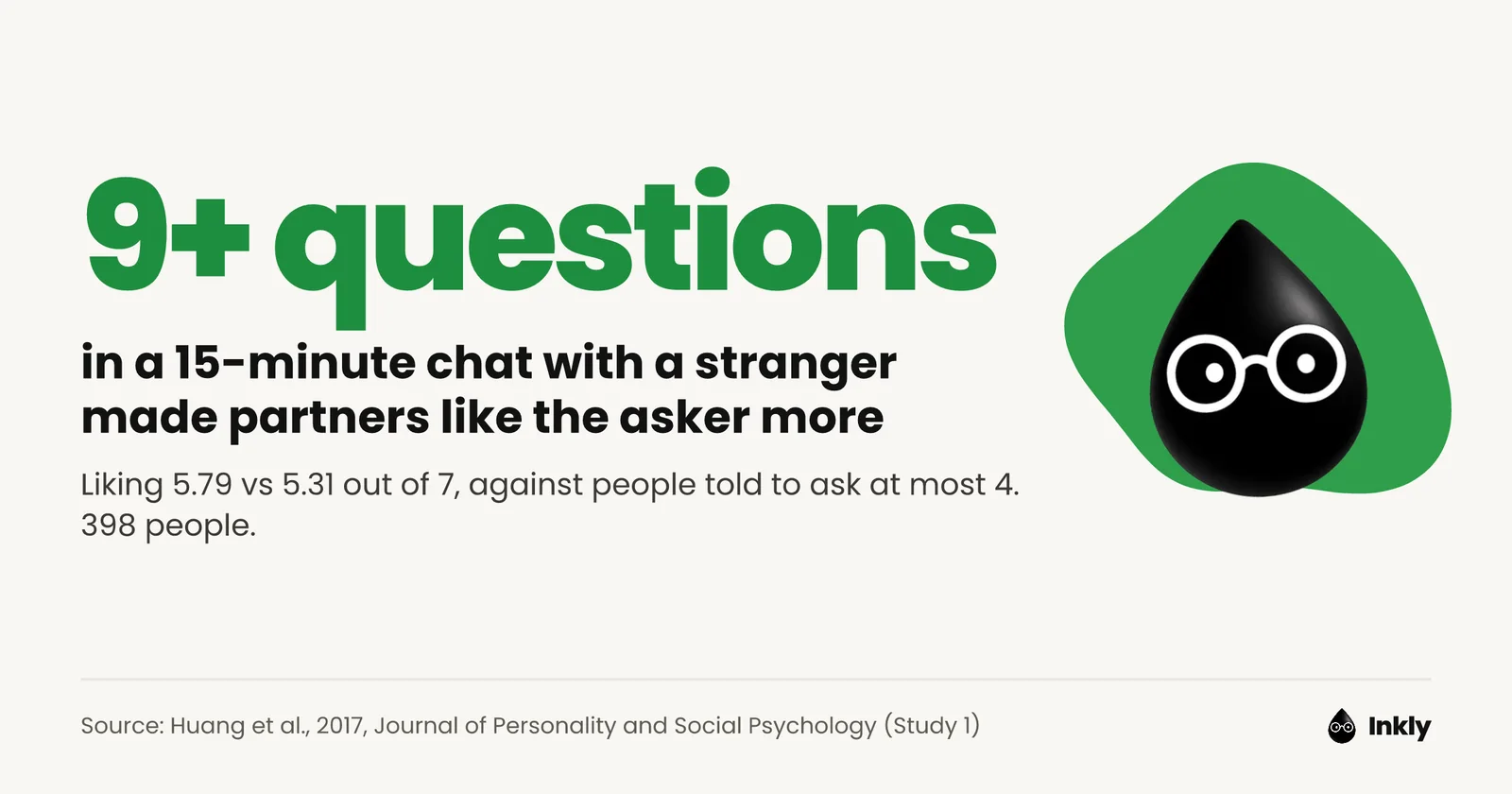
Ask about what the other person just said, not about the next topic on your list. In a 2017 paper in the Journal of Personality and Social Psychology, Karen Huang, Michael Yeomans, Alison Wood Brooks, Julia Minson and Francesca Gino paired 398 strangers for 15-minute online chats. One person in each pair was told to ask at least nine questions or at most four. Partners of the high-question askers liked them more, and follow-up questions did most of the work, because they show you're listening.
A speed-dating study in the same paper found more second-date yeses for people who asked more follow-up questions. Avraham Kluger and Thomas Malloy disputed that analysis in 2019, and the original authors replied that their results hold.
Try it today: When someone tells you something, ask "What happened next?" or "How did you decide that?" before you say anything about yourself.
3. Use their name
Learn the person's name, say it back when you meet them, and use it once more before you leave. This one comes from Dale Carnegie's How to Win Friends and Influence People (1936), not from the studies above. It's on this list because it's free, it shows you were paying attention, and forgetting a name signals the opposite. Our summary of How to Win Friends and Influence People covers the rest of his advice on making people feel noticed.
Don't overdo it: a name in every sentence sounds like a sales script.
Try it today: Learn the name of one person you see often but never name, like a barista or a coworker on another team, and use it.
4. Tell short stories with a point
Swap abstract claims for a quick story: one moment, one concrete detail, and the point in a sentence. Stories and anecdotes were among the tactics Antonakis's team trained, along with metaphors and contrasts ("We used to X. Now we Y."), because they make a message easier to understand and remember.
Keep it under a minute. "The worst manager I ever had taught me to write everything down" plus 30 seconds of what happened beats five minutes of setup.
Try it today: Write down one story from this year that makes a point you often make at work, and tell it in under 60 seconds.
5. Let your face, hands and voice move
Show what you feel about what you're saying. The nonverbal tactics in the Antonakis training were an animated voice, facial expressions and gestures that show emotion.
You don't need to perform. Let your voice rise and fall with what you mean, let your hands move when you explain, and smile when something is actually funny. One tip of ours that isn't from research: a short pause before your main point gives people a beat to catch up.
Try it today: Record a 60-second voice memo explaining something you care about, listen back once, and notice where your voice goes flat.
6. Show warmth and competence
Be friendly and capable at the same time, and lead with warmth. In the Fiske, Cuddy and Glick review, people first judge whether someone means well and then whether they can act on it. Being high on only one gets mixed reactions.
In practice, warmth is a real smile, interest in the other person and credit given freely. Competence is speaking plainly, knowing your stuff, and not apologizing before every sentence.
Try it today: Drop one "sorry, this might be a dumb question" from your next meeting and just ask the question.
7. Assume they like you
Go into conversations assuming the other person likes you, because they probably do more than you think. Erica Boothby, Gus Cooney, Gillian Sandstrom and Margaret Clark called this the liking gap, in a 2018 paper in Psychological Science. Across five studies, including 36 strangers in a 5-minute lab chat, 118 people at UK workshops and 102 first-year college students tracked over a year, people underestimated how much their conversation partners liked them.
In the first study, the gap was bigger for shyer people. Among the dorm mates it lasted for months and only disappeared at the final check in May. The authors' explanation: we're busy criticizing our own performance and miss the other person's signs of interest. The studies show the gap exists; they didn't test whether knowing about it makes you more charismatic.
Try it today: After your next conversation with someone new, write down one sign they enjoyed it before you replay anything you said wrong.
8. Practice where it's cheap
Practice in conversations that don't matter much before you need the skills in ones that do. Antonakis's team credited video examples and role-playing for part of their results. A coffee order, a chat with a neighbor, or a voice memo to yourself are all free reps.
Treat it like any other habit. In the study behind our guide on how long habits take to form, a simple daily habit took a median of 66 days to feel automatic, so expect each step to take a couple of months to feel natural. A printable habit tracker with one check per conversation where you tried this week's step makes the practice visible.
Try it today: Pick one step from this list and one low-stakes conversation where you'll use it before tonight.
Is being charismatic the same as being likeable?
No, but they overlap. Being more likeable is mostly the warmth side: attention, questions, remembering names and taking real interest. Charisma adds the competence and presence side: people want to follow you or listen to you, not only spend time with you.
If you want to be more likeable, steps 1, 2, 3 and 7 do most of the work. If you want people to listen when you speak, add steps 4, 5 and 6.
What are the best books on charisma?
The two we'd start with are The Charisma Myth by Olivia Fox Cabane, for the presence, power and warmth model and exercises for each, and Dale Carnegie's How to Win Friends and Influence People, for the everyday likeability side. Our Charisma Myth summary goes deeper on Cabane's book, and our list of the best books on charisma has more picks.
Inkly is our app, so weigh this accordingly. If you'd rather learn these ideas in small pieces, Inkly is an iPhone app whose growth map has an Influence area, with short daily lessons from books like these, a quiz after each, and a chat to reflect on how you'd use an idea. It won't make you charismatic; the practice does that. It's free to download on the App Store, and the daily lessons need an Inkly Unlimited subscription.
How long does it take to become more charismatic?
Expect weeks to months, not days. In the Antonakis study, coworkers noticed the change three months after training, and the managers had put in about 30 hours. The MBA students put in 80 to 90 hours and showed a bigger change, which the authors credit to the extra time.
Some steps work the first time: asking two follow-up questions or putting your phone away changes a conversation right away. Making them automatic, so you do them when you're tired or nervous, is the slower habit work in step 8.
FAQ
Can you become more charismatic?
Yes, at least in how others see you. In a 2011 study by Antonakis, Fenley and Liechti, managers trained in specific verbal and nonverbal tactics were rated as more charismatic by coworkers three months later, and MBA students gave more charismatic speeches after training. The samples were small, and the training took 30 or more hours.
What are the 3 elements of charisma?
In The Charisma Myth, Olivia Fox Cabane names presence, power and warmth. Presence means being fully in the conversation, power means seeming able to get things done, and warmth means seeming to care about the other person. It's a coaching model that lines up with research on warmth and competence.
What is charisma training?
Charisma training teaches specific behaviors, such as telling stories, using metaphors and contrasts, and showing emotion through voice, face and gestures. The best-known tested version is the "charismatic leadership tactics" training from Antonakis and colleagues, which combined a workshop, video examples, role-play, coaching and weeks of practice.
Are charismatic people born or made?
Both. A 2016 study found that people who answered general-knowledge questions faster were rated as more charismatic by friends, which hints at a part that's hard to change. But training studies show that behaviors like storytelling and expressive delivery can be learned and raise how charismatic others rate you.
How do I become more charismatic if I'm shy or introverted?
Start with the quiet steps: full attention, follow-up questions and using names don't require being loud. In the first liking gap study, the shyer people were, the more they underestimated how much their partner liked them, so assume it's going better than it feels. Practice in low-stakes chats first.
What is the fastest way to seem more charismatic?
Put your phone away and ask follow-up questions about what the other person just said. In one 2017 study, people told to ask more questions in a 15-minute chat were liked more by their partners. You can do both in your very next conversation.