Below is the Rich Dad Poor Dad summary: the six lessons, the assets-versus-liabilities idea that made the book famous, what critics say about both the advice and the author, and what's worth keeping. If you only have a minute, the next section is the whole book.
We wrote this from library records of the book's contents, the Rich Dad Company's site, publisher and press coverage, and published criticism. Lesson titles are the book's; the rest is our paraphrase. We're not financial advisers, and this isn't investment advice.
Rich Dad Poor Dad summary in one minute
Rich Dad Poor Dad says that school teaches you to work for money, and that the wealthy instead learn to make money work for them. The book in five lines:
- Two dads, two mindsets. Kiyosaki's "poor dad" was highly educated but always short of money. His "rich dad," a friend's father, was an entrepreneur who built businesses.
- Buy assets, not liabilities. An asset puts money in your pocket; a liability takes it out. Most people fill their lives with liabilities they think are assets.
- Your house is not an asset, in Kiyosaki's definition, because it costs you money every month.
- Learn money yourself. Schools don't teach financial literacy, so you have to: accounting, investing, markets and law.
- Work to learn. Pick jobs for the skills they teach, not only for the paycheck.
What is Rich Dad Poor Dad about?
Rich Dad Poor Dad: What the Rich Teach Their Kids About Money That the Poor and Middle Class Do Not! is a personal finance book by Robert T. Kiyosaki, first self-published in 1997 and originally credited to Kiyosaki with Sharon Lechter. Warner Books took it on in 2000, and since 2010 it has been published by Kiyosaki's own Plata Publishing. The current version is the 25th anniversary edition. Publisher copy says it has sold more than 40 million copies; its sales got a major boost from an appearance on The Oprah Winfrey Show, according to Publishers Weekly.
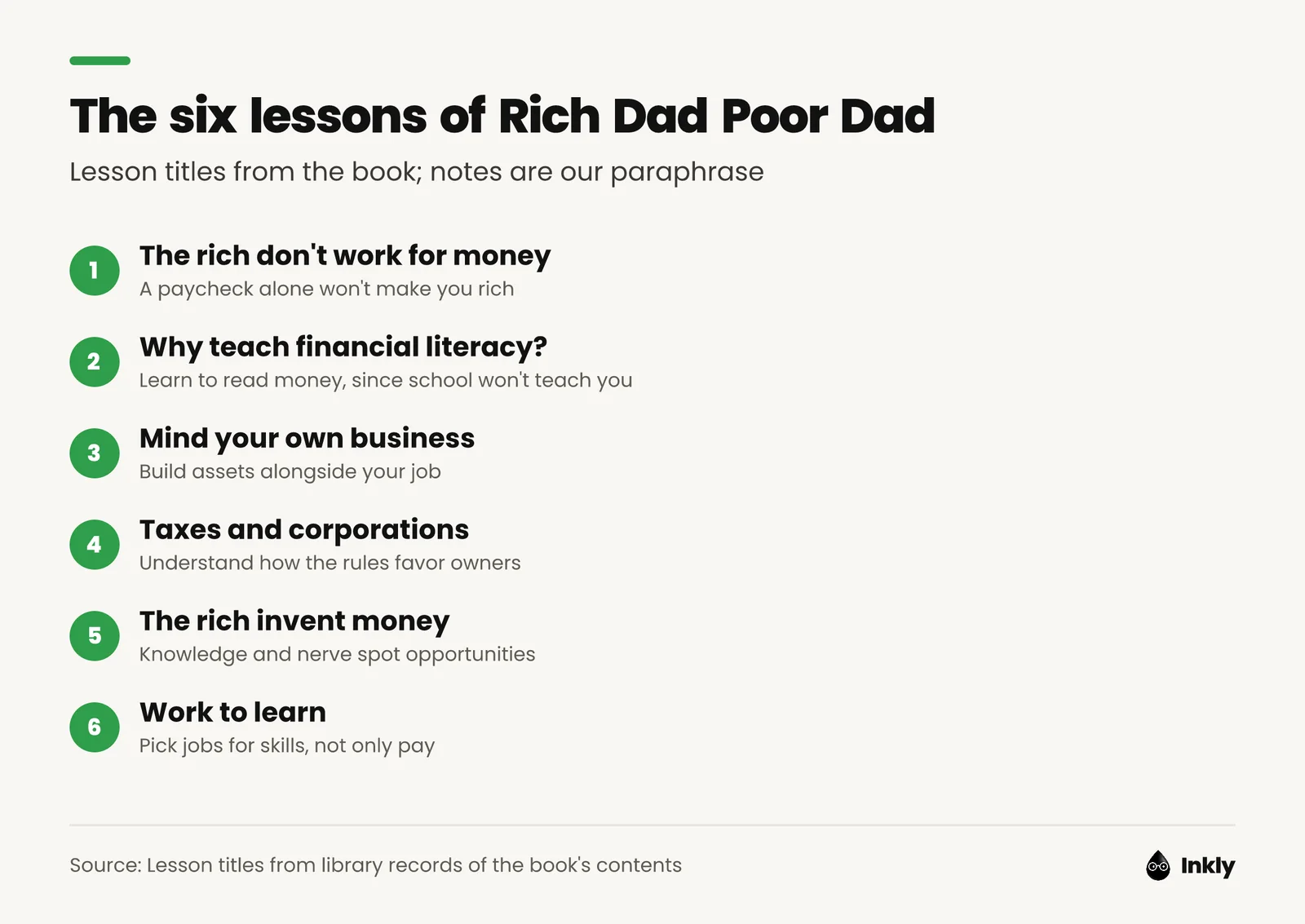
Kiyosaki was born in Hilo, Hawaii, in 1947. The book is written as a parable: the young Robert works for his rich dad for almost nothing and learns money lessons along the way. The book's six lesson chapters, as library records list them:
| Lesson | Title |
|---|---|
| 1 | The Rich Don't Work for Money |
| 2 | Why Teach Financial Literacy? |
| 3 | Mind Your Own Business |
| 4 | The History of Taxes and the Power of Corporations |
| 5 | The Rich Invent Money |
| 6 | Work to Learn: Don't Work for Money |
Later chapters cover overcoming obstacles and getting started.
What does "the rich don't work for money" mean?
"The rich don't work for money" means that a salary alone rarely makes anyone wealthy, because it stops when you stop working. Kiyosaki says the rich own things that keep paying them, such as businesses, rental property or stocks, so their money works while they don't.
He calls the alternative the "rat race": working for others to pay bills and taxes, with little left over. Fear and greed, he says, keep people running in it.
Try it today: look at your last raise. Where did the extra money go?
What is the difference between assets and liabilities in Rich Dad Poor Dad?
In Rich Dad Poor Dad, an asset is anything that puts money in your pocket, and a liability is anything that takes money out. The Rich Dad Company sums it up: unless something is putting money in your pocket, it's not an asset. That's a different definition from the one accountants use, and it's deliberate.
By this rule, a rental property with positive cash flow, a business you own and dividend-paying stocks are assets. A car you finance is a liability. So is the house you live in, which is the book's most famous and most argued-over claim: your home costs you a mortgage, taxes, insurance and repairs every month, even if it gains value over time.
Kiyosaki's picture of the difference: the rich direct their income into the asset column, where it produces more income. The middle class, he says, buys liabilities, such as bigger homes and new cars, and calls them assets.
Try it today: list five things you own and mark each one "pays me" or "costs me."
Why does Kiyosaki say to mind your own business?
Kiyosaki says to mind your own business because your job builds someone else's business, while your assets are the only things that build yours. He doesn't tell you to quit your job. He says to keep it and spend part of your income building assets on the side.
The fourth lesson extends this to taxes. Kiyosaki argues that the rich use corporations and the tax code to keep more of what they earn. Critics, including the real-estate author John T. Reed, say his specific tax claims are wrong or oversimplified. Talk to a tax professional before acting on any of this.
What do "the rich invent money" and "work to learn" mean?
"The rich invent money" means that financial knowledge and confidence let people spot and act on opportunities others miss. The lesson is about financial courage as much as knowledge, and it's where Kiyosaki is most confident and least specific.
"Work to learn" means choosing jobs for the skills they build, not only for the pay. In our view, it's the most useful advice in the book.
What do critics say about Rich Dad Poor Dad?
Rich Dad Poor Dad is one of the best-selling finance books ever, and one of the most criticized. The main points, each from a named source:
- Did the rich dad exist? For years, Kiyosaki didn't name him, and critics including Reed and the press questioned whether he was real. Slate called the book a parable that blurs fact and fable. After the Hawaii businessman Richard Kimi died in 2009, his son told the Honolulu Advertiser that Kiyosaki based his original "rich dad" on Kimi.
- The advice is vague or risky. The Motley Fool and the physician-finance writer James Dahle of White Coat Investor say the book offers little concrete guidance, and that the real-estate ideas sound easier than they are. Dahle still credits it with getting people interested in money.
- The author's businesses. In 2012, Kiyosaki's company Rich Global LLC filed for Chapter 7 bankruptcy after the Learning Annex won a judgment of about $23.7 million in a dispute over seminar profits, ABC News reported. Kiyosaki himself didn't file, and his company said the entity had no funds.
Is Rich Dad Poor Dad worth reading?
Rich Dad Poor Dad is worth reading if you've never thought about money beyond your paycheck, as a mindset book rather than a manual. Its core questions (does this pay me or cost me, and what am I learning at work?) are useful. Its specific claims about taxes, real estate and the author's own deals should be taken with a lot of salt.
Skip it if you want a step-by-step plan, or if you're tempted to borrow heavily for real estate on the strength of one book. For a calmer take on money and behavior, The Psychology of Money by Morgan Housel, from our list of the best self-improvement books, is the better first read.
Is a summary enough? Yes, for most readers. The book repeats its few ideas many times. If you do read it, our reading time calculator tells you how long it'll take.
How do you apply Rich Dad Poor Dad?
You apply the useful parts of Rich Dad Poor Dad by looking honestly at what your money is doing, not by buying property next month. A one-week money check:
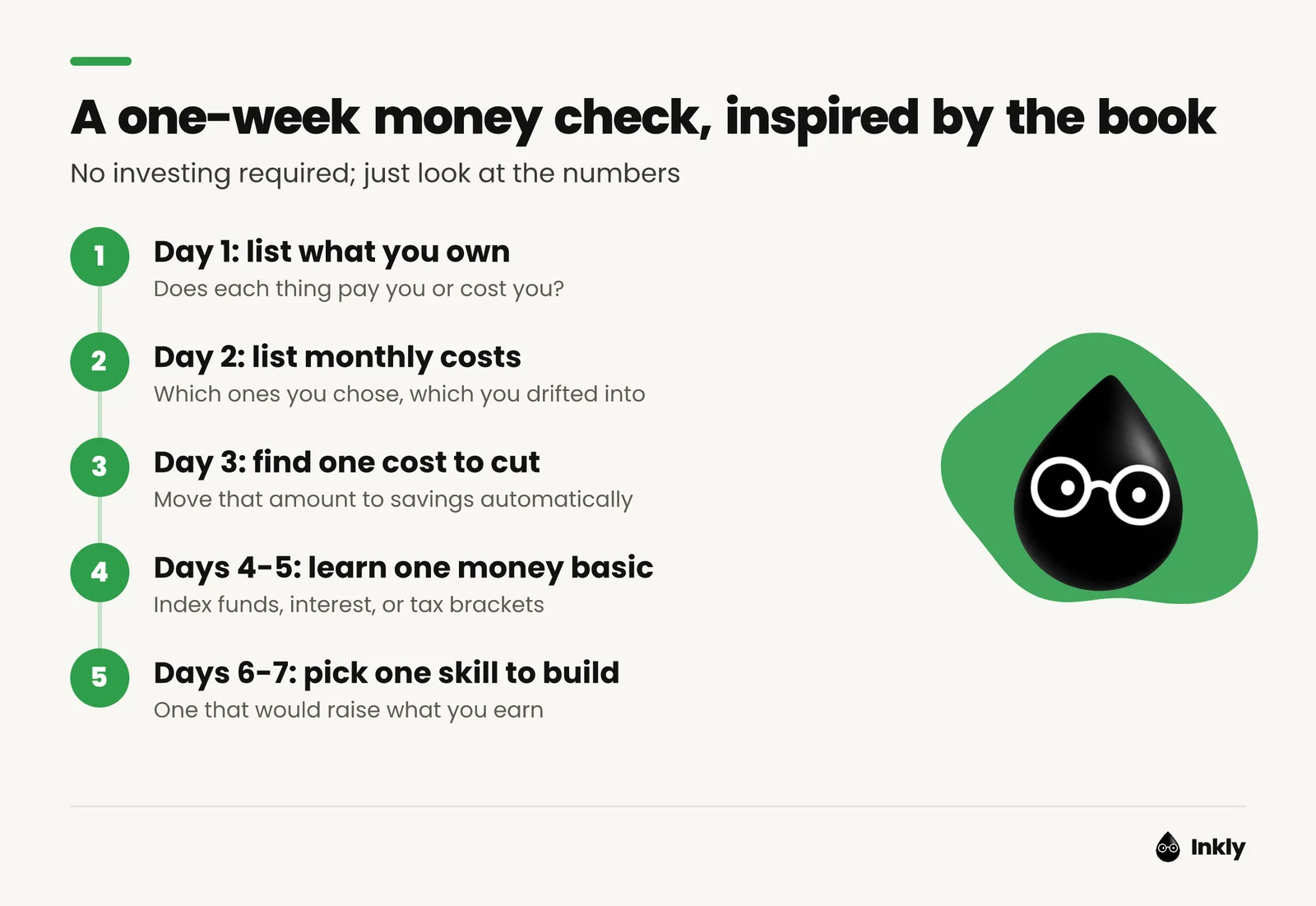
- Day 1: list what you own, and mark whether each thing pays you or costs you.
- Day 2: list your monthly costs, and note which you chose and which you drifted into.
- Day 3: cut one cost and set the same amount to move to savings automatically.
- Days 4-5: learn one money basic properly, such as how index funds or tax brackets work.
- Days 6-7: pick one skill that would raise what you earn, and find a way to start learning it.
Turning these into habits is the hard part. Our Atomic Habits summary shows how to make one stick.
What should you read after Rich Dad Poor Dad?
After Rich Dad Poor Dad, The Psychology of Money is the more grounded money book. Our Atomic Habits summary helps you turn a money goal into a system, and our 48 Laws of Power summary covers another bestseller worth reading critically.
One more option, and it's ours: Inkly is our app, so weigh this accordingly. It turns big ideas from non-fiction books into short daily lessons with a quick quiz after each one, with Wealth as one of its six growth areas. It's iPhone only and free to download; the daily lessons need a subscription.
FAQ
What is the main lesson of Rich Dad Poor Dad?
The main lesson of Rich Dad Poor Dad is that you build wealth by acquiring assets that put money in your pocket, rather than by earning a bigger salary and buying liabilities. Robert Kiyosaki contrasts his educated "poor dad" with his entrepreneur "rich dad" to argue that financial education matters more than formal education.
What are the six lessons of Rich Dad Poor Dad?
The six lessons are: the rich don't work for money; why teach financial literacy; mind your own business; the history of taxes and the power of corporations; the rich invent money; and work to learn, don't work for money. Each is a chapter of the book.
Is your house an asset according to Rich Dad Poor Dad?
No. By Kiyosaki's definition, an asset puts money in your pocket and a liability takes it out, so the home you live in counts as a liability because it costs money every month. Accountants and many financial writers disagree, since a home can build equity; the definition is the book's own.
Was the rich dad real?
Robert Kiyosaki didn't name his "rich dad" for years, and critics questioned whether he existed. After Hawaii businessman Richard Kimi died in 2009, his son told the Honolulu Advertiser that Kiyosaki based his original "rich dad" on Kimi. The book itself is best read as a parable.
Is Rich Dad Poor Dad good advice?
Rich Dad Poor Dad gives good general advice (learn about money, buy things that earn, build skills) mixed with specific claims about taxes and real estate that critics call wrong or risky. Use it to change how you think about money, and get concrete advice from a qualified professional.
Who wrote Rich Dad Poor Dad?
Rich Dad Poor Dad was written by Robert T. Kiyosaki, with Sharon Lechter credited on the original 1997 and 2000 editions. Kiyosaki self-published it in 1997. It is now published by his own company, Plata Publishing, in a 25th anniversary edition.