If you used to read a lot and now mostly read captions, you're in a big club. The fix is less about discipline than about where the book sits and when you open it.
Below is how to read more books with eight small habits, plus the real numbers: how much the average person reads, how many books a year is realistic, and how to get back into reading after a long break.
How to read more books: the 8 habits
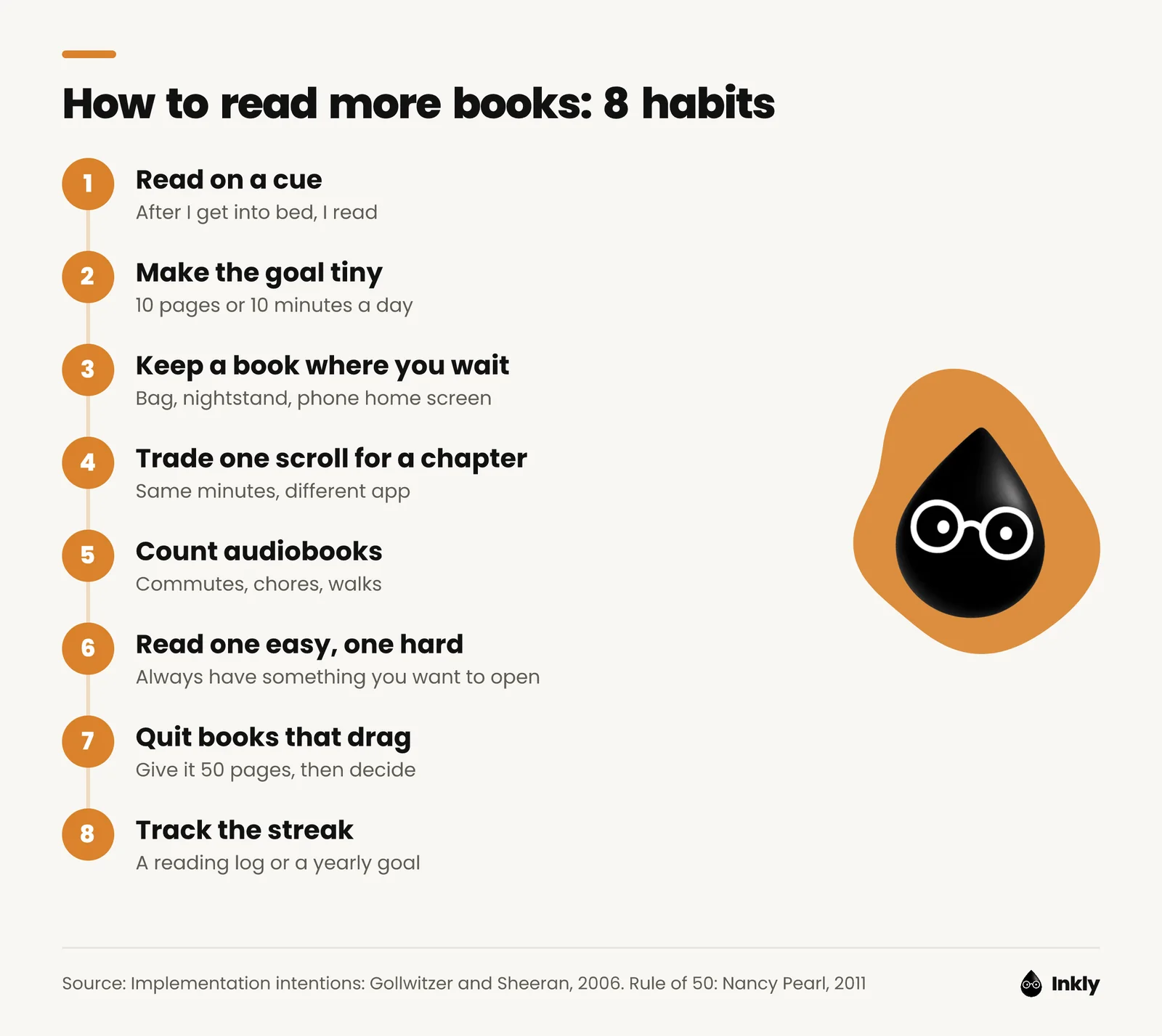
You read more books by making reading the easy default at a few fixed moments each day. Here are the eight habits, in the order we'd add them:
- Read on a cue you already have, like getting into bed.
- Make the daily goal tiny: 10 pages or 10 minutes.
- Keep a book wherever you wait.
- Trade one scrolling session for a chapter.
- Count audiobooks.
- Read two books at once, one easy and one hard.
- Quit books that drag.
- Track your streak.
Start with the first two. Add one more habit a week if you want to, not all eight on Monday.
1. Read on a cue you already have
Pick a moment that already happens every day and attach reading to it: "After I get into bed, I read." Psychologists call this an implementation intention, an if-then plan for when and where you'll act. A 2006 meta-analysis by Peter Gollwitzer and Paschal Sheeran pooled 94 tests of these plans and found a medium-to-large effect on reaching goals (d = 0.65). Those studies covered all kinds of goals, not reading specifically, but the logic carries over: a plan with a when and a where beats "I should read more."
Good cues for reading: morning coffee, the train, lunch alone, the first 10 minutes in bed.
2. Make the daily goal tiny
Aim for 10 pages or 10 minutes, because a goal you hit on a bad day is a goal that survives the month. Ten minutes a day still adds up to about 11 average-length books a year. On good days you'll read more, and that's a bonus, not the new target.
3. Keep a book wherever you wait
Put a book in every place you end up waiting: your bag, the nightstand, the car, your phone. Move a reading app to the spot on your home screen where a social app used to be. Libby, OverDrive's library app, lends ebooks and audiobooks for free with a library card, so your phone can carry a library without costing anything. Popular titles can have a waitlist, so keep a couple of holds going.
4. Trade one scrolling session for a chapter
Pick one scrolling session you'd happily lose, usually the one in bed, and read there instead. You're not finding new time, you're spending time you already have. If that's harder than it sounds, our guide on how to stop doomscrolling has eight fixes that don't rely on willpower.
5. Count audiobooks
Audiobooks count, and for most non-fiction you'll understand them about as well as print. In a 2016 experiment by Rogowsky, Calhoun and Tallal, 91 adults read, listened to, or read along with the same non-fiction chapter, and comprehension didn't differ significantly, either right away or two weeks later. A meta-analysis of 46 studies by Virginia Clinton-Lisell found no reliable overall difference between reading and listening, with a small edge for reading when people could set their own pace. So save the dense books for paper, where you can reread a sentence, and use audio for commutes, chores and walks.
6. Read two books at once, one easy and one hard
Keep one demanding book and one easy one going at the same time. This is our opinion, not a research finding: when you're tired, you'll pick up the easy one instead of your phone, and the hard one doesn't stall your whole reading life.
7. Quit books that drag
A book you dread opening blocks every book behind it. Librarian Nancy Pearl's Rule of 50 says to give a book 50 pages, then drop it if you're not enjoying it. Over 50? Read 100 minus your age instead. Picking better books in the first place helps even more, and our guide on how to choose a book to read walks through it in seven steps.
8. Track your streak
Write down what you read each day, even if it's four pages. A streak you can see is a reason not to break it. Our free printable reading log has room for a month of days, and the Goodreads Reading Challenge lets you set a yearly book goal if you like a number to chase.
How many books does the average person read?
The average US adult read 12.6 books in the past year, all or part of the way through, in a Gallup poll from December 2021. That was Gallup's lowest average on record, down from 15.6 in 2016. The average is pulled up by heavy readers. The median was 5 books, and 17% read none.
Other surveys measure reading differently, so read these as separate snapshots, not one trend line:
- Any book in a year: 75% of US adults read at least part of a book in any format in the past 12 months, in a Pew Research Center survey from October 2025. 64% read a print book, 31% an ebook and 26% listened to an audiobook.
- Minutes per day: Americans aged 15 and over spent an average of 16 minutes a day reading for personal interest in 2025, according to the Bureau of Labor Statistics' American Time Use Survey. That average includes everyone who read nothing that day.
- Reading on a given day: the share of Americans who read for pleasure on an average day fell from 28% in 2004 to 16% in 2023, in an analysis of 236,270 time-use diaries by Bone, Bu, Sonke and Fancourt (2025). People who did read spent slightly more time at it than before.
So fewer people read on any given day, but the people who read are reading a bit more. Getting into that second group is mostly a matter of habit.
How many books should you read a year?
There's no right number, so pick a yearly goal that your daily minutes can actually cover. A typical non-fiction book runs about 75,000 words, which takes about 5 hours and 15 minutes at 238 words per minute, the average adult silent reading speed for non-fiction in a 2019 meta-analysis by Marc Brysbaert.
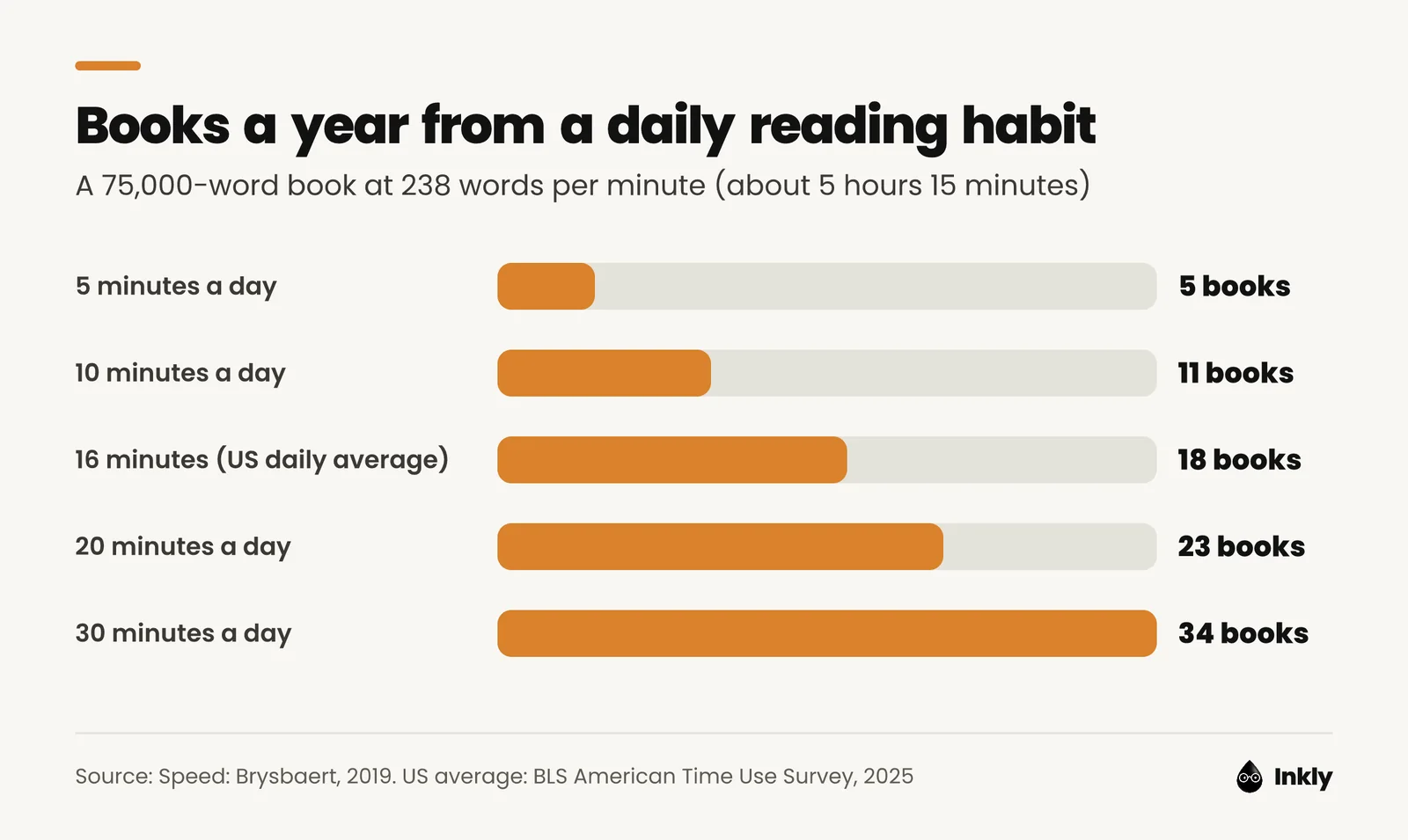
The useful surprise is the middle bar. The US average of 16 minutes a day, read every day, would cover about 18 books a year. Most people spend their reading minutes in a few bursts and get far fewer.
Our take on goals:
- Getting back into it: 6 to 12 books a year. That's one a month at most, about 10 minutes a day.
- Steady reader: 20 to 25 books, about 20 minutes a day.
- Heavy reader: 35 or more, which takes 30 minutes a day or a lot of audiobooks.
Your own speed changes the math. Put your daily minutes into our reading time calculator and it will tell you how many books a year that adds up to.
How do you make time to read?
You make time to read by taking it from something that already eats your free time, and for most people that's screens. In the 2025 American Time Use Survey, watching TV was the leisure activity that took the most time, about 2.6 hours a day on average, against 16 minutes of reading.
Three ways to find the minutes:
- Check your screen time first. On iPhone it's under Settings > Screen Time. Pick one app or one slot you'd miss least.
- Read before the screen, not after. Reading for 15 minutes before you turn on the TV works better than "I'll read after this episode."
- Use the dead minutes. Waiting rooms, lines and short commutes add up, as long as a book is already within reach.
It also helps to see the finish line. Kindle can show the estimated time left in a chapter or book, and a chapter that says "12 minutes left" is easy to say yes to.
How do you get back into reading?
Get back into reading by starting with a book that's short and easy and that you actually want to read, not the classic you feel you should have read by now. Your attention for books is a muscle you haven't used in a while, so don't test it with 600 pages.
- Reread a book you loved. You already know it's good, so it carries you through the first rusty week.
- Go short. Under 250 pages, so you finish something within two or three weeks.
- Pick the problem, not the prestige. A book about something bothering you right now is easier to open than a book you think you ought to read. Our free book recommendation quiz gives you three picks in about a minute.
- Lower the stakes. Graphic novels, essays, short stories and audiobooks all count.
Finishing one easy book does more for the habit than abandoning a hard one. Once you've finished two or three, the bigger books stop looking scary.
Does reading faster help you read more books?
Not much, because reading much faster usually means understanding less. A 2016 review by Keith Rayner and colleagues in Psychological Science in the Public Interest found a trade-off between speed and comprehension, and said you're unlikely to double or triple your speed while still understanding the text as well. Their advice for reading faster: read more, and grow your vocabulary.
If you're curious where you stand, our free reading speed test takes a couple of minutes. Then put the effort into the habits above. And if you want the books to stick once you've read them, our guide on how to remember what you read covers the recall techniques with the best evidence.
What if you only have five minutes a day?
Five minutes a day is still about five books a year, so use them. Read a few pages, listen to part of a chapter on the walk to the car, or take one idea from a book and think about it.
Inkly is our app, so weigh this accordingly. It turns big ideas from non-fiction books into short daily lessons with a quick quiz after each one. That's not the same as reading the book, but it keeps ideas coming on the days a full chapter won't fit. It's free to download on iPhone, and the daily lessons need an Inkly Unlimited subscription. If you're looking for what to read next, our list of the best self-improvement books has 15 picks sorted by the problem each one fixes.
FAQ
How many pages should I read a day?
Ten pages a day is a good starting goal, because it's small enough to do on a bad day. At about 275 words per page and an average speed, that's roughly 12 minutes. Ten pages a day adds up to about 3,650 pages a year, or 12 to 15 typical books.
What is a good reading goal for a year?
A good reading goal is one your daily minutes can cover. About 10 minutes a day gets you through roughly 11 average-length books a year, and 20 minutes gets you about 23. If you're getting back into reading, aim for 6 to 12 books and raise the goal next year.
Do audiobooks count as reading?
Yes, for most purposes. A 2016 experiment by Rogowsky, Calhoun and Tallal found no significant difference in comprehension between listening to, reading or doing both with the same non-fiction chapter. A meta-analysis of 46 studies found a small edge for reading only when people could set their own pace.
Is it better to read one book at a time?
Not necessarily. Many readers keep one demanding book and one easy one going, so there's always something they actually want to open. If switching makes you lose the thread, stick to one book and a 50-page rule for dropping it.
How do I focus when reading?
Put your phone in another room, or at least face down and out of reach, and read in short sessions of 10 to 20 minutes. Read with a question in mind so you know what you're looking for. If you keep drifting after 50 pages, the problem may be the book, not your focus.
Why can't I get into reading anymore?
Usually it's out of practice, a book that's too long or dense for where you are right now, or a phone that's more convenient than the book. Start with something short and easy, read at the same moment each day, and keep the book closer than your phone.