You finish a great book, and two weeks later you can name the author and maybe one idea. That's how memory works, and it's fixable.
Below is how to remember what you read using the two techniques with the strongest evidence, retrieval practice and spaced review. Every study is linked, so you can check our work. The last section covers how to read more books without a speed-reading course.
What does the forgetting curve actually show?
The forgetting curve shows that memory fades fastest in the first hours and days after learning, then much more slowly. Hermann Ebbinghaus published it in 1885, and it gets misquoted a lot.
Ebbinghaus ran his experiments on one person: himself. He memorized lists of nonsense syllables (he picked them because they were more uniform than real words), relearned each list after a delay, and timed how much effort the second round saved him. That "savings" score is the curve (his book in English translation).
| Time since learning | Relearning effort saved: Ebbinghaus (1885) | Relearning effort saved: Murre & Dros (2015) |
|---|---|---|
| About 20 minutes | 58% | 47% |
| About 1 hour | 44% | 37% |
| About 9 hours | 36% | 28% |
| 1 day | 34% | 32% |
| 2 days | 28% | 23% |
| 6 days | 25% | 17% |
| 31 days | 21% | 4% |
Savings scores for lists of nonsense syllables, one person per study. Ebbinghaus's shortest intervals were 19 minutes, 63 minutes and 8.75 hours. Figures from Murre & Dros, 2015, Table 3.
So when someone tells you people forget about 70% of what they read within a day, be skeptical. Ebbinghaus's actual result: after one day, he needed roughly two-thirds of his original effort to relearn a list of meaningless syllables. That tells you how forgetting is shaped, not what share of a book's ideas you'll lose.
In 2015, Jaap Murre and J. Dros replicated the experiment in PLOS ONE, again with one subject, who spent about 70 hours learning and relearning lists. Their curve came out close to the original, except for a much lower 31-day score. When they compared the original with its replications, the authors also concluded that the curve probably jumps up slightly at the one-day mark, possibly because of sleep.
For readers, the shape is the part worth keeping. Forgetting is steepest right after you learn something, so the method below has you recall each chapter as soon as you finish it.
What helps you retain what you read?
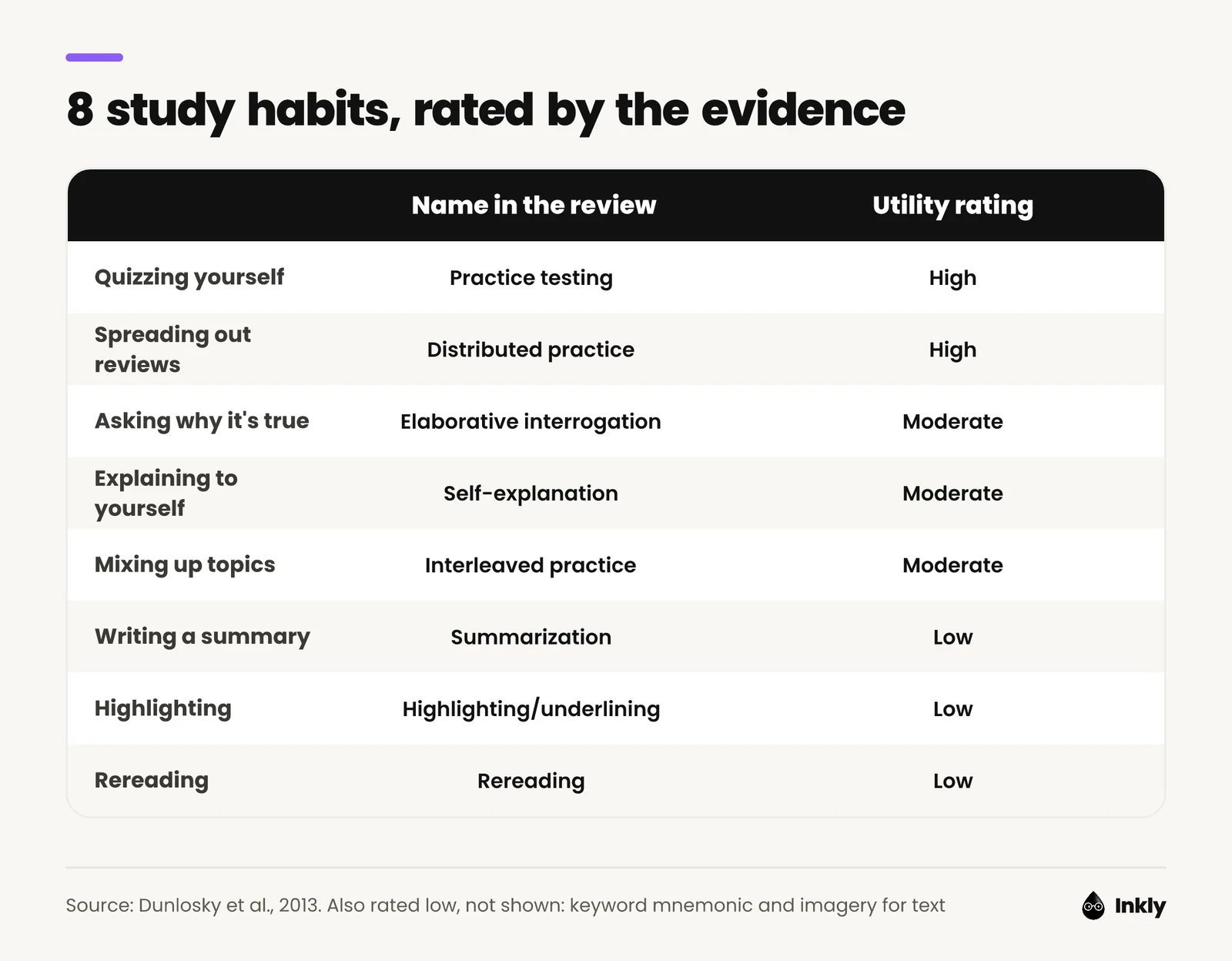
Testing yourself and spreading your reviews out over time have the best evidence for helping you retain what you read. That's what a large 2013 review by Dunlosky, Rawson, Marsh, Nathan and Willingham in Psychological Science in the Public Interest concluded.
The five authors rated 10 study techniques as high, moderate or low utility, depending on whether the benefits held up across different learners, materials and kinds of tests. Only practice testing and distributed practice got a high rating. Five techniques were rated low: summarization, highlighting, the keyword mnemonic, imagery for text and rereading. The awkward part is that two of those, rereading and highlighting, are what most students report using.
How to remember what you read: the 8-step method
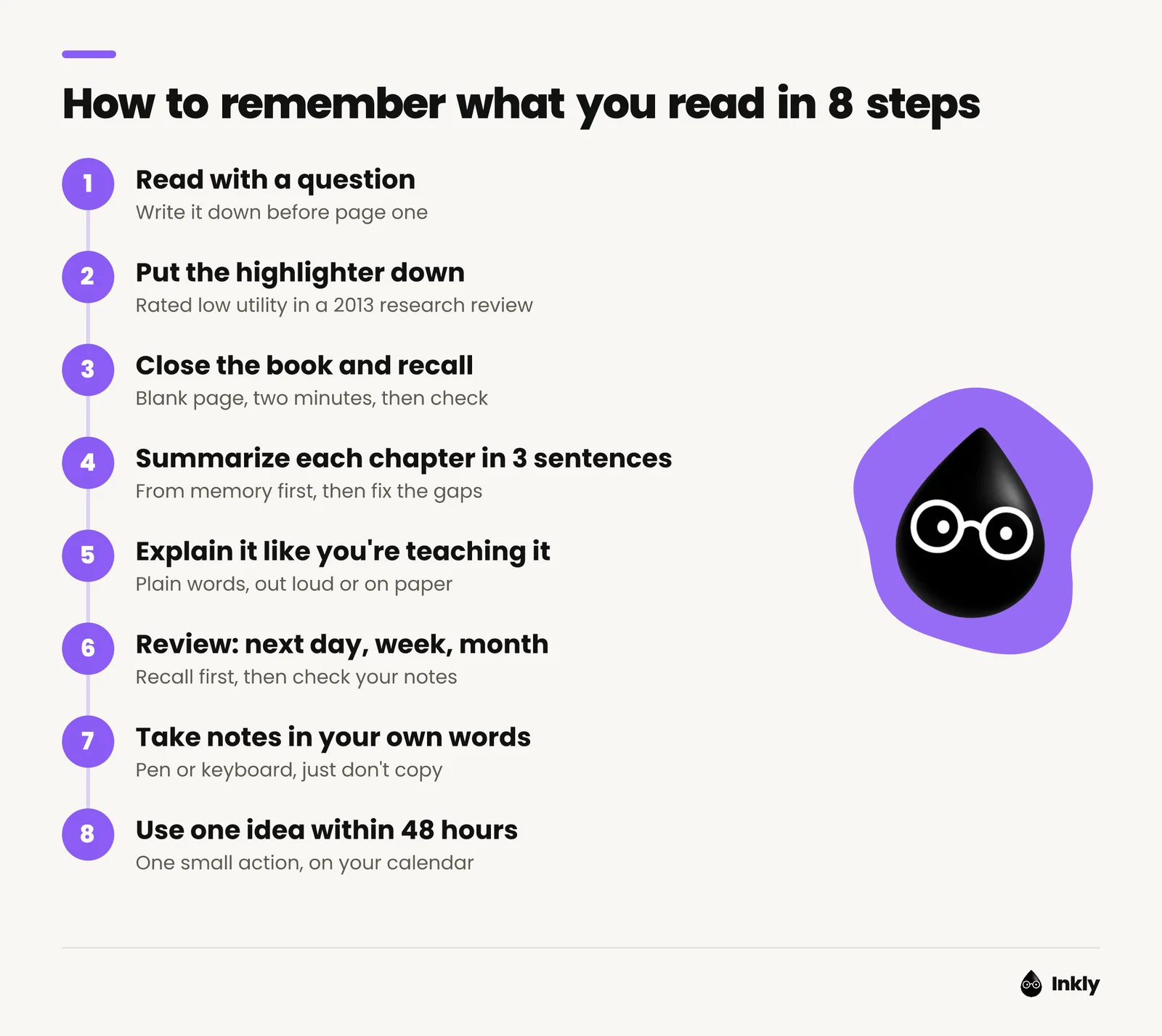
These eight steps put the research in the order you'd use it with a real book. You don't need all eight on day one. If you only try two, make them steps 3 and 6.
1. Read with a question in mind
Before page one, write down the one question you want the book to answer, like "How do I stop checking my phone during deep work?" Reading turns into a search, and you pay extra attention to the parts that answer your question.
Treat this step as practical advice, though a related lab finding points the same way. In five experiments by Richland, Kornell and Kao (2009), people who tried to answer questions about an essay before reading it remembered those concepts better afterward than people who got extra reading time instead. That held even when their pre-reading guesses were wrong.
2. Put the highlighter down
Highlighting feels productive and mostly isn't. The Dunlosky review rated highlighting and rereading low utility, because neither consistently improves test performance. Its recommendation is to swap rereading for practice testing.
If you can't read without a pen in your hand, fine. Use highlights as bookmarks only, and later turn each one into a question you answer from memory.
3. Close the book and recall before you move on
Retrieval practice means pulling information out of your memory instead of pouring it back in. It's one of only two techniques the Dunlosky review rated high.
The classic study is Roediger and Karpicke (2006) in Psychological Science. In the first experiment, 120 students read two short science passages (256 and 275 words), then reread one and wrote down everything they could recall from the other. Five minutes later, rereading came out slightly ahead (81% vs 75% of the ideas). After a week it flipped: 56% recalled for the tested passage, 42% for the reread one.
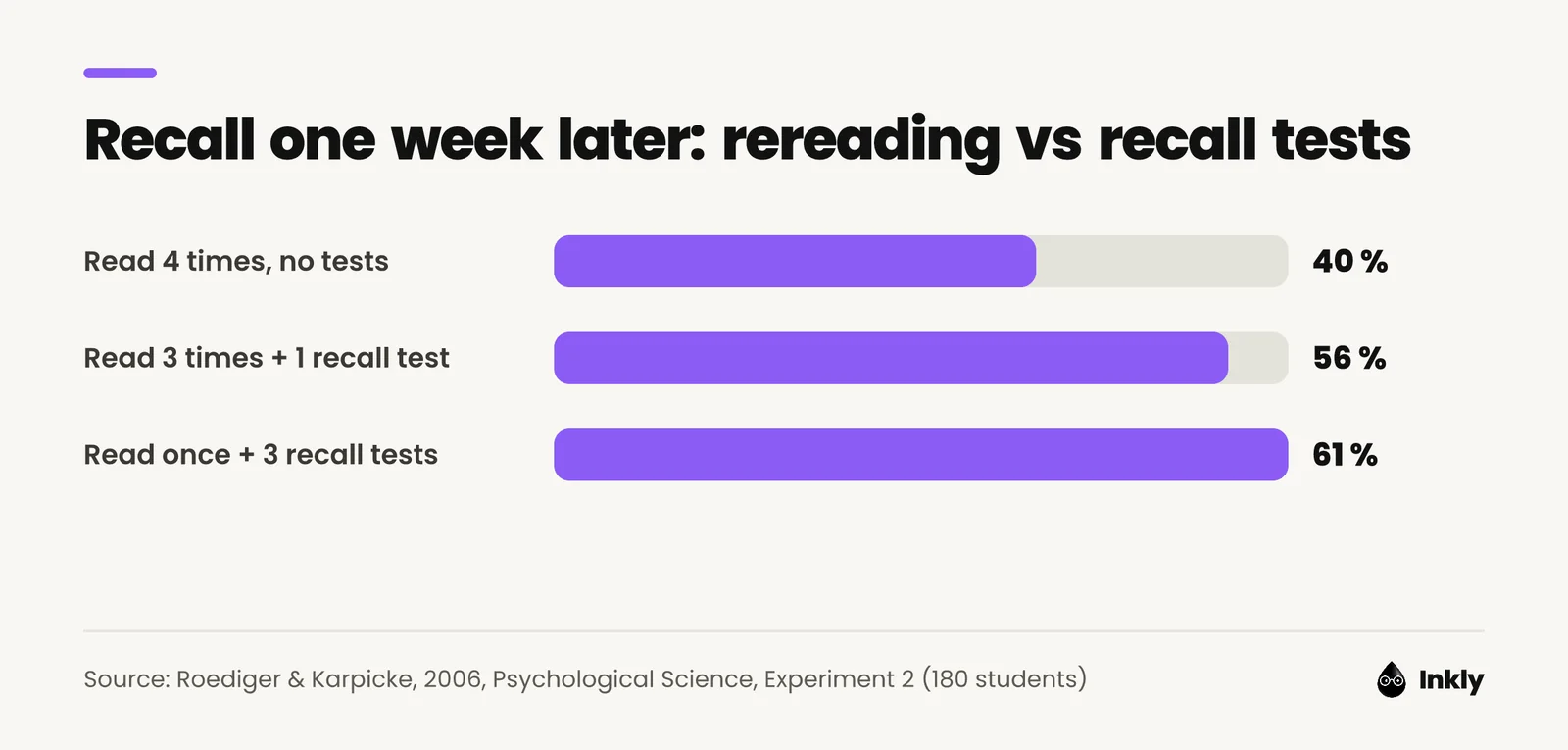
The second experiment, with 180 students, is the one to show anyone who swears by rereading. Students who read a passage once and then took three recall tests remembered 61% a week later. Students who spent all four study sessions rereading got through the passage about 14 times and remembered 40%. The rereaders also felt more confident they'd remember it, which is exactly the trap.
How to do it: when you stop reading, close the book, grab a blank page or a notes app, and spend two minutes writing down everything you remember. Then open the book and check what you missed. Use a blank page rather than a multiple-choice quiz. A 2014 meta-analysis by Rowland found that recall tests produced bigger benefits than recognition tests.
4. Write a three-sentence summary after each chapter
When you finish a chapter, close the book and write three sentences: the main claim, the best example or evidence, and what you'll do with it. Then check the chapter and fix anything you got wrong.
Yes, Dunlosky's review rated summarization low, because it helped some students on some tests under limited conditions. That's why you write it with the book closed. From memory, a summary becomes retrieval practice, and retrieval practice is the part with strong evidence behind it. If you want somewhere to keep your summaries, use our free printable one-page book notes template.
5. Explain it like you're teaching it
The Feynman technique is a popular study method named after the physicist Richard Feynman: explain an idea in plain words as if to a beginner, notice where you stall, go back to the book, try again. Nobody has tested it as a package, so treat it as a rule of thumb.
Its pieces do have support, though. The Dunlosky review rated self-explanation and elaborative interrogation (asking yourself why a claim is true) moderate utility, and noted that neither has been tested enough in real classrooms. And in two experiments by Nestojko and colleagues (2014), people who expected to teach a passage recalled more of it, and in a better organized way, than people expecting a test. Nobody actually taught anything. Expecting to was enough.
6. Space your reviews: tomorrow, next week, next month
Spacing means coming back to the same material on separate days instead of covering it all in one sitting. The main evidence comes from a meta-analysis by Cepeda and colleagues (2006) in Psychological Bulletin covering 839 assessments of spaced practice from 317 experiments. Across 271 direct comparisons, spaced learning averaged 47.3% correct on the final test versus 36.7% for massed learning, and only 12 comparisons showed no benefit from spacing. Most of those studies used word lists and word pairs rather than books. The authors' conclusion was that separating study sessions by at least a day is very useful for long-term retention.
How far apart? A follow-up study by the same group (Cepeda et al., 2008) taught more than 1,350 people a set of facts and tested them up to a year later. For a one-week delay, the best gap before a review was about 20-40% of the time until the test. For a one-year delay, it fell to about 5-10%. If you want to remember a book all year, that puts a review roughly 18 to 37 days out. Call it a month.
A simple schedule: chapter summaries on the day, a five-minute recall the next day, another a week later, another a month later. Each time, recall first. Only then check your notes.
7. Take notes in your own words, on paper or a screen
Use whichever tool you'll actually stick with, and rephrase instead of copying. The pen-versus-laptop question is less settled than you've probably heard.
The study behind the "pen wins" story is Mueller and Oppenheimer (2014) in Psychological Science. In three studies, students who typed lecture notes did worse on conceptual questions, and the authors blamed the typists' habit of transcribing word for word. Then Morehead, Dunlosky and Rawson (2019) in Educational Psychology Review ran a direct replication. Performance did not consistently differ between longhand, laptop, e-writer or even no-notes groups, and the small effects favoring longhand overall were non-significant. A second replication by Urry and colleagues (2021), with 142 students, also found no reliable difference.
These were all lecture studies. Our take for books: copying passages is the weak move. Use the book notes template and write each idea as a sentence you'd say out loud.
8. Use one idea within 48 hours
Pick one idea from the book and do something with it in the next two days. Change a setting on your phone, try the conversation technique at dinner, or put the 10-minute walk on your calendar. This one is our rule of thumb, not a study finding. It takes step 5 off the page and into your week.
It matters most with self-help, since the whole point of those books is to change something. If you're picking what to read next, start with our list of the best self-improvement books, and plan for your 48-hour idea before you open one.
Can an app help you remember what you read?
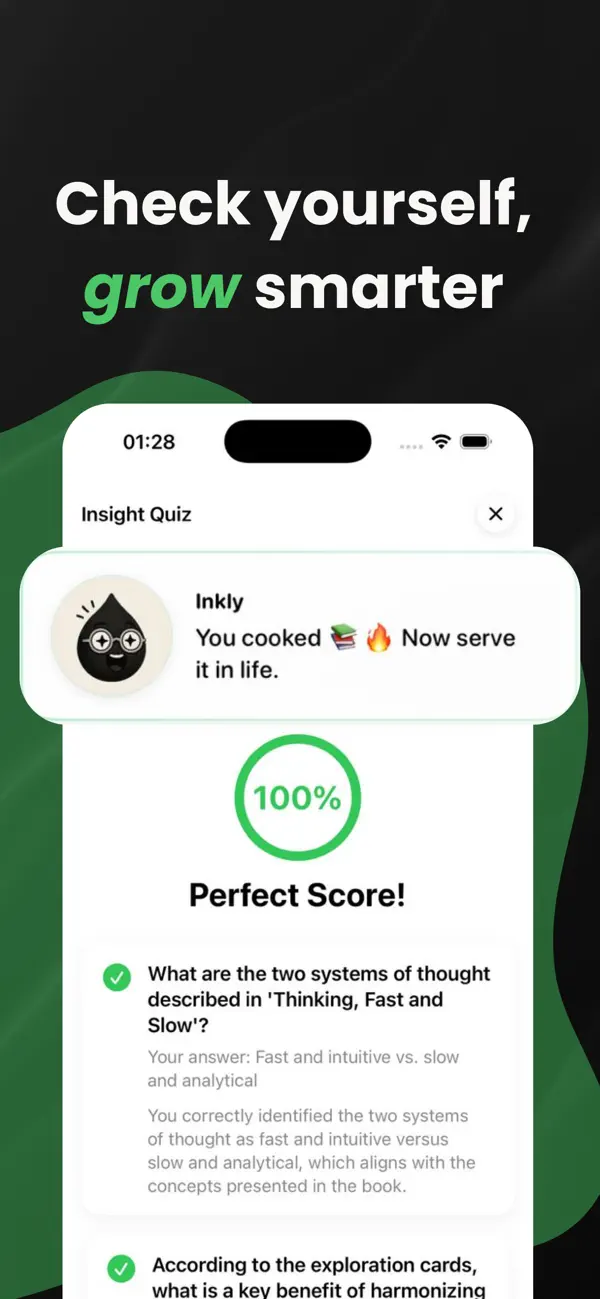
Yes, if the app makes you recall ideas and brings them back on different days. Inkly is our app, so weigh this accordingly. Inkly is an iPhone app that turns big ideas from non-fiction books into short daily lessons, with a quick quiz after each insight. The quiz is a form of retrieval practice, and one short lesson a day spreads your learning out instead of cramming it into one sitting. Inkly doesn't publish a specific spaced-repetition schedule, so we won't claim one. It's free to download, but daily insights and quizzes need an Inkly Unlimited subscription. For other options, see our roundup of the best self-improvement apps.
How to read more books (without speed reading)
You read more books by finding more minutes, not by reading faster. A 2016 review by Rayner and colleagues found a trade-off between speed and comprehension: you're unlikely to double or triple your speed and still understand the text as well. Their advice for reading faster with good comprehension is boring and true. Read more, and build your vocabulary.
The math is friendlier than you'd expect. A meta-analysis by Brysbaert (2019) of 190 studies puts the average adult's silent reading speed for non-fiction at 238 words per minute, with most people between 175 and 300. At that speed, a 75,000-word book takes about 5 hours and 15 minutes.
| Reading time per day | Days per 75,000-word book | Books per year |
|---|---|---|
| 10 minutes | 32 | 11 |
| 20 minutes | 16 | 23 |
| 30 minutes | 11 | 34 |
| 60 minutes | 5 | 69 |
Assumes 238 words per minute, the average for non-fiction in Brysbaert (2019). Your speed and your books will differ.
To run your own numbers, find your real speed with the free reading speed test, then plug it into our reading time calculator.
How to build a reading habit that sticks
- Tie reading to something you already do every day: "After I get into bed, I read 10 pages." If you're wondering how long before it sticks, our guide on how long it takes to form a habit covers the research on timing.
- Keep a book within reach: an e-reader app on your phone's home screen, a paperback in your bag. That's how a waiting room turns into reading time.
- Track it. A printable reading log makes your streak visible, and seeing 12 days in a row is a good reason not to skip the 13th.
- Quit bad books. Librarian Nancy Pearl's Rule of 50 says to give a book 50 pages and put it down if you're not enjoying it. Over 50? Subtract your age from 100 and read that many pages instead.
FAQ
Why do I forget what I read so fast?
Memory fades fastest in the first hours and days after you learn something. Ebbinghaus first measured that pattern in 1885. Most people read a book once and never practice pulling the ideas back out, so nothing slows the fade. The best-supported fix is to recall the main points with the book closed, then do it again on later days.
Is it better to take notes by hand or on a laptop?
Neither one reliably wins. A 2014 study by Mueller and Oppenheimer found an advantage for longhand, but direct replications by Morehead, Dunlosky and Rawson (2019) and by Urry and colleagues (2021) found no reliable difference. Putting ideas in your own words matters more than the tool.
Does highlighting help you remember what you read?
Not much. Dunlosky and colleagues' 2013 review rated highlighting low utility because it doesn't consistently improve later test performance. If you highlight anyway, turn the highlights into questions and answer them from memory later.
How do you retain information from self-help books?
Read with one question in mind, write a three-sentence summary from memory after each chapter, and use one idea within 48 hours. Then recall the main ideas a day, a week and a month later. Self-help books are supposed to change what you do, so the 48-hour step is the one not to skip.
How many times should you review something to remember it?
There's no proven magic number. Spread your reviews over separate days, and recall before you reread each time. In Roediger and Karpicke's 2006 study, swapping one of four reading sessions for a recall test lifted one-week recall from 40% to 56%. To keep something for a year, Cepeda and colleagues (2008) suggest a review gap of roughly a month.
Does speed reading help you read more books?
Not if you want to understand them. A 2016 review by Rayner and colleagues in Psychological Science in the Public Interest found a trade-off between speed and comprehension. An extra 10 to 20 minutes of reading a day gets you more books without that trade-off.