You have a list of books you swear you'll get to, a half-read hardback on the nightstand, and somehow you're scrolling instead. The problem usually isn't willpower. It's that you picked the wrong book, or picked it the wrong way.
Below is how to choose a book to read in seven steps, built for non-fiction and self-improvement reading. If you'd rather skip the thinking, our free book recommendation quiz does the first three steps for you in about a minute.
How to choose a book to read: the 7 steps
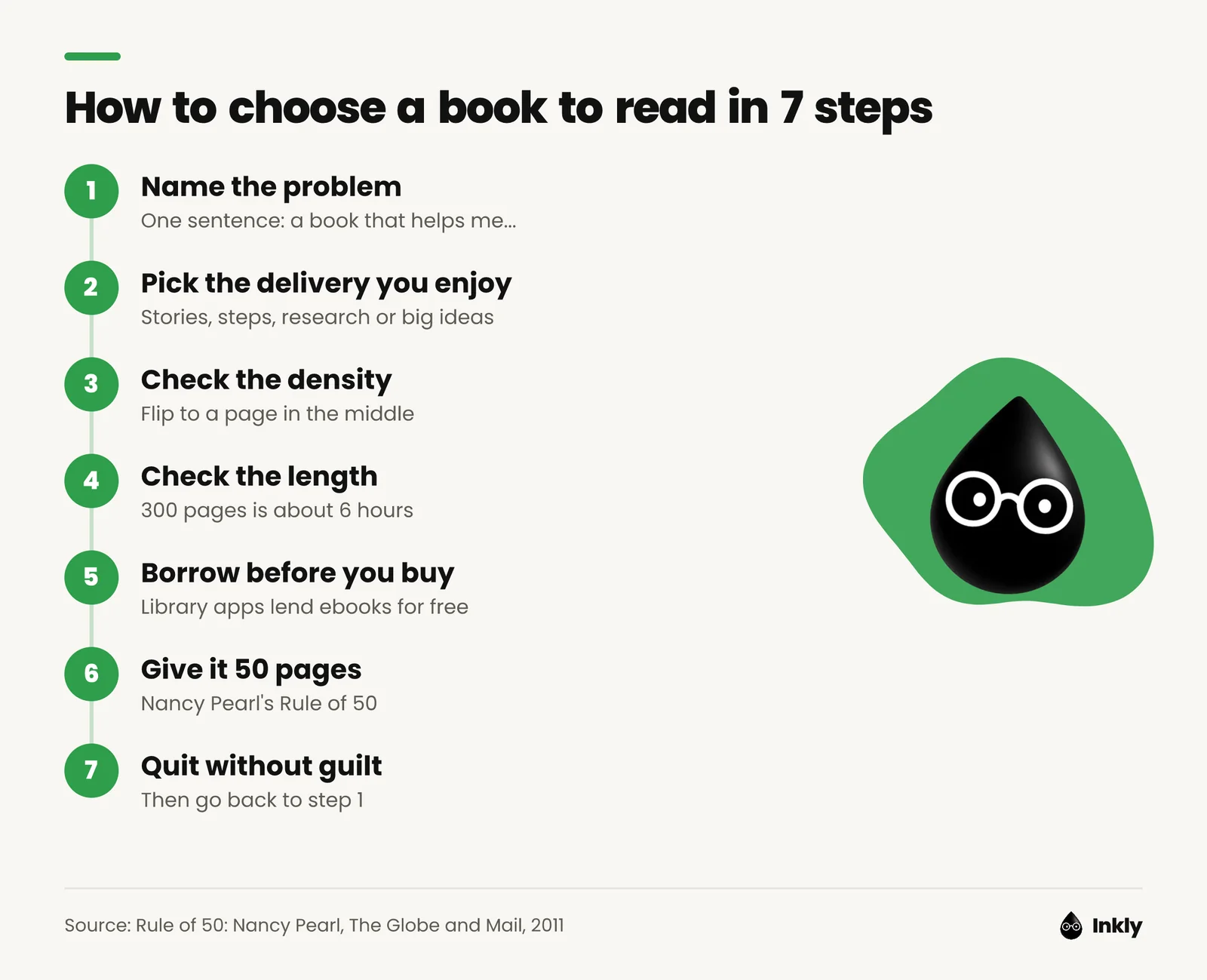
You choose a book to read by working backward from what you want it to do for you, then checking that it fits how you like to read before you commit. Here are the seven steps in order:
- Name the problem. Write one sentence: "I want a book that helps me ___."
- Pick the delivery you enjoy: stories, step-by-step frameworks, research, or big ideas to think about.
- Check the density: light and practical, some theory, or properly heavy.
- Check the length against your week. At an average pace, a 300-page book is about six hours.
- Borrow before you buy. Your library's app lends ebooks and audiobooks for free.
- Give it 50 pages. That's about an hour, and enough to know.
- Quit without guilt, then go back to step 1 with what you learned.
Most bad picks fail in the first three steps. You get a great book aimed at someone else's problem, or a good book in a style you'll never finish. Steps 4 to 7 just keep a wrong pick cheap.
What problem do you want the book to solve?
Start with the thing that's costing you the most right now, because a book that answers a question you actually have is a book you'll finish. "I should read more" isn't a problem. "I open my phone before I've decided to" is.
Write that sentence down before you browse. It turns a bookstore into a search with one right answer instead of a wall of shiny covers.
Here's where we'd start for the most common problems. Every book comes from our list of the 15 best self-improvement books, which also says who should skip each one.
| If your problem is | Start with | Why it fits |
|---|---|---|
| Habits that don't stick | Atomic Habits (James Clear, 2018) | Small systems instead of big resolutions |
| You can't focus | Stolen Focus (Johann Hari, 2022) | Explains why attention breaks, beyond willpower |
| Never enough time | Four Thousand Weeks (Oliver Burkeman, 2021) | Stops the efficiency chase |
| Worry and anxious thoughts | The Happiness Trap (Russ Harris, 2007) | Unhook from thoughts instead of fighting them |
| Money stress | The Psychology of Money (Morgan Housel, 2020) | Behavior over spreadsheets |
| Decisions you regret | Thinking, Fast and Slow (Daniel Kahneman, 2011) | Names the biases so you can catch them |
| Awkward with people | How to Win Friends and Influence People (Dale Carnegie, 1936) | Simple habits few people actually use |
| No clear purpose | Man's Search for Meaning (Viktor Frankl, 1946) | Where meaning comes from, even in hard times |
If two problems tie, pick the one you'd fix first if you could only fix one. The other one is your next book.
How do you know if a book's style will suit you?
A book's style suits you when the way it delivers ideas matches how you already like to take them in. Non-fiction comes in roughly four deliveries:
- Stories carry the idea through people and examples. Easy to read in bed, harder to turn into a to-do list.
- Frameworks give you steps you can use tomorrow. Great for habits and productivity, thinner on the why.
- Research books walk you through the studies. Convincing, sometimes slow.
- Philosophy hands you a big idea and trusts you to do something with it. Best in small doses.
The same topic comes in every flavor. On focus, Stolen Focus is mostly reporting and stories, while Deep Work by Cal Newport (2016) is a set of rules. Same problem, a very different week of reading.
Then check the density. Open the book to a page in the middle, not the first page, which gets the most polish. If you find long paragraphs, footnotes and terms you'd need to look up, and you wanted something light, put it back. Thinking, Fast and Slow is brilliant and heavy; The Psychology of Money covers some of the same ground about bad decisions in a lighter, story-driven book.
One honest caveat: matching your preferred style doesn't make you learn more. A 2008 review in Psychological Science in the Public Interest found no adequate evidence that teaching people in their preferred style improves learning. Our take is that style still matters for picking books, for a simpler reason: you're more likely to finish a book you enjoy reading. Not sure what you prefer? Our three-minute learning style quiz shows your mix.
How long will the book take to read?
A 300-page book takes most adults about six hours to read. That assumes about 275 words per page and 238 words per minute, the average adult silent reading speed for non-fiction in a 2019 meta-analysis of 190 studies by Marc Brysbaert.
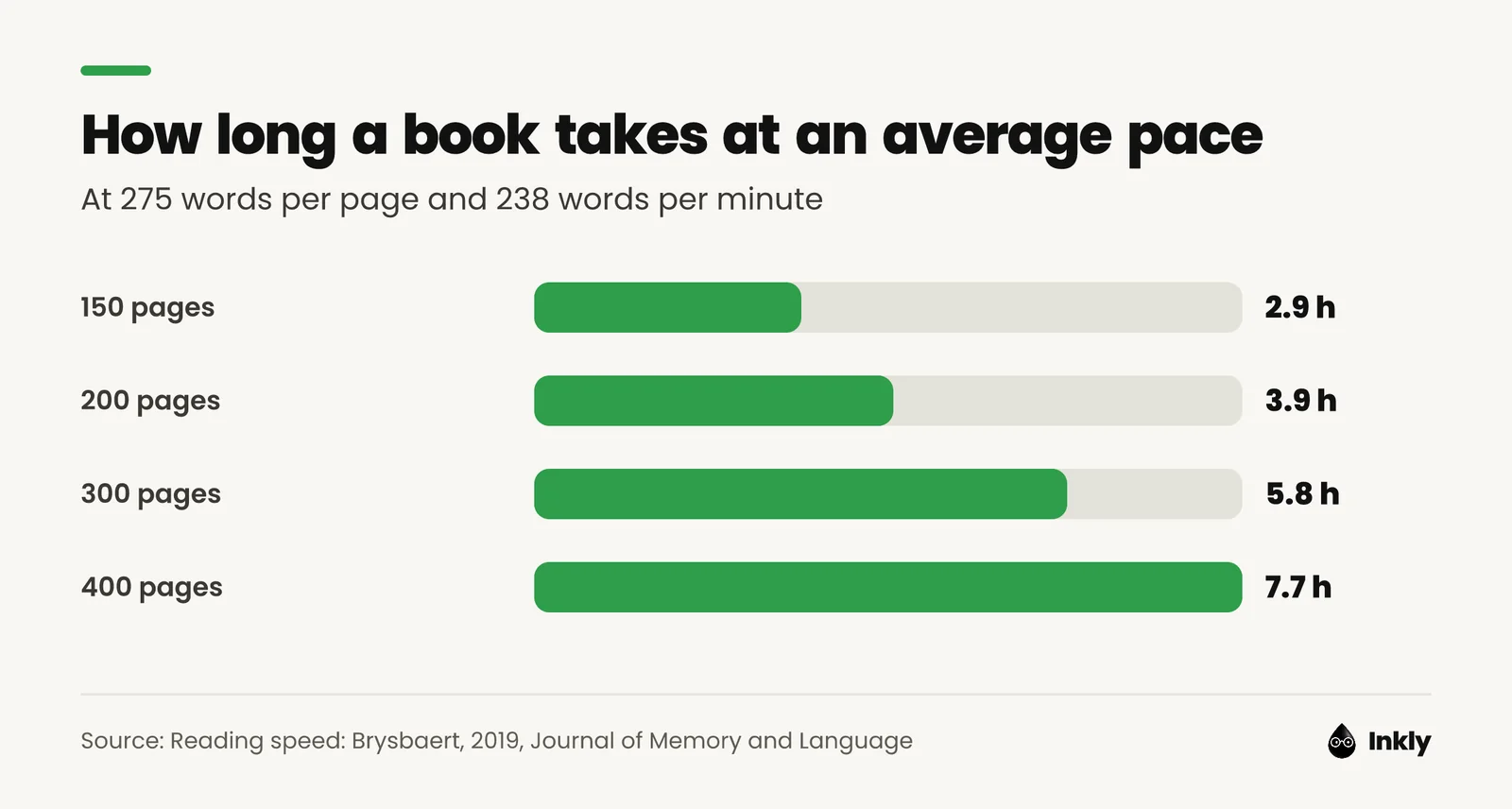
Six hours sounds like a weekend. Spread over 20 minutes a day, it's about two and a half weeks. Check that against your actual calendar before you start a 600-page doorstop in your busiest month. Your own speed changes the math, so plug the page count into our reading time calculator and it will give you a finish date too.
Where can you find good books to read?
The best places to find good books to read are the ones that already know your taste: the notes of a book you loved, a friend who reads like you, and your library.
- The notes or bibliography of a book you loved. Authors cite the books that shaped their thinking, so those picks come pre-filtered by someone you already trust.
- One friend whose taste matches yours. Ten strangers' star ratings tell you less than one person who knows what you liked last time.
- Reviews that say who should skip the book. A review that only says "amazing" can't tell you whether it's amazing for you.
- Your library. Libby, OverDrive's library app, lends ebooks, audiobooks and magazines for free with a library card, on iPhone, Android and the web. Loan limits depend on your library.
- A quiz built on a list you trust. More on that below.
Borrowing first takes the pressure off. A free book you quit after 50 pages cost you an hour, and nothing else.
How many pages should you read before giving up on a book?
Read about 50 pages before you decide. That's librarian Nancy Pearl's Rule of 50: give a book 50 pages, and if you're not enjoying it by then, put it down and pick another. Readers aged 51 and older read 100 minus their age instead, so the test gets shorter every year. Pearl laid it out in an essay for The Globe and Mail in 2011.
Fifty pages is about an hour at an average pace. That's a cheap test for a book that could take six.
Pearl also says you can come back to a dropped book later, and that part is worth remembering. Sometimes the book is fine and the timing is wrong. A book about grief can bounce off you in a good year and land hard in a bad one.
What should I read next?
Read whatever answers the problem you named in step 1, in the style you enjoy. If you want that done for you, our free quiz that picks your next book asks six questions and gives you three picks, with the reason each one fits you.
It works like the steps above. The problem you want to fix counts most, then how you like ideas delivered, then tone and density, and it leaves out the books you've already read. Every pick is a book we've written about in depth. There are no affiliate links and nobody pays to be on the list.
If none of the three feel right, that's useful too. It usually means the problem you named isn't the one that's actually bugging you.
How do you remember the book once you've picked it?
Choosing well is half the job. The other half is remembering the book a month later, and the method with the best evidence is recalling ideas from memory instead of rereading. Our guide on how to remember what you read walks through it, and the free one-page book notes template gives you somewhere to write it all down.
Inkly is our app, so weigh this accordingly. It turns big ideas from non-fiction books into short daily lessons with a quick quiz after each one, so the recall habit is built in. It's free to download on iPhone.
FAQ
How do I choose a book when I have too many options?
Cut the list with one question: which of these answers a problem I have right now? That usually leaves two or three. Read a few pages from the middle of each, or borrow them from the library, and start the one you didn't want to put down.
How do I pick a book to read if I haven't read in years?
Pick something short, light and about a problem you care about this month. A 200-page book takes about four hours at an average pace, or roughly eight 30-minute evenings. Finishing one easy book does more for the habit than abandoning a classic.
Is it OK to stop reading a book halfway?
Yes. A book you're forcing yourself through is eating the time you could spend on one that helps. Librarian Nancy Pearl's Rule of 50 says to give a book 50 pages and drop it if you're not enjoying it, and you can always come back later.
What is the Rule of 50 for reading?
The Rule of 50 is Nancy Pearl's guideline for quitting books: read 50 pages, and if the book hasn't won you over, stop. If you're 51 or older, read 100 minus your age in pages instead. Pearl is a librarian and the author of Book Lust (2003).
Should I read a book summary instead of the whole book?
Use a summary to decide, not to replace the book. A good summary tells you in a few minutes whether the book answers your problem. If it does and the book is under 200 pages, skip the summary and read the book.
What is a good first self-help book to read?
If nothing specific is bothering you, start with Atomic Habits by James Clear (2018). It's practical from the first chapter, and better habits make every other book easier to act on. If something is bothering you, start with the book that matches that problem instead.