A general knowledge app teaches you a little about a lot, from the fall of Constantinople to how undersea cables work. Search the App Store for one and you mostly get trivia games. These are the eight that actually teach.
The list isn't ranked: it's sorted by how each app teaches, with its November 2026 price, free part and catch. Everything comes from store listings, company sites and recent public reviews; we didn't hands-on test the apps.
At the end sits Inkly, which teaches ideas from non-fiction books instead. Inkly is our app, so weigh our take accordingly.
What are the best general knowledge apps in 2026?
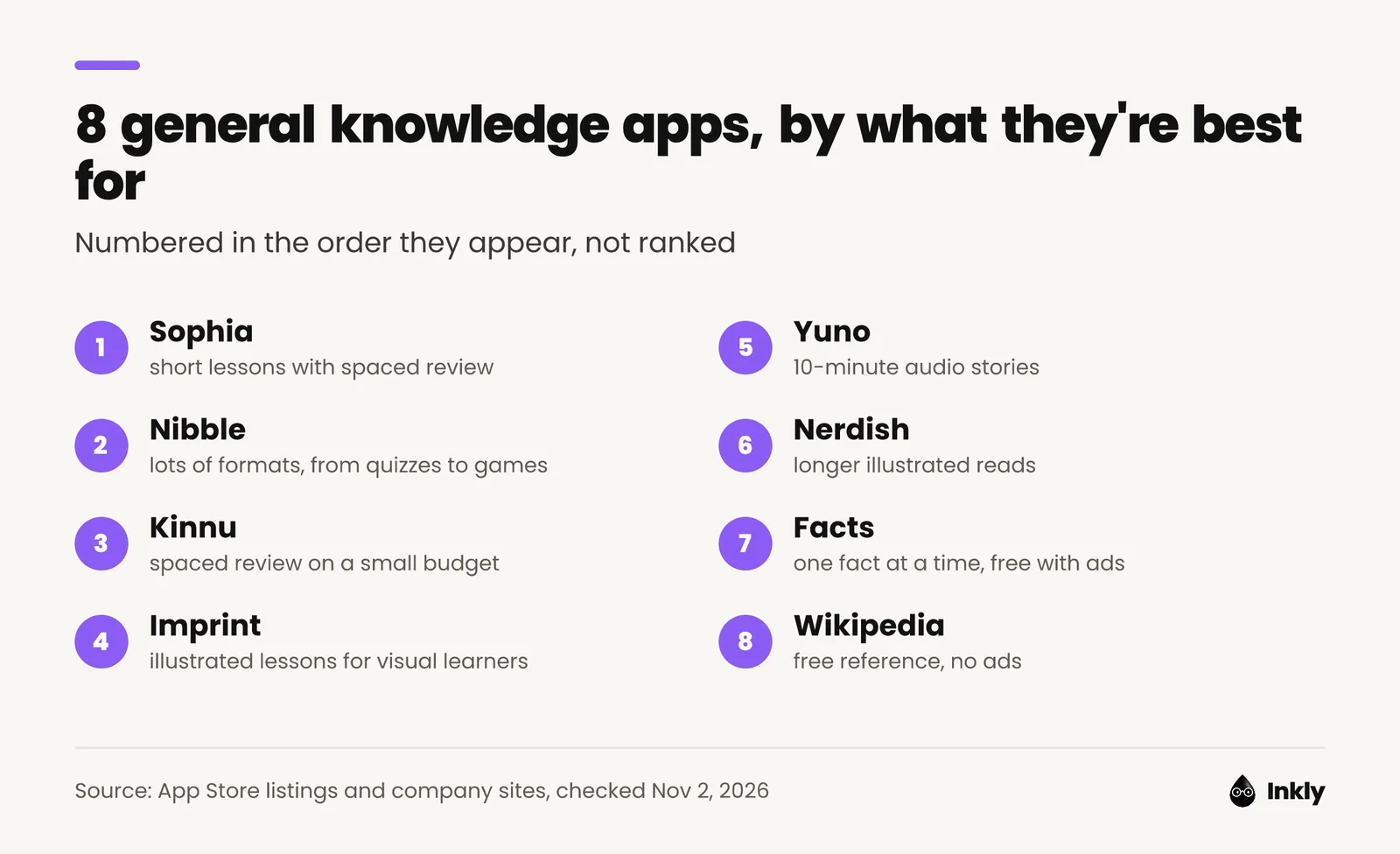
The best general knowledge apps in 2026 are Sophia, Nibble, Kinnu, Imprint, Yuno, Nerdish, Facts and Wikipedia, each suited to a different way of learning. The table puts them side by side.
| App | Best for | Format | Free part | Price from (US App Store) | Platforms | App Store rating |
|---|---|---|---|---|---|---|
| Sophia | Lessons with spaced review | 5-screen lesson + quiz | First lessons | $8.99/month or $5.99/week | iPhone, iPad, Android | 4.7 (161) |
| Nibble | Variety of formats | 10-min lesson + quiz | First lesson | $19.99/month; yearly $12.99 to $89.99 | iOS, Android, web | 4.3 (46,940) |
| Kinnu | Review on a small budget | Pathways + questions | Pathways (Kinnu says) | $1.99/month item listed | iOS, Android | 4.8 (516) |
| Imprint | Visual learners | 2-min illustrated chapters | None listed | $15.99/month; yearly $74.99 to $99.99 | iOS, Android, web login | 4.8 (59,650) |
| Yuno | Learning by ear | 10-min audio story + quiz | Limited stories | $12.99/month; $79.99/year | iOS, Android | 4.8 (14,636) |
| Nerdish | Longer reads | 10 to 15-min article, with audio | Not stated | $4.99/month; yearly $29.99 to $39.99 | iOS, Android | 4.8 (2,676) |
| Facts | One fact at a time | One-fact cards | Everything, with ads | $4.99/month; $99.99 lifetime | iOS, Android | 4.8 (69,450) |
| Wikipedia | Looking things up | Encyclopedia + feed | Everything, no ads | Free | iOS, Android, web | 4.3 (6,382) |
Prices are the US App Store's in-app purchase lists, checked November 2, 2026. Apple doesn't say which item you'll be offered and none of these apps posts prices on its own site, so treat them as ranges. Ratings are US App Store averages with the number of ratings.
How we picked: we searched the US App Store for "general knowledge", skipped the trivia games that fill the results (they test what you know rather than teach), dropped apps with fewer than 125 US ratings, and added Imprint, Facts and Wikipedia, which teach general knowledge without the label. All eight got an update in 2026.
What is a general knowledge app?
A general knowledge app is a phone app that teaches short pieces of history, science, art, philosophy and other subjects, usually in sessions of 2 to 15 minutes, often with a quiz at the end. There's no exam and no single skill to master; the point is breadth.
Most apps to learn general knowledge fall into one of three groups:
- Lesson apps (Sophia, Nibble, Kinnu, Imprint) give you a short lesson and questions each day.
- Listening and reading apps (Yuno, Nerdish) give you a story or an article.
- Fact feeds and references (Facts, Wikipedia) hand you material and leave the rest to you.
If you'd rather build one skill, like math, design or a university subject, our guide to the best learning apps for adults is a better fit.
Which general knowledge apps teach in daily lessons?
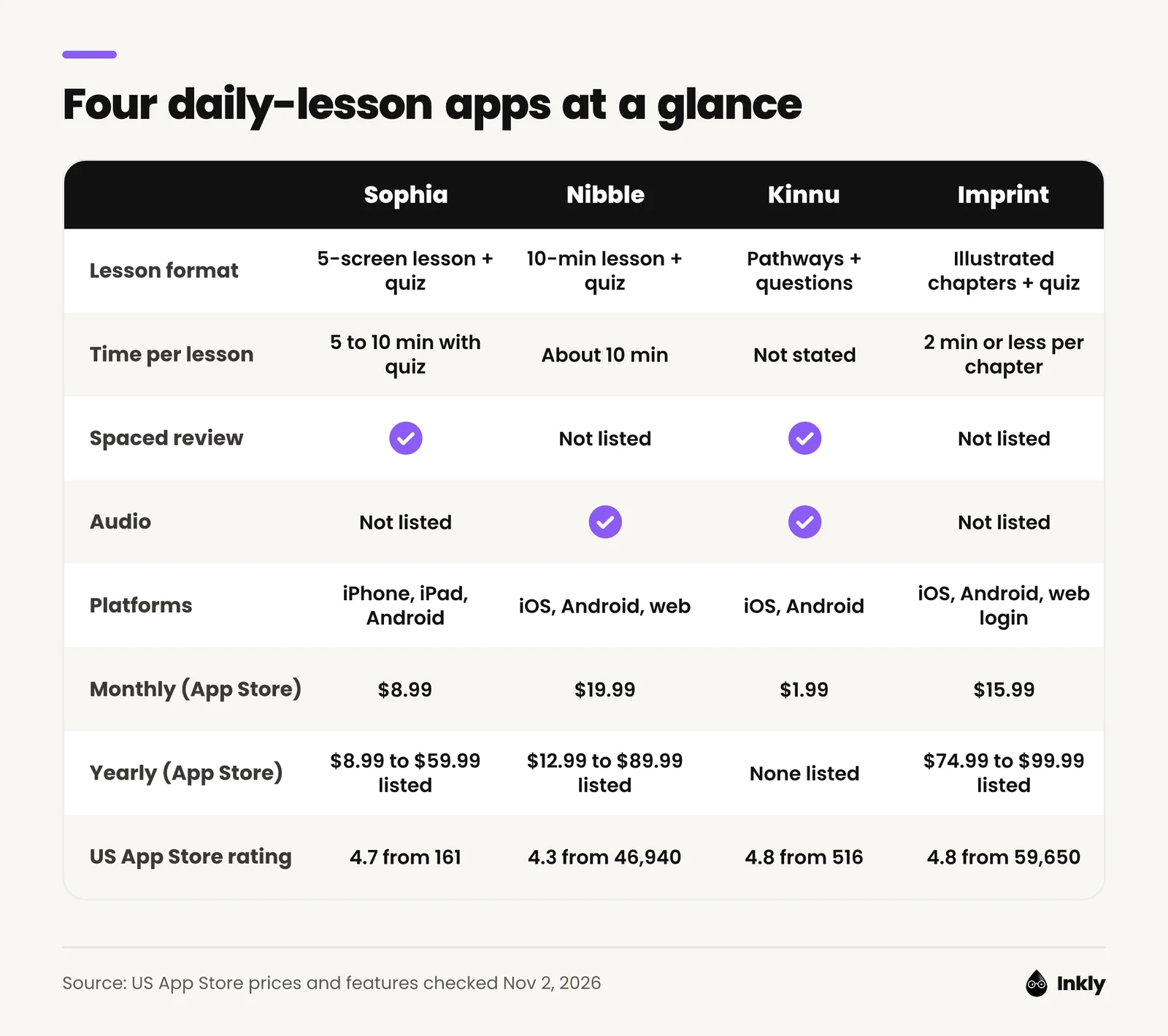
Sophia, Nibble, Kinnu and Imprint teach in short daily lessons, each followed by questions. Sophia and Kinnu also bring old material back for review, which is the part that makes it stick.
1. Sophia: best for short lessons with spaced review
Sophia (listed as "Sophia : General Knowledge") is a general knowledge app from France that teaches history, mythology, art, literature, science and "understanding today's world" in five-screen lessons, each followed by a short quiz.
- Best for: a tidy 10-minute habit with review built in.
- What you get: Sophia says it has over 240 lessons, written with academics and PhD holders. A lesson takes 5 to 10 minutes including the quiz, and a daily review uses spaced repetition, according to Sophia's website.
- Price: the first lessons are free; a subscription opens the full catalog, the quizzes and the daily review. As of November 2026, the US App Store listing shows $8.99 a month or $5.99 a week, with yearly plans listed from $8.99 to $59.99.
- Platforms: iPhone, iPad and Android. 4.7 stars from 161 US App Store ratings.
- Catch: it's new (first released in April 2026), and several reviewers say only the intro is free. Some find the lessons short on context and the quiz questions repetitive. Our Sophia vs Inkly comparison goes into more detail.
2. Nibble: best for variety
Nibble is a general knowledge app of interactive 10-minute lessons and quizzes, on topics including art, math, logic, history, statistics, personal finance, philosophy, biology and literature.
- Best for: people who get bored of one format by Thursday.
- What you get: lessons with quizzes, games, audio and video episodes, and chats with historical figures and AI tutors, per Nibble's website. You choose 5, 10 or 15 minutes a day.
- Price: Nibble's site says your first lesson is free. As of November 2026, the US App Store lists $19.99 a month, $39.99 for three months and annual plans from $12.99 to $89.99.
- Platforms: iPhone, iPad, Android and web, with progress synced. 4.3 stars from 46,940 US App Store ratings.
- Catch: most recent reviews are happy, but the unhappy ones describe a subscription bought on the web after a quiz or ad that never showed up in Apple's subscription list. A few call the content simple or AI-generated.
3. Kinnu: best for review on a small budget
Kinnu (listed as "Kinnu - General Knowledge") is a microlearning app that teaches through map-based "pathways" of short, expert-edited lessons, with questions and a spaced review feature it calls Memory Shield.
- Best for: people who want review built in without paying much.
- What you get: pathways on psychology, health, science, history, technology and literature, plus random ones like dinosaurs and secret societies, with adaptive questions, games and audio versions of all content, per its App Store listing. It doesn't say how long a lesson takes.
- Price: Kinnu's website calls its pathways free. As of November 2026, the US App Store lists a $1.99 monthly subscription and certificates from $7.99 to $19.99; Kinnu doesn't say what the $1.99 plan adds.
- Platforms: iPhone and Android. 4.8 stars, but from only 516 US App Store ratings.
- Catch: that small count, and the App Store's public review feed has nothing newer than April 2025. Those older reviews mention courses that failed to load or sync, and content with no named authors or sources.
4. Imprint: best for visual learners
Imprint is a visual learning app that explains psychology, philosophy, history, finance, science and bestselling books in illustrated chapters of two minutes or less, with daily quizzes.
- Best for: people who remember a picture long after they've lost the paragraph.
- What you get: courses, quick reads and visual guides to books such as Sapiens and Atomic Habits, per its App Store listing.
- Price: no free plan is listed. As of November 2026, the US App Store lists $15.99 a month and yearly plans from $74.99 to $99.99.
- Platforms: iOS and Android, plus a web login. 4.8 stars from 59,650 US App Store ratings.
- Catch: 48 of its 100 most recent App Store reviews give one star, mostly because you can't see a lesson before subscribing and the free trial requires the yearly plan. Our Imprint app review covers where to pay and how to cancel.
Which general knowledge apps let you listen or read longer?
Yuno and Nerdish suit people who would rather follow a story than answer questions. Yuno is audio first, with a quiz after each story; Nerdish publishes 10- to 15-minute illustrated articles you can also listen to.
5. Yuno: best for learning by ear
Yuno (listed as "Yuno: Daily Micro Learning") is an audio app that teaches general knowledge in stories about 10 minutes long, read by professional voice actors, with quizzes afterward.
- Best for: commutes, dishes and walks. Not sure listening works for you? Our free learning preferences quiz shows which formats you reach for.
- What you get: stories in eight categories, from art and music to nature and health, in playlists with new stories every week, per its App Store listing. The listing says 400 stories; Yuno's website claims 1,000.
- Price: Yuno's terms (dated September 2022) describe free registration with a limited number of stories. As of November 2026, the US App Store lists Yuno Plus at $12.99 a month or $79.99 a year, plus other items up to $99.99 for a family plan.
- Platforms: iPhone and Android. 4.8 stars from 14,636 US App Store ratings.
- Catch: 43 of its 100 most recent App Store reviews give one star, more than give five. Most describe a free trial that became an annual charge of about $80 with no reminder; some complain about AI-generated images with mistakes in them.
6. Nerdish: best for longer reads
Nerdish (listed as "Nerdish: Learn Something New") is a general knowledge app of short editorial articles, each 10 to 15 minutes long and split into five or six chapters of two to three minutes, with an audio version of every article.
- Best for: swapping an evening scroll for one proper story.
- What you get: illustrated articles on topics such as Nefertiti, Fordlandia, undersea cables and the history of antibiotics, per Nerdish's website. Neither the site nor the listing mentions quizzes.
- Price: Nerdish doesn't say what's free, and Google Play labels the app "Contains ads". As of November 2026, the US App Store lists Premium at $4.99 a month or $39.99 a year, plus a $29.99 annual special.
- Platforms: iPhone and Android. 4.8 stars from 2,676 US App Store ratings, a small count.
- Catch: Nerdish says people write its articles with subject experts, but some recent reviewers say they read as AI-written or contain factual errors. We can't verify either side, so check a second source before you repeat anything at dinner.
Which apps teach you something new every day without lessons?
Facts and Wikipedia hand you material with no lessons, plan or review. That makes them the lightest way to learn something new every day, and the easiest to forget.
7. Facts: best for one fact at a time
Facts ("Facts - Daily Random Trivia" on the App Store, "Daily Random Facts" on Google Play) is a fact feed that shows one fact per card, from categories such as the human body, history, animals, science and life hacks.
- Best for: people who want something lighter than a lesson. It's the purest learn-something-new-every-day app here.
- What you get: "thousands of facts", per its App Store listing. Premium removes ads and adds favorites, search and browsing by category.
- Price: free with ads. As of November 2026, the US App Store lists Premium from $4.99 a month, yearly items from $14.99 to $47.99 and a $99.99 lifetime option.
- Platforms: iPhone and Android. 4.8 stars from 69,450 US App Store ratings.
- Catch: about 9 of its 100 most recent App Store reviews say a fact was wrong, was a myth or wasn't backed by its "more info" link. For a facts app, that's the complaint that matters.
8. Wikipedia: best free option
Wikipedia is the official app of the free encyclopedia, made by the Wikimedia Foundation. It's a reference, with no lessons, quizzes or streaks.
- Best for: following your own curiosity, for free.
- What you get: the App Store listing claims 60+ million articles in nearly 300 languages; English alone has about 7.26 million, per Wikipedia's statistics page. The app adds a personalized feed, a picture of the day and offline reading lists.
- Price: free, with no ads and no in-app purchases.
- Platforms: iPhone, Android and the web. 4.3 stars from 6,382 US App Store ratings.
- Catch: Wikipedia only teaches what you think to look up. With no plan, quiz or reminder, it makes a great second app and a weak first one if you want a daily habit.
What if you want ideas from books instead?
If you want ideas you can use, like why decisions go wrong or how habits form, a book-ideas app fits better than anything above. Inkly is one; Headway and Blinkist are others, and our list of microlearning apps covers all three.
Inkly is an iPhone app that works like Duolingo for personal growth: it turns big ideas from non-fiction books, such as Thinking, Fast and Slow, into short daily insights, each followed by a quick quiz. It isn't a general knowledge app, which is why it isn't one of the eight. As noted above, it's ours; the facts come from its App Store listing.
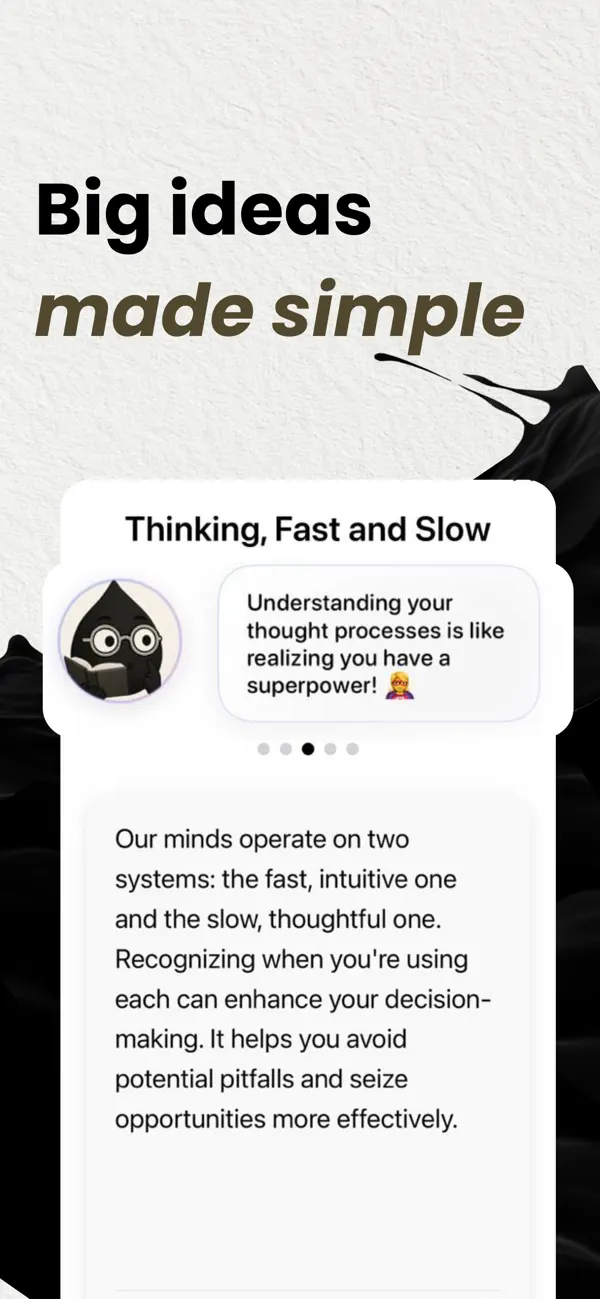
- What you get: a learning type (for example "Vision Weaver"), an adaptive plan built from your goals and habits, daily insights, quizzes, chat with Inkly to turn an idea into action, and a growth map across six areas.
- Price: the learning-pattern analysis and plan preview are free; insights, quizzes, AI reflection and progress tracking need Inkly Unlimited. As of November 2026, the App Store listing shows plans from $9.99 a month or $19.99 a year.
- Platforms: iPhone only. 4.6 stars from 17 App Store ratings.
- Catch: no Android or web app, and the lessons themselves need a subscription.
Looking for habit, focus or meditation apps instead? Our roundup of the best self-improvement apps covers those.
Which general knowledge app is free?
Wikipedia is the only app here that's completely free, with no ads and nothing to buy. Here's what each app gives you without paying:
- Wikipedia: everything, no ads.
- Facts: every fact, with ads.
- Kinnu: its website calls the pathways free, though a $1.99 monthly plan exists.
- Sophia: the first lessons.
- Nibble: the first lesson.
- Yuno: a limited number of stories, per its terms.
- Imprint: no free plan listed.
- Nerdish: not stated, and Google Play shows it has ads.
If you start a free trial, note where you signed up (App Store, Google Play or the app's website) and set a reminder for the day before it ends. Billing and paywall complaints lead the recent one-star reviews of Imprint, Yuno and Facts.
How do you actually remember what these apps teach?
You remember what a general knowledge app teaches by pulling it back out of your head later, not by reading more of it. Two well-tested findings back this up:
- Recall beats rereading. In Roediger and Karpicke's 2006 study, 120 students who took a recall test on a short passage remembered 56% of it a week later, against 42% for students who studied it again.
- Spread beats cram. A 2006 review by Cepeda and colleagues found spaced study beat massed study across 271 comparisons (47.3% recall against 36.7%). One limit: most of those experiments used word lists, not history lessons.
In this list, Sophia and Kinnu build in spaced review, and Nibble, Imprint and Yuno quiz you after each lesson. Nerdish, Facts and Wikipedia don't test you at all, so add the test yourself:
- Close the app and say the point out loud. One sentence: what happened and why it mattered.
- Recall it the next morning before you open the app. If nothing comes back, redo that lesson instead of starting a new one.
- Tell someone. Explaining the fall of Constantinople over dinner is a recall test with an audience.
Our guide on how to remember what you read has the full method, and it works as well for a 10-minute lesson as for a book.
FAQ
What is the best general knowledge app?
There isn't one best general knowledge app, because they teach in different ways. Sophia and Kinnu are the strongest picks if you want review built in, Nibble if you want variety, Imprint if you learn from pictures and Yuno if you'd rather listen. Wikipedia is the best free option.
Is there a free general knowledge app?
Yes. Wikipedia is completely free with no ads, and Facts is free with ads. Kinnu says its pathways are free, while Sophia and Nibble let you try the first lessons before you pay.
What are some apps like Sophia?
The closest apps to Sophia are Nibble and Kinnu, which also teach general knowledge in short lessons with questions; Kinnu has spaced review too. Imprint is similar but illustrated, and Yuno does the same job in audio. If you want ideas from non-fiction books rather than general knowledge, Inkly (our app) is an iPhone option.
What is the best app to learn something new every day?
For a daily lesson you'll remember, pick an app with quizzes and review, such as Sophia, Kinnu or Nibble. For something lighter, Facts gives you one fact at a time, free with ads. Nerdish suits one longer story a day.
Which general knowledge apps work on Android?
All eight apps in this list work on Android: Sophia, Nibble, Kinnu, Imprint, Yuno, Nerdish, Facts and Wikipedia. Nibble and Wikipedia also run in a web browser, and Imprint has a web login. Inkly, the book-ideas app at the end, is iPhone only.
Is Sophia the same as Sophia Learning?
No. Sophia: General Knowledge is a daily lesson app made by Vik Studios in France and first released in April 2026. Sophia Learning (sophia.org) is a separate US site that sells college-credit courses.