A microlearning app teaches in lessons short enough to finish while the kettle boils: two to fifteen minutes, usually with a quiz or streak to pull you back tomorrow. Plenty of apps call themselves that now, and most "best microlearning apps" lists are written by one of them, with their own app at number one.
This one isn't ranked. We sorted ten apps by what they teach, then wrote down each one's October 2026 price, its free tier and its catch. Inkly is our app, so weigh our take accordingly. Everything below comes from each app's App Store and Google Play listing, pricing page and public reviews; we didn't hands-on test all ten.
What is a microlearning app?
A microlearning app is a phone app that teaches in very short lessons, usually under 15 minutes, built to fit into gaps in your day. Most add a daily goal, a streak and a quick quiz, borrowing the loop that made Duolingo a habit for millions. You'll see it spelled both ways: micro learning apps and microlearning apps are the same thing.
This list covers apps for individuals. Microlearning platforms, the business tools companies use to send short training to staff, are a different product; G2's microlearning platforms category is a better starting point for those.
What are the best microlearning apps in 2026?
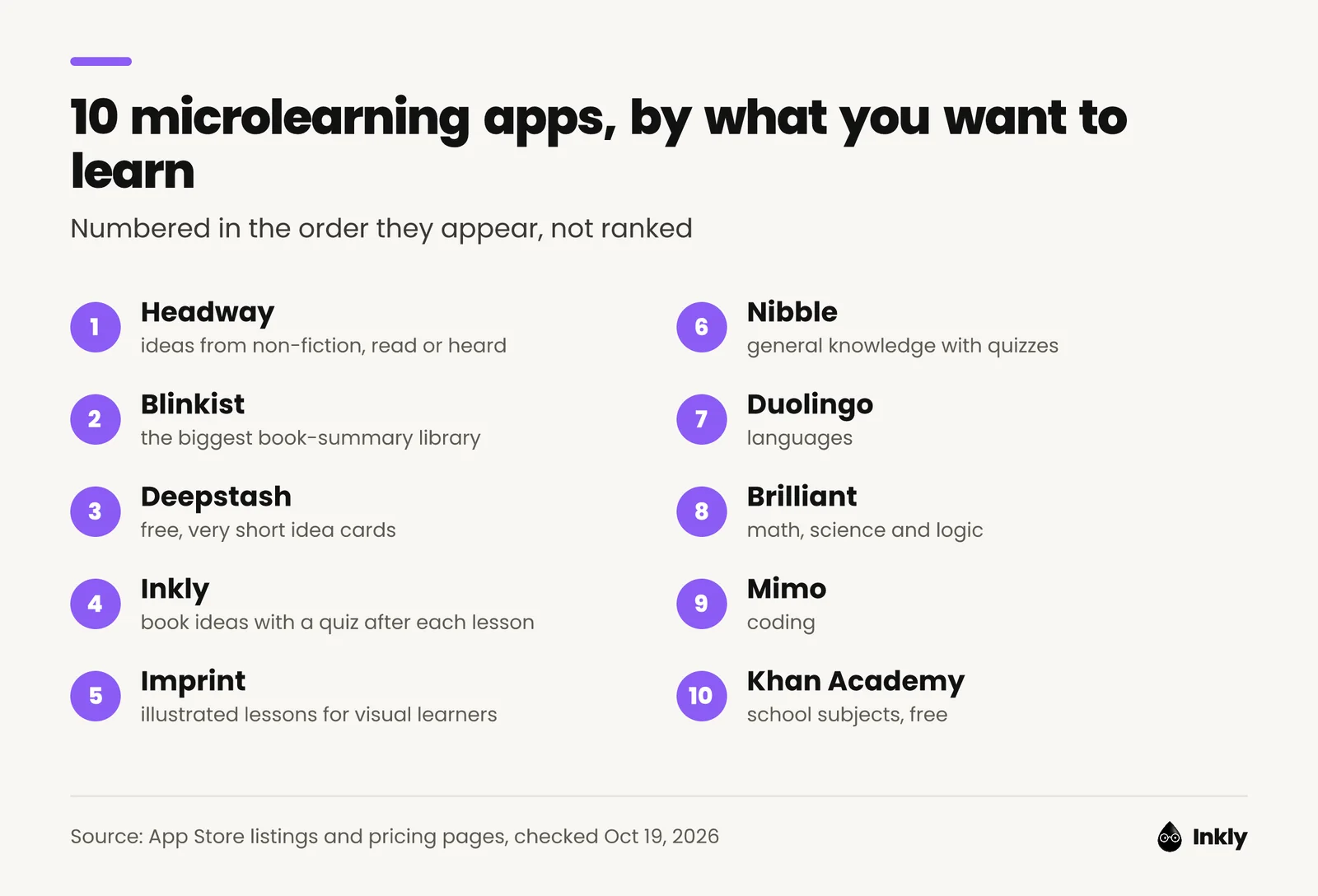
The best microlearning apps in 2026 are Headway, Blinkist, Deepstash, Inkly, Imprint, Nibble, Duolingo, Brilliant, Mimo and Khan Academy, each matched to what it teaches best. The table puts them side by side.
| App | Best for | Free tier | Price from (US) | Platforms | App Store rating |
|---|---|---|---|---|---|
| Headway | Ideas from books | 1 summary a day | $12.99/month or $89.99/year | iOS, Android | 4.6 (117,203) |
| Blinkist | Book summaries, audio | 1 daily pick | $99.99/year ($79.99 first year) | iOS, Android, web | 4.8 (157,080) |
| Deepstash | Very short idea cards | Yes, with ads | Pro from $12.99/month | iOS, Android, web | 4.7 (80,815) |
| Inkly | Book ideas + quizzes | Plan preview | $9.99/month or $19.99/year | iPhone only | 4.6 (17) |
| Imprint | Visual lessons | None listed | $15.99/month or $74.99/year | iOS, Android | 4.8 (58,078) |
| Nibble | General knowledge | First lesson | In-app items $12.99 to $89.99 | iOS, Android, web | 4.3 (46,866) |
| Duolingo | Languages | All courses, with ads | Super from $9.99 (in-app) | iOS, Android, web | 4.7 (5.5 million) |
| Brilliant | Math and science | Daily lesson | $20/month, billed yearly | iOS, Android, web | 4.7 (33,045) |
| Mimo | Coding | Basic, limited | $9.99/month, billed yearly | iOS, Android, web | 4.8 (110,649) |
| Khan Academy | School subjects | Everything | Free | iOS, Android, web | 4.6 (112,460) |
Prices are in US dollars, checked on October 19, 2026, on each company's pricing page or, where it publishes none, the US App Store's in-app purchase list. Ratings are US App Store averages with the number of ratings. Intro prices renew higher; the entries below give the details.
How we picked: we started from what people want to learn in short bursts (book ideas, general knowledge, languages, math, code, school subjects), chose the best-known app for each, and kept only apps that list their prices somewhere official. The numbers are only there to help you find your place. Number 1 isn't better than number 10.
Which microlearning apps teach ideas from books?
Headway, Blinkist, Deepstash and Inkly turn non-fiction books into lessons you can finish in under 15 minutes. Headway and Blinkist give you a whole book's argument, Deepstash gives you single ideas in seconds, and Inkly gives you one big idea a day with a quiz.
1. Headway: best for ideas from non-fiction
Headway is a book-summary app that sums up key ideas from non-fiction bestsellers in under 15 minutes, as text or audio, with a short daily learning session.
- Best for: getting the main argument of a popular book before you decide to read the whole thing.
- What you get: summaries, self-growth challenges, spaced-repetition flashcards and widgets, per its App Store listing.
- Price: the free plan gives you one summary a day, no card needed. As of October 2026, Headway's features page lists $12.99 a month, $29.99 a quarter or $89.99 a year, with a 7-day free trial.
- Platforms: iPhone, iPad and Android, plus CarPlay and Android Auto. 4.6 stars from 117,203 US App Store ratings.
- Catch: almost all recent App Store reviews are five stars or one, and the one-star reviews cluster around surprise renewals. More in our Headway app review.
2. Blinkist: best for the biggest summary library
Blinkist is a book-summary app with 9,000+ titles in 15-minute text and audio summaries, plus a free summary every day.
- Best for: commutes and chores, when your ears are free and your eyes aren't.
- What you get: the full library, expert Guides, offline listening and Send-to-Kindle on Premium. Pro adds Blinkist AI, which summarizes articles, PDFs and videos.
- Price: the free Basic plan gives you one summary a day, picked by Blinkist's editors. As of October 2026, Blinkist's pricing page lists Premium at $99.99 a year, shown as $79.99 for the first year with an auto-applied coupon, and Pro at $174.99 a year ($139.99 the first year).
- Platforms: iOS, Android, web and CarPlay. 4.8 stars from 157,080 US App Store ratings.
- Catch: in recent App Store reviews, the most repeated complaint is a free trial that rolled into a full yearly charge. Our Blinkist review covers how to avoid that.
3. Deepstash: best for free, very short idea cards
Deepstash is a microlearning app that breaks books, articles and podcasts into short idea cards you can read in seconds, with about five minutes a day as the pitch.
- Best for: replacing a social feed.
- What you get: according to the App Store listing, free access to 200,000+ ideas, plus collections called stashes. Pro removes ads and adds audio, offline reading and unlimited history.
- Price: free with ads. As of October 2026, the US App Store lists Pro from $12.99 a month and yearly plans from $29.99 to $119.99, depending on the offer shown. The website publishes no prices.
- Platforms: iOS, Android and web. 4.7 stars from 80,815 US App Store ratings.
- Catch: about 30 of its 100 most recent App Store reviews mention charges, refunds or canceling. Our Deepstash review has the details.
4. Inkly: best for book ideas with a quiz after each lesson
Inkly is an iPhone app that works like Duolingo for personal growth: it turns big ideas from non-fiction books into short daily insights, each followed by a quick quiz. Inkly is our app; the facts here come from its App Store listing, same as the others.
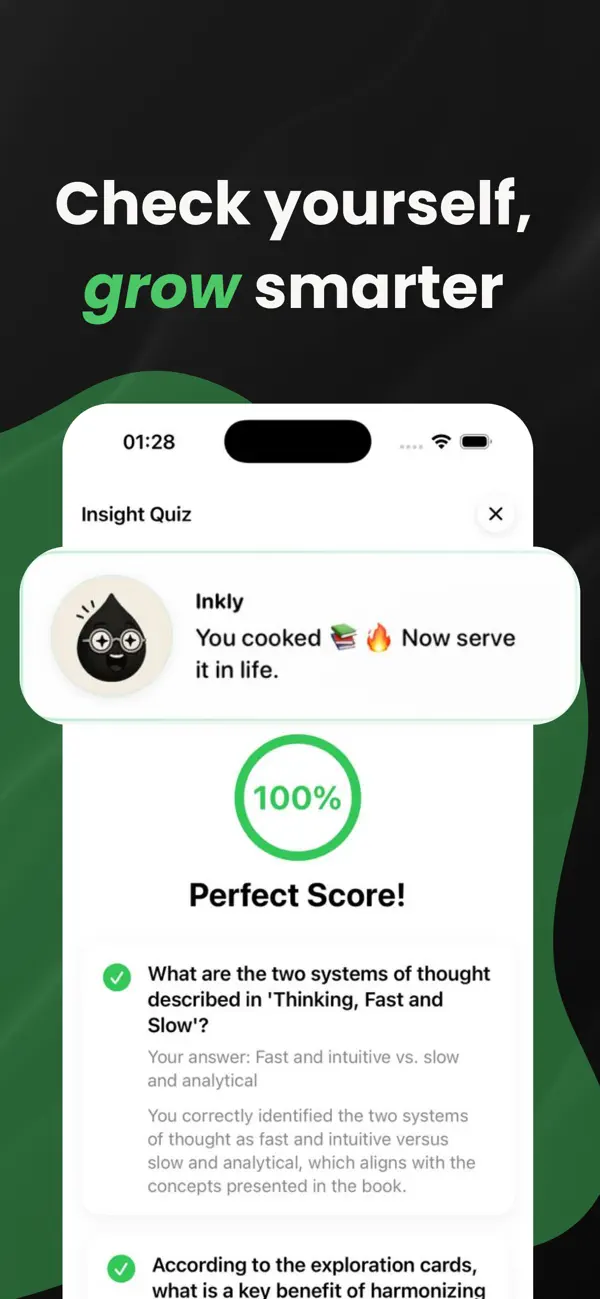
- Best for: remembering what you learn. A quiz right after each lesson makes you pull the idea back out of your head.
- What you get: a learning type (for example "Vision Weaver"), an adaptive plan built from your goals and habits, daily insights, quizzes, chat with Inkly to turn ideas into action, and streaks plus a growth map across six areas.
- Price: the learning-pattern analysis and plan preview are free. Lessons, quizzes, AI reflection and progress tracking need Inkly Unlimited; as of October 2026, the App Store listing shows plans from $9.99 a month or $19.99 a year.
- Platforms: iPhone only. 4.6 stars from 17 App Store ratings.
- Catch: no Android or web app, and the free part is only a preview; the lessons themselves need Unlimited.
Which microlearning apps teach general knowledge?
Imprint and Nibble teach a bit of everything (psychology, history, money, philosophy) in short lessons with quizzes. Imprint leads with pictures, Nibble with variety.
5. Imprint: best for visual learners
Imprint is a visual learning app that explains psychology, philosophy, finance, history and bestselling books with illustrated, two-minute chapters and daily quizzes.
- Best for: people who remember a diagram long after they've forgotten the paragraph. Not sure that's you? Our free learning style quiz shows which format you reach for first.
- What you get: courses, quick reads and visual guides to books such as Sapiens and Atomic Habits, per its App Store listing. It has an Editors' Choice badge on the App Store and was Google Play's best app of 2023.
- Price: as of October 2026, $15.99 a month or $74.99 to $99.99 a year on the US App Store. No official page lists a free plan.
- Platforms: iOS and Android. 4.8 stars from 58,078 US App Store ratings.
- Catch: 51 of its 100 most recent App Store reviews give one star, mostly about the paywall and trials that turned into yearly charges. Our Imprint app review explains where to pay and how to cancel.
6. Nibble: best for general knowledge with quizzes
Nibble is a general-knowledge app of interactive 10-minute lessons and quizzes on topics from art and history to math, logic, philosophy and personal finance.
- Best for: curious generalists who want a different topic every day.
- What you get: lessons with quizzes, plus chats with historical figures, videos, games and audio, according to Nibble's website. You choose 5, 10 or 15 minutes a day.
- Price: Nibble's site says your first lesson is free. After that, the US App Store lists annual subscriptions from $12.99 to $89.99, a monthly plan at $19.99 and a 3-month plan at $39.99, depending on the offer. Nibble's own site gives only approximate prices.
- Platforms: iPhone, iPad, Android and web, with progress synced. 4.3 stars from 46,866 US App Store ratings, the lowest here.
- Catch: most recent reviews are happy, but the unhappy ones describe a subscription bought on the web after a quiz or ad that never showed up in their Apple subscriptions.
Which microlearning apps teach practical skills?
Duolingo, Brilliant, Mimo and Khan Academy teach skills you can practice: languages, math, code and school subjects.
7. Duolingo: best for languages
Duolingo is a language app with 40+ languages in quick, game-like lessons, plus courses in math, music and chess.
- Best for: a daily language habit.
- What you get: every course is free, according to its App Store listing. Super Duolingo removes ads, and Max adds AI video calls and roleplay.
- Price: free with ads. Duolingo's website doesn't publish Super prices; as of October 2026, the US App Store lists Super Duolingo items from $9.99 to $119.99 without saying which period each covers. The App Store mentions a 14-day free trial and duolingo.com a 1-week trial, so check what you're offered.
- Platforms: iOS, Android and web. 4.7 stars from 5.5 million US App Store ratings.
- Catch: the streak works so well that some people end up protecting the streak instead of learning.
8. Brilliant: best for math, science and logic
Brilliant is an interactive learning app for math, science and coding concepts, from grade 5 to college level, built around solving problems rather than watching videos.
- Best for: adults who want to get better at math, logic or data without going back to a textbook.
- What you get: 40+ interactive courses on Premium, in bite-size lessons, plus an AI tutor, according to Brilliant's pricing page.
- Price: the free plan includes a daily lesson. As of October 2026, Premium costs $20 a month billed yearly (about $240) or $30 month to month on Brilliant's site. App Store prices differ from the website, so compare before you subscribe.
- Platforms: iOS, Android and web. 4.7 stars from 33,045 US App Store ratings.
- Catch: one of the priciest plans here, and Google Play flags it as containing ads. Recent reviewers say the free version offers too little and that canceling sends you to the website.
9. Mimo: best for learning to code
Mimo is a coding app that teaches Python, JavaScript, HTML, CSS and SQL in short interactive lessons, from your first line of code to small projects.
- Best for: beginners who want to try coding before paying for a full course.
- What you get: per Mimo's pricing page, Pro unlocks every course and career path on mobile, 1,000+ lessons, certificates and no ads. Max adds full web access and desktop projects.
- Price: the Basic plan is free forever with limited access. As of October 2026, Pro costs $9.99 a month billed yearly or $14.99 month to month; Max costs $24.99 a month billed yearly or $39.99 month to month. The 7-day trial applies to yearly plans only.
- Platforms: iOS, Android and web (full web access needs Max). 4.8 stars from 110,649 US App Store ratings, the highest average here.
- Catch: Pro is mobile-only, so if you want to code on a laptop you need Max. Some recent reviewers say the free tier has shrunk.
10. Khan Academy: best free option for school subjects
Khan Academy is a nonprofit learning app with free videos, exercises and articles in math, science, economics and the humanities.
- Best for: brushing up on algebra, biology or economics, or helping a kid with homework, without paying anything.
- What you get: according to Khan Academy's About page, 840+ free courses for K-12 and early college. You can download videos to watch offline.
- Price: free. Khan Academy is a 501(c)(3) nonprofit and the App Store lists no in-app purchases. Its AI tutor, Khanmigo, is a separate paid product for learners and parents.
- Platforms: iOS, Android and web. 4.6 stars from 112,460 US App Store ratings.
- Catch: lessons are longer and more classroom-like than the rest of this list, and some features (test prep, programming, community) only work on the website.
What are the best free microlearning apps?
The best free microlearning apps are Khan Academy, which is free in full, and Duolingo, which is free with ads. Several others have a free tier that doesn't expire:
- Khan Academy: everything, with no ads label on Google Play.
- Duolingo: every course, with ads and an Energy limit.
- Deepstash: 200,000+ ideas, with ads.
- Headway and Blinkist: one book summary a day.
- Mimo: a limited Basic plan.
- Brilliant: a daily lesson.
Imprint lists no free plan, Nibble gives you a first lesson, and Inkly's free part is the learning analysis and plan preview.
Does microlearning actually work?
Microlearning works when it makes you recall information and spreads practice over days, and it doesn't do much when it's just short reading. That's the honest answer to critics like PCMag's opinion piece calling apps that shrink books into bite-size nuggets a waste of time: it depends on what the app makes you do.
Two well-tested findings decide it:
- Spacing beats cramming. A 2006 review by Cepeda and colleagues in Psychological Bulletin pooled hundreds of experiments. Across 271 comparisons, spaced study averaged 47.3% recall against 36.7% for massed study. A few minutes a day is spacing by design. One limit: most of those experiments used word lists and word pairs, not book ideas.
- Testing beats rereading. In Roediger and Karpicke's 2006 study, 120 students who took a recall test on a short passage remembered more of it a week later (56%) than students who simply studied it again (42%), even though rereading looked better on a test five minutes later.
So pick an app that quizzes you, not one that only lets you scroll. In this list, Duolingo, Brilliant, Mimo and Khan Academy make you answer all the time; Inkly, Imprint and Nibble add quizzes to their lessons; Headway has flashcards. Our guide on how to remember what you read shows how to add the missing quiz yourself.
How to pick a microlearning app (and keep using it)
Pick one app for one subject, try it free for a week, and tie it to a moment you already have every day. Step by step:
- Pick the subject first. Languages, math, code or book ideas each have a clear winner in this list. An app that teaches a bit of everything only works if variety is the point.
- Start on the free tier or trial. Khan Academy, Duolingo, Deepstash, Headway, Blinkist, Mimo and Brilliant all let you use some of the app for free indefinitely.
- Check where you're paying. Recent reviews of Imprint, Nibble and Blinkist describe subscriptions bought on a website that never appeared in the iPhone's subscription list. If you take a trial, note where you signed up and set a reminder for the day before it ends.
- Give it a fixed slot. Right after your first coffee, on the train, before you open your email. Same time, same place.
- Audit after 30 days. If you opened it on fewer than half the days, cancel and try a different format.
Want options beyond learning, like habit trackers, meditation and focus apps? Our list of the best self-improvement apps covers those.
FAQ
What is the best microlearning app?
There isn't one best microlearning app, because they teach different things. Duolingo is the best-known for languages, Brilliant for math, Mimo for coding and Khan Academy for free school subjects. For ideas from books, start with Headway, Blinkist for the biggest library, or Inkly (our app) if you want a quiz after every lesson. Imprint is the strongest pick for visual learners.
Is there a free microlearning app?
Yes. Khan Academy is completely free and run by a nonprofit, and Duolingo's courses are free with ads. Deepstash is free with ads, Headway and Blinkist give you one free summary a day, and Mimo and Brilliant have limited free plans.
What is the best microlearning app for adults?
For adults, the best microlearning app depends on the goal: Headway, Blinkist or Inkly (our app, iPhone only) for ideas from non-fiction books, Imprint or Nibble for general knowledge, Brilliant for math and Mimo for coding. Inkly suits adults who want a daily lesson on personal growth with a quiz after it.
Is microlearning effective?
Microlearning is effective when lessons make you recall what you learned and come back to it over several days. Research on spacing (Cepeda and colleagues, 2006) and on testing (Roediger and Karpicke, 2006) supports both. Short lessons you only read and never review are much less effective.
Is Headway a microlearning app?
Yes. Headway calls its daily session "microlearning" and sums up non-fiction books in under 15 minutes, in text or audio. It also has spaced-repetition flashcards, which makes it one of the better book-summary apps for remembering what you read.
Which microlearning apps work on Android?
Nine of the ten apps here work on Android: Headway, Blinkist, Deepstash, Imprint, Nibble, Duolingo, Brilliant, Mimo and Khan Academy. Inkly is iPhone only. Blinkist, Deepstash, Nibble, Duolingo, Brilliant, Mimo and Khan Academy also work in a web browser.