Below is the Four Agreements summary in plain English: what each agreement means, the ideas around them that most summaries skip, where the book is weaker than its reputation, and one small way to try each rule this week. If you only have a minute, the next section is the whole book.
We wrote this from the publisher's and author's pages, the book's library catalog record and published study guides. The agreements are quoted in the book's own wording; everything else is our paraphrase.
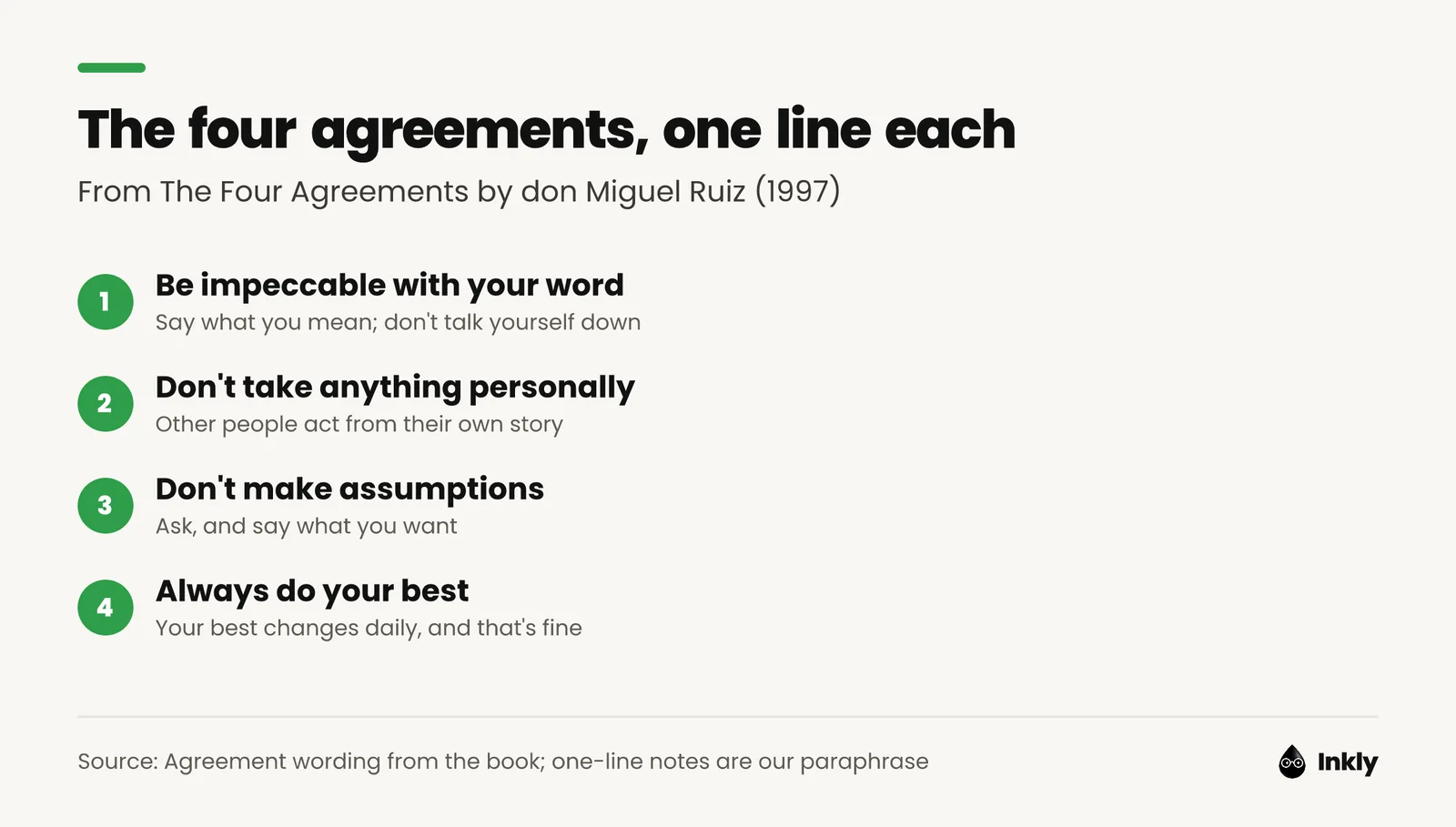
The Four Agreements summary in one minute
The Four Agreements says you live by thousands of rules you never chose, and that four new ones can replace most of them. Here's the book in five lines:
- "Be impeccable with your word." Say only what's true and kind. Don't use words against other people, and don't use them against yourself, which is the part people forget.
- "Don't take anything personally." What other people say and do comes from their own view of the world. It's information about them, not a verdict on you.
- "Don't make assumptions." We fill gaps with guesses and then suffer over the guesses. Ask questions, and say clearly what you want.
- "Always do your best." Your best changes from moment to moment: tired-you has a lower ceiling than rested-you. Do your best, and you have no reason to beat yourself up.
- The catch: old habits fight back. The second half of the book is about breaking old agreements slowly, through practice, forgiveness and a lot of starting again.
That's the core. The rest of this summary explains each part and tells you which bits hold up.
What is The Four Agreements about?
The Four Agreements: A Practical Guide to Personal Freedom is a self-help book by don Miguel Ruiz, written with Janet Mills and first published in 1997 by Amber-Allen Publishing. It's now published by Tarcher, part of Penguin Random House, at about 160 pages. Ruiz presents the four agreements as a code of conduct based on Toltec wisdom, the spiritual tradition he says his family passed down to him.
It's a big seller. The author's website says the book has sold over 15 million copies in the US alone, has been published in 52 languages, and spent over a decade on the New York Times bestseller list. Oprah Winfrey's praise for it is quoted on the author's book page, and Wikipedia notes she featured it on her show in 2001 and again in 2013.
Ruiz himself was born in Tijuana, Mexico, in 1952 and trained as a surgeon before turning to teaching. The book is short and plainly written. Its contents, as the publisher lists them:
| Chapter | What it covers |
|---|---|
| Introduction | A parable about a student healer who realizes that what people perceive is a kind of fog, which sets up the book's idea of life as a "dream" |
| 1. Domestication and the Dream of the Planet | How kids learn society's rules through reward and punishment, and why adults keep punishing themselves |
| 2. The First Agreement | Be impeccable with your word |
| 3. The Second Agreement | Don't take anything personally |
| 4. The Third Agreement | Don't make assumptions |
| 5. The Fourth Agreement | Always do your best |
| 6. The Toltec Path to Freedom: Breaking Old Agreements | How to drop the old rules: three practices, plus forgiveness |
| 7. The New Dream: Heaven on Earth | What life looks like when you act from love rather than fear |
| Prayers | Two short closing prayers, one for freedom and one for love |
How do we learn our old agreements?
Ruiz says we learn our first agreements the way animals are trained: through reward and punishment. He calls this domestication. As kids, we're taught what's good, bad, pretty, ugly, right and wrong, and we agree because we're too young to question it. Those agreements add up to a "Book of Law" in your head.
Two inner voices enforce that law. The Judge tells you you're not good enough. The Victim takes the judgment and feels the shame. Ruiz's sharpest point is about how often this happens: you pay for a mistake when you make it, again every time you remember it, and again whenever someone brings it up. He treats that as a kind of injustice, with one mistake and endless payments, and says it fills you with emotional poison.
The shared rulebook of a whole society, built from billions of personal versions, is what Ruiz calls "the dream of the planet." He describes it as run largely by fear. The four agreements are his proposal for a smaller, kinder rulebook.
What does "be impeccable with your word" mean?
Being impeccable with your word means speaking with integrity: saying only what's true and kind, and never using words to hurt anyone, including yourself. Ruiz puts it first because, in his view, words are how all the other agreements get made.
He's hard on gossip, because putting other people down trains you to judge, and that judgment eventually turns back on you. One careless comment from a parent or teacher ("you can't sing," "you're bad at math") can stick for decades, because the listener agrees with it and starts repeating it to themselves.
The part most summaries miss: impeccability points inward too. Calling yourself stupid, lazy or ugly counts as breaking the agreement.
Try it today: for one day, count every sentence you say or think that starts with "I'm so..." and ends badly. Don't fix them yet. Just count. Most people are surprised by the number.
Why shouldn't you take anything personally?
You shouldn't take things personally, Ruiz says, because what other people do comes from their own beliefs, fears and moods, not from your worth. You just happen to be standing in front of them.
Taking things personally, in his telling, keeps you offended and defensive. Someone who's secure in themselves can let a harsh judgment pass, because they don't agree with it. That's the lever: an insult only lands if part of you signs on.
This is the agreement people misread most. It doesn't mean ignoring feedback, and it doesn't mean putting up with mistreatment. If someone keeps hurting you, the point is that you don't need to take it as proof of your worth. You can still walk away.
Try it today: the next time a comment stings, write one line: "What does this say about them?" Then one more: "Is any of it useful to me?" Keep the useful part and drop the rest.
How do you stop making assumptions?
You stop making assumptions by asking questions until you understand, and by saying what you want instead of hoping people will guess. Ruiz argues that we fill every gap in our knowledge with a story, then treat the story as true and suffer over it.
We assume because asking feels risky, and because the mind hates a blank. So we fill the gap, usually with an unflattering version, and react as if it were fact. Ruiz's fix is simple and slightly awkward: ask, and say what you need.
There's a useful overlap with cognitive behavioral therapy here. David Burns's Feeling Good, which sits in our list of the best self-improvement books, names the same traps "mind reading" and "personalization" in its list of common thinking errors, the ones CBT teaches people to catch. Ruiz gets there with spiritual language; Burns gets there with worksheets.
Try it today: pick one assumption you're carrying ("my boss is annoyed with me") and replace it with one direct question.
What does "always do your best" really mean?
"Always do your best" means giving the effort you have right now, knowing it changes with your health, mood and energy. If you did your best, there's nothing left for the inner Judge to convict you of, so this agreement props up the other three.
The important word is "your." Your best when you're sick is not your best after a good night's sleep, and Ruiz says both count. He also ties this agreement to action for its own sake: you do your best because you want to do the thing, not because you're angling for a reward. When you miss, you say you did your best and move on, instead of replaying it.
Try it today: before your next task, decide what "done" looks like. When you hit it, stop, even if a perfectionist voice says otherwise.
How does Ruiz say to break old agreements?
Ruiz says you break old agreements the way you made them: slowly, through repetition. He calls the old system (the Judge, the Victim and the beliefs behind them) a parasite, and offers three practices to weaken it, as study guides to the book describe them:
- Transformation: notice the fear-based beliefs running your reactions, and stop agreeing with them, one at a time.
- The discipline of the warrior: take charge of your own behavior, forgive the people who hurt you (yourself included), and say what you feel at the right moment instead of letting it fester.
- The initiation of the dead: remember that life is short, so you stop living in yesterday's grudges and tomorrow's fears.
He's clear that you'll fail often at first. The answer is to start again, which is where "always do your best" earns its place.
This chapter leans hardest on spiritual language. If that isn't your thing, the practical takeaway still holds: new habits replace old ones through small, repeated practice, not one big decision. Our guide on how long it takes to form a habit shows why that takes longer than the "21 days" myth suggests.
What is the fifth agreement?
The fifth agreement is "Be skeptical, but learn to listen." It comes from the 2010 follow-up book The Fifth Agreement: A Practical Guide to Self-Mastery, which don Miguel Ruiz wrote with his son don Jose Ruiz and Janet Mills. As the wording suggests, it asks you to question what you hear, including the stories in your own head, without tuning people out.
It's a useful addition because it covers a gap in the first four: how to handle a world full of opinions and claims without swallowing them whole or dismissing everyone.
What does The Four Agreements get wrong?
The Four Agreements is strongest as a memorable set of reminders and weakest as an explanation of how people change. Three honest criticisms:
- "Toltec wisdom" is the author's framing. Ruiz presents the ideas as Toltec teachings handed down in his family. Wikipedia attributes that basis to the author, and the historical Toltecs are known mostly through later Aztec accounts that scholars still argue over. Read the book as one teacher's philosophy, not as a window into an ancient culture.
- It's light on how. The agreements are easy to remember and hard to keep, and the book offers more encouragement than method. A CBT book like Feeling Good or a habit book like Atomic Habits adds the missing steps.
- "Don't take anything personally" can be misused. Taken too far, it becomes a reason to brush off fair criticism. The better reading is "don't take it as a verdict on your worth."
None of this makes the book useless. It's lasted because the four rules are easy to recall on a bad day, and that matters more than polish.
Is The Four Agreements worth reading?
Yes, The Four Agreements is worth reading if you're hard on yourself, overthink what people mean, or take criticism to heart. At about 160 pages it's an evening or two for most readers; our reading time calculator gives you an estimate at your own speed.
Skip it if spiritual language puts you off, or if you want research-backed methods. In that case, this summary plus a CBT book will serve you better.
Is a summary enough? For the four rules themselves, mostly yes, and Blinkist and Headway both carry 13 to 15 minute versions in their apps. What a summary can't give you is the repetition: the book says the same few things many ways, and for this kind of idea, hearing it again is the point. If you read it, jot your favorite line for each agreement on a free one-page book notes template, so you have something to look at when an old agreement kicks in.
How do you practice the four agreements?
You practice the four agreements one at a time, in small daily doses, rather than all four at once. Here's a one-week trial in the spirit of the book's advice to start small and keep starting again:
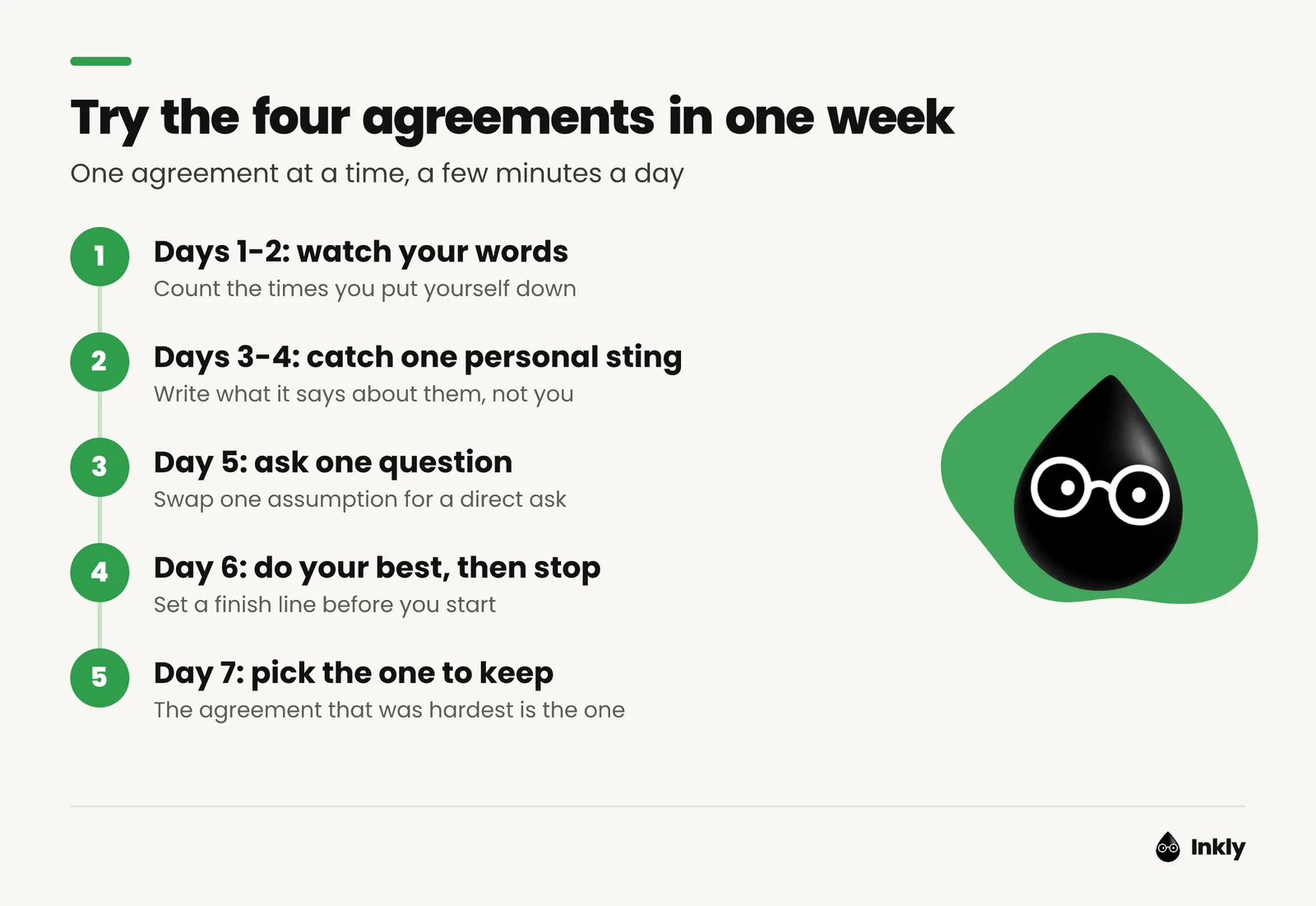
- Days 1-2: notice your words. Count put-downs, gossip and "I'm so..." sentences.
- Days 3-4: catch one moment you took something personally, and write what it says about the other person.
- Day 5: swap one assumption for a direct question.
- Day 6: set a finish line for a task, do your best, and stop there.
- Day 7: pick the agreement that felt hardest. That's the one to practice next month.
Ideas only stick if you come back to them. Our guide on how to remember what you read explains why a quick self-quiz beats rereading.
What should you read after The Four Agreements?
If The Four Agreements clicked, these books go further on the same themes: Feeling Good by David Burns for the thinking-errors side, Man's Search for Meaning by Viktor Frankl for meaning under pressure (see our Man's Search for Meaning summary), and Meditations by Marcus Aurelius for an older take on not letting other people's behavior run your mood. Not sure which? The book recommendation quiz picks three for you in about a minute.
One more option, and it's ours: Inkly is our app, so weigh this accordingly. It works like Duolingo for personal growth, turning big ideas from non-fiction books into short daily lessons with a quick quiz after each one. It's iPhone only and free to download; the daily lessons need a subscription.
FAQ
What are the four agreements?
The four agreements are: be impeccable with your word, don't take anything personally, don't make assumptions, and always do your best. They come from don Miguel Ruiz's 1997 book The Four Agreements. Ruiz presents them as a code of conduct that replaces the self-limiting beliefs people pick up in childhood.
What is the main message of The Four Agreements?
The main message is that much of your suffering comes from rules and beliefs you absorbed as a child and never questioned, and that you can replace them. The four agreements are Ruiz's replacement rulebook: speak carefully, don't take others' behavior as a verdict on you, ask instead of guessing, and do your best without punishing yourself.
Is The Four Agreements a religious book?
The Four Agreements is spiritual rather than tied to one religion. Ruiz frames it as Toltec wisdom, uses words like "heaven," "hell" and "dream," and ends the book with two prayers. The four rules themselves work without any belief system, which is why many secular readers like it.
What is the fifth agreement?
The fifth agreement is "Be skeptical, but learn to listen." Don Miguel Ruiz added it in The Fifth Agreement (2010), written with his son don Jose Ruiz and Janet Mills. It asks you to question what you hear, including your own inner voice, while still listening to other people.
How long does it take to read The Four Agreements?
The Four Agreements runs about 160 pages in the current paperback, so most adults finish it in an evening or two. Your exact time depends on your reading speed. Try our free reading speed test, then plug your result into the reading time calculator for your own estimate.
Is The Four Agreements based on real Toltec teachings?
The Four Agreements is based on Toltec teachings as don Miguel Ruiz understands them, from the tradition he says his family passed down. There's no independent record tying these four rules to the historical Toltec culture of central Mexico, which is known mainly through later Aztec accounts. Treat the Toltec label as Ruiz's framing, and judge the ideas by whether they help you.